Ranked: College Degrees by 10-Year Earnings and ROI
See visuals like this from many other data creators on our Voronoi app. Download it for free on iOS or Android and discover incredible data-driven charts from a variety of trusted sources.
Key Takeaways
- Electrical engineering leads all 37 majors with $652,644 in 10-year added earnings and a 100% return on the degree’s full cost.
- Business information systems & statistics posts the highest ROI in the dataset at 135%, despite ranking third in added earnings.
- Only 15 of the 37 majors recoup their full cost within a decade.
- Family & consumer sciences (-$181) and psychology (-$6,866) are the only two majors with negative added earnings over the first decade.
Choosing a college major is one of the biggest financial decisions many young adults make. While some degrees generate substantially higher earnings over the first decade after graduation, their higher costs mean they do not always deliver the strongest return on investment.
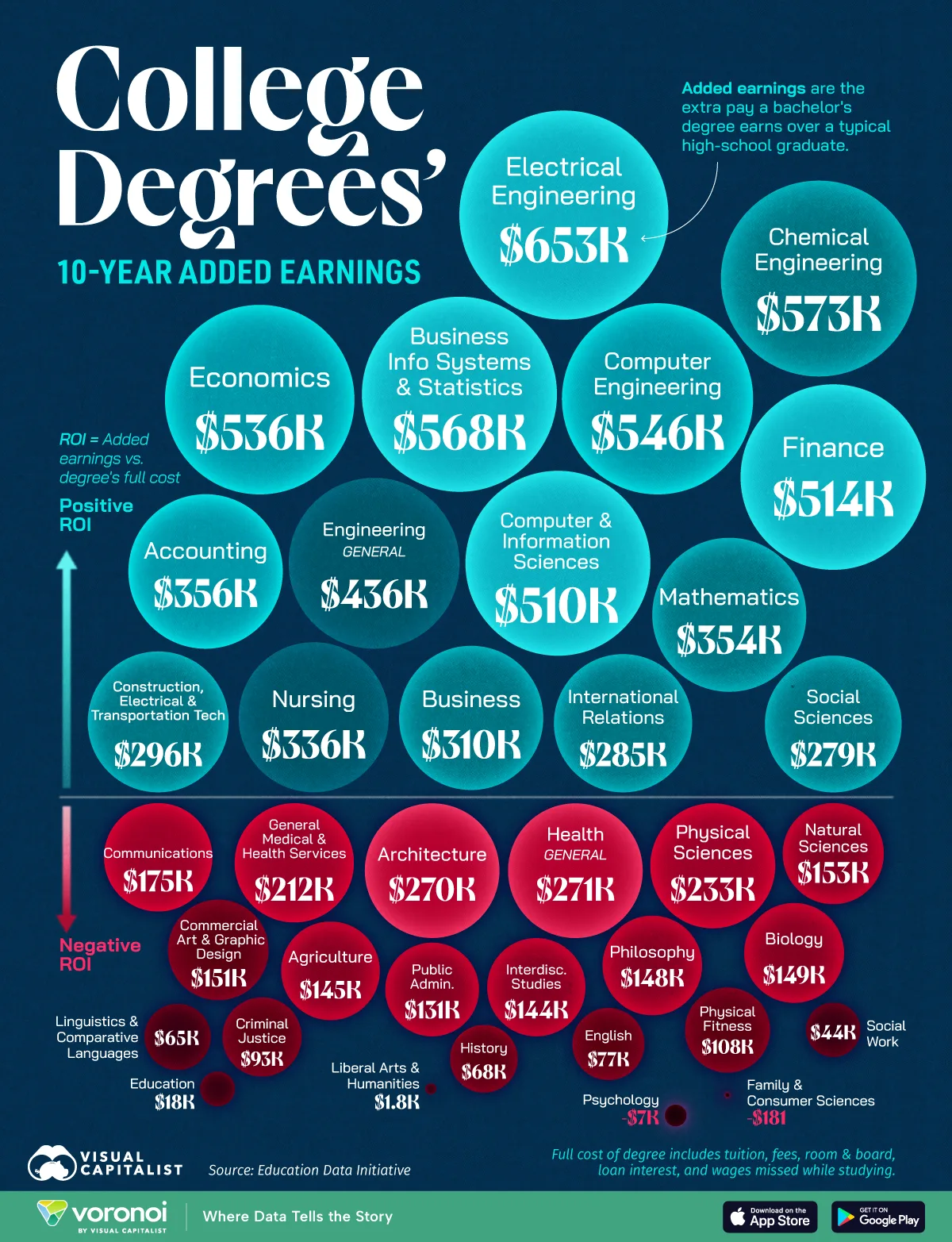
This visualization compares 37 U.S. bachelor’s degree fields using two measures: the additional earnings graduates make during their first 10 working years relative to a typical high school graduate, and each degree’s return on investment after accounting for tuition, fees, room and board, loan interest, and wages forgone while studying.
The data comes from the Education Data Initiative, which modeled earnings using median salaries and assumed annual raises of 4% to estimate both 10-year added earnings and ROI.
Engineering and Computing Degrees Add the Most in Raw Dollars
Engineering dominates the ranking, claiming four of the top five spots for added earnings over the first decade after graduation.
| Rank | Degree | 10-Yr Added Earnings (USD) | 10-Yr ROI |
|---|---|---|---|
| 1 | Electrical Engineering | 652,644 | 100% |
| 2 | Chemical Engineering | 572,595 | 43% |
| 3 | Business Info Systems & Statistics | 567,973 | 135% |
| 4 | Computer Engineering | 545,801 | 67% |
| 5 | Computer & Information Sciences | 536,171 | 110% |
| 6 | Finance | 513,560 | 112% |
| 7 | Economics | 510,487 | 96% |
| 8 | Engineering (General) | 435,507 | 9% |
| 9 | Accounting | 355,898 | 47% |
| 10 | Mathematics | 353,666 | 36% |
| 11 | Nursing | 335,848 | 5% |
| 12 | Business | 310,221 | 28% |
| 13 | Construction, Electrical & Transportation Tech | 296,130 | 28% |
| 14 | International Relations | 285,093 | 23% |
| 15 | Social Sciences | 278,993 | 13% |
| 16 | Health (General) | 270,664 | -15% |
| 17 | Architecture | 270,372 | -12% |
| 18 | Physical Sciences | 233,117 | -27% |
| 19 | General Medical & Health Services | 212,054 | -34% |
| 20 | Communications | 175,264 | -32% |
| 21 | Natural Sciences | 152,617 | -39% |
| 22 | Commercial Art & Graphic Design | 150,738 | -50% |
| 23 | Biology | 148,820 | -46% |
| 24 | Philosophy | 147,917 | -40% |
| 25 | Agriculture | 145,067 | -49% |
| 26 | Interdisciplinary Studies | 144,110 | -47% |
| 27 | Public Administration | 130,956 | -49% |
| 28 | Physical Fitness | 108,050 | -58% |
| 29 | Criminal Justice | 93,445 | -65% |
| 30 | English | 77,362 | -70% |
| 31 | History | 68,362 | -74% |
| 32 | Linguistics & Comparative Languages | 65,195 | -77% |
| 33 | Social Work | 43,887 | -81% |
| 34 | Education | 17,970 | -94% |
| 35 | Liberal Arts & Humanities | 1,752 | -99% |
| 36 | Family & Consumer Sciences | -181 | -100% |
| 37 | Psychology | -6,866 | -103% |
Electrical engineering leads the list at $652,644 of 10-year added earnings, followed by chemical engineering. Computer engineering and computer & information sciences also place in the top five. Engineering degrees also tend to have the highest early-career median wages of all degree fields.
Several business and social science fields keep pace with engineering programs in added earnings. Business information systems & statistics ranks third with $567,973 in 10-year added earnings, while finance and economics rank sixth and seventh, respectively, ahead of general engineering.
Only 15 of 37 Degrees Pay for Themselves Within a Decade
Raw earnings measure income, but they do not reveal whether a degree has earned back what it cost. Factoring in tuition, fees, room and board, loan interest, and forgone wages paints a very different picture.
Despite ranking third in added earnings, business information systems & statistics has the highest 10-year ROI of any major in the dataset at 135%. Its lower program cost allows it to pay off faster than several pricier engineering degrees. Similarly, finance ranks second in ROI but only sixth in added earnings, showing that higher earnings do not always guarantee a better return.
At the other end of the scale, social sciences, with a 13% 10-year ROI, is the last major to record a positive return. General health, just one spot lower in the earnings ranking, has a 10-year ROI of -15%.
Humanities and Social Service Fields Trail on Flatter Wage Curves
Education ($17,970), social work ($43,887), linguistics ($65,195), and history ($68,362) all show positive but modest added earnings, reflecting career paths with flatter wage curves rather than a complete lack of financial value.
Notably, two majors have negative added earnings: family & consumer sciences (-$181) and psychology (-$6,866). They are the only fields in the dataset where modeled 10-year earnings trail those of a typical high school graduate. By mid-career, defined here as workers aged 35 to 45, the median salaries for these two majors are $65,000 and $72,000, respectively, compared with an average of $87,000 across all majors.
Early-career earnings are only one way to measure the value of a degree, but the results show how strongly field of study can influence financial outcomes. Some majors generate hundreds of thousands of dollars in additional earnings within a decade, while others take much longer to recover their upfront costs. Comparing both earnings and ROI provides a fuller picture of how quickly each degree pays off.
Learn More on the Voronoi App 
If you enjoyed today’s post, check out The Extra Earnings of a Bachelor’s Degree by State on Voronoi.