

Support CleanTechnica’s work through a Substack subscription, on Patreon, or on Stripe. Help us produce all of the high-quality, original content we publish week after week despite the challenges of content-scraping AI, antisocial media, inflation, and other hurdles.
The second quarter of 2026 saw plugin EVs at 37.7% share in Germany, up from 28.6% in Q2 2025. BEV share grew strongly year on year, and PHEV share grew slowly. Overall, Q1 auto volume was 784,989 units, up some 6% YoY. The Tesla Model Y was the best-selling BEV in Q2.
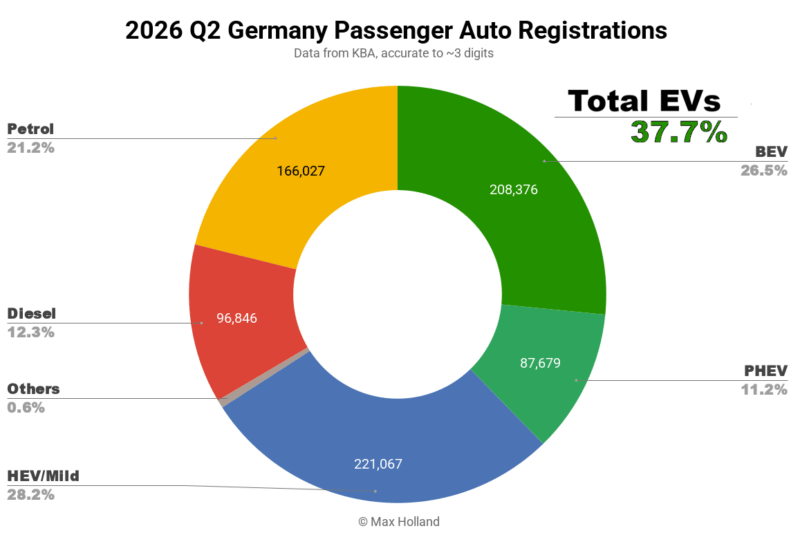
2026 Q2 auto sales saw combined plugin EVs at 37.7% share in Germany, with full electrics (BEVs) at 26.5% and plugin hybrids (PHEVs) at 11.2%. These figures compare YoY against 28.6% combined, 18.4% BEVs and 10.2% PHEVs.
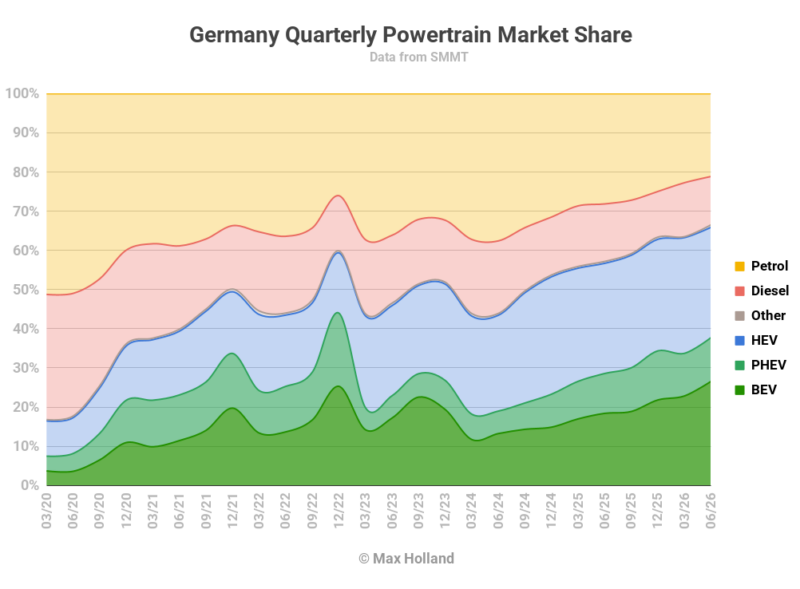
Last quarter we noted that it had been “the best ever start to a year in terms of BEV share in Germany” with 22.8% share (from previous Q1 best of 17.0%). That share has now jumped up further still, to 26.5% in Q2, an even bigger step up compared to the previous Q2 record (18.4%). In volume terms, BEVs saw sales numbers grow by over 53% YoY, an impressive result.
As with the French market, this strong first half of 2026 is due to an improved incentive policy, and due to very high oil prices stemming from the war of aggression against Iran. There’s a good chance that the trend will continue throughout the rest of the year.
Meanwhile, PHEVs remain solid, with modest YoY growth, but have still not overtaken HEVs – which are now the biggest single powertrain category, grabbing around 28% share for most of the past 2 years. Petrol and diesel are still declining steadily, with petrol falling from 28.2% to 21.2% YoY, and diesel from 14.7% to 12.3%.
We can expect combined combustion-only share to fall to close to 25% by the end of this year, as plugins are on track to end the year getting into the mid-40% share, perhaps not far off 50%.
Best-Selling BEV Models
The Tesla Model Y took the top spot in Q2 2026, with 10,401 units registered. The last time the Tesla took pole position was over 2 years ago, in Q1 2024, so this is a significant recovery, building upon the second place it had already achieved in Q1.
Second place went to the Volkswagen ID.3, with 10,082 units, up from third spot last quarter. In third spot was the Skoda Elroq (Q1’s leader), with 9,739 units.
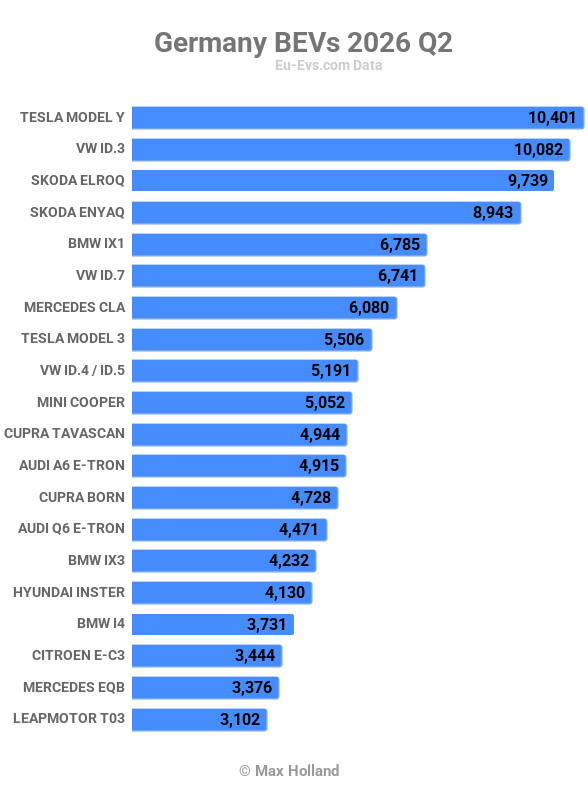
There were a few notable QoQ performances visible in the top 20 – the BMW iX1 saw record quarterly volumes, around 50% higher than recent averages. The new BMW iX3 has also ramped quickly, seeing close to triple the volumes in Q2 over Q1. Mercedes is about to refresh the EQB (to be renamed the GLB with EQ tech), and has offered major discounts on the outgoing version, leading to a surge of sales to 3,376 units, around twice the recent quarterly averages.
Just outside the top 20, the Dacia Spring had a good quarter, with 2,752 units, 2.5x its recent averages. The refreshed Mercedes EQC (28th) is already ramping up, from 251 units in Q1 to 2,225 units in Q2. It’s a similar growth story for the new Kia EV2 (32nd), from 100 units in Q1 to 2,003 units in Q2. Further back still, the Renault Twingo (42nd) ramped to 1,501 units, and the refreshed BYD Atto 3 (58th) ramped to 1,066 units.
There were a few Q2 debutant BEVs in the German market. The highest volume entry was the Cupra Raval, at 636 units, a decent start. Others included: The Geely E5; Xpeng X9; Zeekr 7GT; Mercedes VLE; MG IM6; Volvo EX60; Dongfeng Box; VW Polo; Omoda 5; MG IM5; Leapmotor B05; Skoda Epiq; and the Jaecoo 5. The latter of these are likely showroom-only units for now.
The ones to watch in the German market are the new generation of relatively small-and-affordable VW Group offerings, the Cupra Raval itself (already started customer deliveries), as well as the VW Polo, and the Skoda Epiq (both with customer units coming soon). These are all based on the MEB+ (or “MEB Small”) platform, with front wheel drive and a ~2,600mm wheelbase. These models will later be joined by the ID.Cross (an Epiq sibling), and also the ID.Every1 (positioned below the Polo, aiming for a €20k start price, expected in 2027). These can be thought of as VW Group’s answer to Renault’s 4 and 5, and Stellantis’ Citroen e-C3, Fiat Panda, and similar.
Outlook
The oil price rise following yet another US empire war of aggression in West Asia, combined with the reintroduction of purchase incentives has given a boost to the BEV market so far this year, and growth should continue in the coming quarters. Volkswagen Group is talking about shutting down German factories – many of their models discussed above are built in Spain, where energy costs are substantially lower (thanks to renewables and Algerian natural gas, amongst other options lacking in Germany).
Largely due to this energy crisis, the German economy remains effectively at a standstill, with Q1 2026 figures 0.4% YoY GDP growth. Inflation dipped to 2.3% in June from 2.7% at the end of Q1. ECB interest rates were flat at 2.15% for 13 months until early June, stepping up to 2.4%. Manufacturing PMI has hovered around 51 points so far in 2026, with no notable uptick.
What does the remainder of 2026 have in store for Germany, the EV transition, and which BEV models do you expect to do well? Please share your thoughts and perspectives in the comments section below.
Sign up for CleanTechnica’s Weekly Substack for Zach and Scott’s in-depth analyses and high level summaries, sign up for our daily newsletter, and follow us on Google News!
Advertisement
Have a tip for CleanTechnica? Want to advertise? Want to suggest a guest for our CleanTech Talk podcast? Contact us here.
Sign up for our daily newsletter for 15 new cleantech stories a day. Or sign up for our weekly one on top stories of the week if daily is too frequent.

[embedded content]
[embedded content]
CleanTechnica uses affiliate links. See our policy here.
CleanTechnica’s Comment Policy


