

Peak electricity demand in the United States is projected to increase 24% by 2030, according to Vote Solar, driven by data centers, industrial growth, and widespread electrification. The grid could meet this demand most cost effectively with clean energy rather than with fossil fuels, according to Let the sun in: Clean energy is the cheapest way to meet rising demand, a recent report from Electricity and Energy Innovation (EEI), a nonpartisan think tank.
To better understand the best pathway to meet the growing demand, EEI examined two scenarios for meeting electricity demand through 2030. In one, the United States follows the current federal policy approach, increasing use of fossil fuels as demand accelerates. The other pathway models the United States taking full advantage of clean energy to meet growing electricity use.
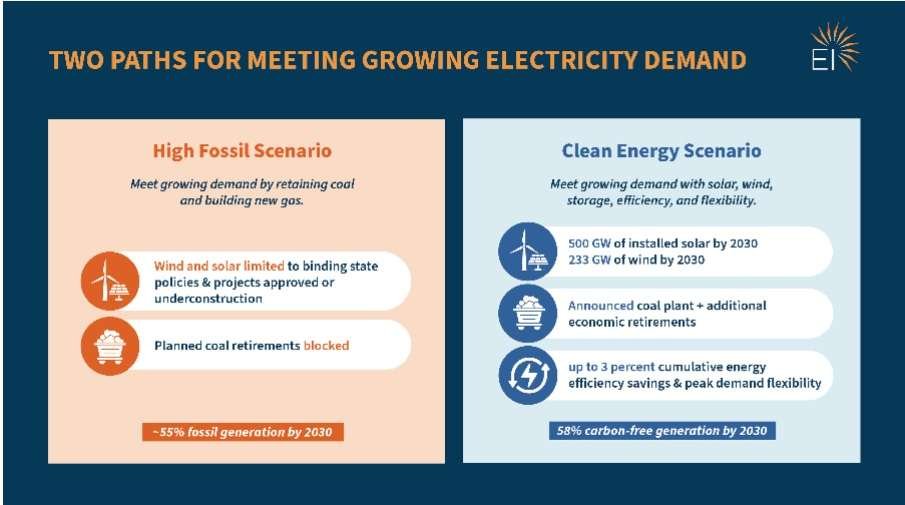
The report found that meeting the expected demand growth in the U.S. with a fossil fuel-heavy approach will add $29.7 billion annually to customer bills by 2030. The clean energy scenario, however, reduces overall costs to meet load growth by $5.1 billion annually that year compared to a high fossil scenario, a savings of 17%.
In the high-fossil fuel scenario the researchers blocked any planned coal retirements. In the clean energy model they accelerated the deployment of solar and sustained the deployment of wind out to 2030 to levels that represent what the researchers thought of as “the high end of ambition” for deployment nationally, Brendan Pierpont, director at EEI said in a webinar hosted by Clean Energy States Alliance.
The report found meeting demand growth in the high fossil case would be $5 billion more than the clean energy approach.
“That’s $5 billion of savings per year with this much more ambitious clean energy future for meeting demand growth,” he concluded.
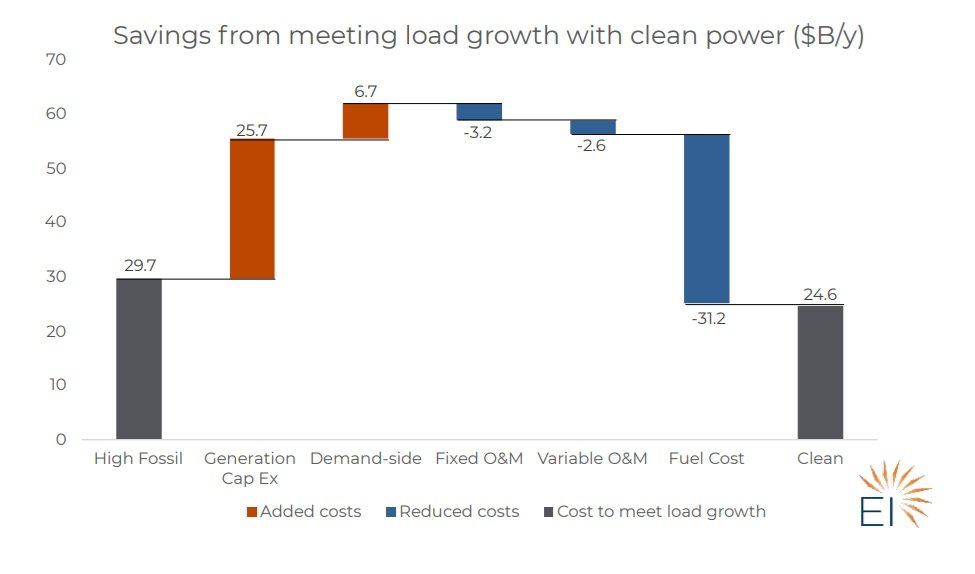
The savings are primarily driven by reduced fuel costs and reduced operation and maintenance costs from retirement of what Pierpont called “expensive, inefficient plants,” as well as offsetting just the usage of many coal and gas plants. The savings, he noted, are somewhat offset by the need for new capital investment and the cost of enabling demand response and energy efficiency at the scale that we’re talking about.
Price volatility of fossil fuels
Fossil fuel prices are very volatile, as seen in 2022 when Russia invaded Ukraine and fuel prices spiked. Natural gas prices jumped by a factor of four, Pierpont said, with coal prices following suit. The study took into consideration price volatility and found that where fuel prices rise to 2022 levels, savings in the clean energy scenario increased by $8 billion per year.
“This really shows that a clean pathway is a significant hedge against that fuel price risk,” Pierpont said. “And that’s important because we are headed, by everything I have read, into a period of more, not less, uncertainty in fuel prices.”
In addition to fuel price uncertainty, the study acknowledges that there is some uncertainty in demand growth as well. Pierpont noted that a lot of load growth proposals are speculative as data centers are not being built as quickly as expected. Some utilities are creating a large load tariff for data centers to make a financial commitment. Pierpont pointed to AEP as an example of one utility that created a long-term contract mechanism for large loads. He said new large loads dropped by nearly two-thirds when it was issued.
This uncertainty was factored into the study, Pierpont said, to determine whether there would be downsides to following the clean energy scenario even if the demand doesn’t grow as expected. Pierpont said that even under this low demand growth case, clean energy will still provide savings.
“The savings are lower because the costs of the system overall are lower. But those savings are still there even if that demand doesn’t show up because even without the scale of demand growth, clean energy still reduces fuel costs, still reduces the operations and maintenance costs and drives those savings.”
Pierpont noted that states can remove some key barriers to the acceleration of clean energy and he pointed to Illinois as an example of improving both state and local permitting processes. The state set minimum standards for local siting that help prevent overly restrictive permit requirements at the county or local level. Illinois has also implemented a process that allows for a check to make sure that those local rules are fair. This is not the state usurping local authority, but it’s making sure that things can happen at the local level in an efficient way, Pierpont said.
Indiana is an example of a state that’s started to tackle the interconnection challenge by requiring that utilities look at the opportunity for surplus interconnection, which Pierpont said is a way of connecting additional resources to existing points of interconnection to make better use of those points.
“We have peaking power plants across the country that may use their interconnections 10% of the time or less, and that’s 90% of the time that all of that equipment…across the grid goes unutilized,” Pierpont said. “And so there’s an opportunity there to make better use of those existing points of interconnection and those existing interconnection rights.”
Other barriers exist including the need to improve electricity planning. Pierpont stressed the need for utilities to validate cost inputs against recent market data. He said for example, new natural gas turbine prices have increased almost two to three times in just a few years while, at the same time, battery storage continues to decline in cost.
Source procurement is one way of doing this, Pierpont noted. This, he explained, is where you go out to the market and say, what would it cost and what are the performance characteristics of a whole bunch of different resources. Those resources can be wind, solar and energy storage or new dispatchable capacity. Or it can be demand side resources like energy efficiency and virtual power plants and other load flexibility options, Pierpont said.
Clean energy confidence
One of the great myths about solar energy is that it’s unreliable because the sun isn’t always shining. The study tested each of the 2030 portfolios in its modeling against seven years of hourly weather data, added any days that at risk of a shortfall of being able to meet demand, then iterated until there were no days with any unserved load in any region across all seven years. Pierpont said the researchers are confident in their findings that clean energy can meet the needs of a growing electricity system.
In addition to certainty around the reliability of clean energy, Pierpont said evidence points certainty that gas prices will continue to rise along with load demand. As we think about meeting demand growth in the future, Pierpont concluded that “it’s important to make the pathway future proof so that we are mitigating these risks as we’re making good decisions.”
The post Clean energy offers least-cost path to meeting US electricity demand appeared first on pv magazine Global.


