
Walmart is showing that even the world’s largest retailer can grow while cutting emissions. The company reported that it has reduced its operational greenhouse gas emissions (Scopes 1 and 2) by 25% from its 2015 baseline. This marks another step toward its goal of becoming a zero-emissions company by 2040.
The climate progress comes as Walmart continues to grow its business. The company is expanding e-commerce, investing in artificial intelligence (AI), improving automation, and building a cleaner logistics network.
Strong Earnings Support Walmart’s Long-Term Growth
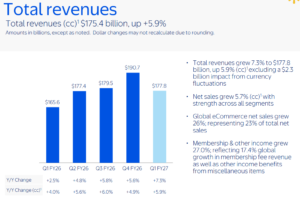
Walmart continued its strong performance in the first quarter of fiscal 2027, which ended April 30, 2026. The company reported growth in total revenue and net sales.
Sales at existing Walmart U.S. stores increased 4.1%. More customers visited stores, and shoppers also spent more during each trip. Operating income increased 5.0%, although higher fuel costs for transportation and deliveries reduced part of the gain.
Walmart’s digital business also kept growing.
Its online marketplace, advertising business, and Walmart+ membership program continue to generate higher profits. At the same time, the company is using AI, automation, and modern fulfillment centers to improve efficiency and serve customers faster.
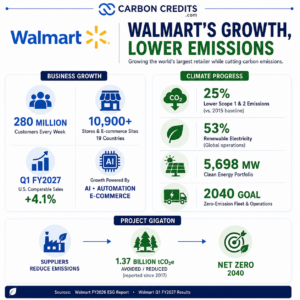
Today, Walmart serves about 280 million customers and members every week through more than 10,900 stores and e-commerce websites in 19 countries. The company also employs over 2 million associates, making it the world’s largest private employer.
Yet, Walmart’s biggest climate challenge is still ahead.
Unlike many companies, most of Walmart’s emissions do not come from its stores, offices, or trucks. They come from the products it buys, makes, transports, and sells through one of the world’s largest supply chains.
That means it cannot reach its climate goals alone. It also needs thousands of suppliers around the world to reduce their emissions.
Cleaner Stores, Trucks, and Power Are Cutting Emissions
Walmart’s business growth is happening alongside steady progress on climate. According to its latest FY2026 ESG Report, the company has reduced its absolute Scope 1 and Scope 2 greenhouse gas emissions by 25% compared with 2015.
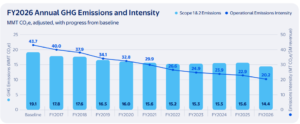
Walmart achieved this by buying more renewable electricity, improving energy efficiency, upgrading refrigeration systems, and using cleaner transportation.
Renewable power remains one of Walmart’s biggest tools for cutting emissions.
The company continues to install solar power at its facilities and sign long-term renewable energy agreements. It is also making stores, offices, and distribution centers more energy efficient. Older refrigeration equipment is being replaced with systems that use refrigerants with lower global warming potential and consume less electricity.
By the end of FY2026, 53% of Walmart’s global electricity needs were supplied by renewable sources. This exceeds its 2025 target of 50% and moves the company closer to its goal of 100% renewable electricity by 2035.
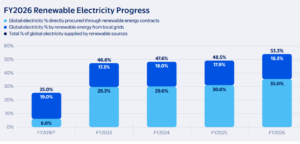
The retail giant directly procured 35.0% of its global electricity through renewable energy contracts. Its total clean energy portfolio also reached 5,698 megawatts (MW). This includes 3,386 MW enabled through current FY2026 investments as the company works toward enabling 10 gigawatts (GW) of new clean energy projects by 2030.
Transportation is another major focus.
Walmart is testing battery-electric trucks and hydrogen fuel cell trucks. It is also expanding EV charging stations and using smarter delivery routes to reduce fuel use. These efforts support the company’s goal of operating a zero-emissions fleet by 2040.
Even with this progress, Walmart says its own operations account for only a small part of its total emissions. The much bigger challenge is Scope 3 emissions. These come from the products suppliers manufacture, package, and transport before they reach Walmart stores.
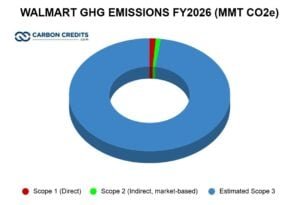
Scope 3 accounts for almost 98% of the retailer’s total GHG emissions at 635 million metric tons of CO2e. Meanwhile, Scope 1 and Scope 2 emissions represent only 2% of its entire carbon footprint, totaling only 14.4 MMT CO2e.
That is why Walmart is working closely with suppliers. Cutting emissions across its global supply chain could have a much bigger impact than reducing emissions from its own buildings and vehicles alone.
Kathleen McLaughlin, Executive Vice President and Chief Sustainability Officer at Walmart, said:
“As well, suppliers engaged through our Project Gigaton platform reported projects since 2017 expected to avoid, reduce, or sequester 1.37 billion metric tons of CO2e through 2030.”
Retail’s Carbon Challenge Starts in the Supply Chain
Walmart is not the only retailer working to lower emissions. The whole retail industry faces the same challenge. Companies must keep prices low, deliver products faster, and reduce emissions at the same time.
Most emissions do not come from stores. They come from making products, moving goods around the world, and delivering orders to customers.
According to the International Energy Agency, freight transport accounts for about 8% of global energy-related carbon dioxide (CO₂) emissions. As online shopping continues to grow, moving products efficiently while cutting emissions is becoming more important.
Retailers are also investing more in cleaner transportation. Many are adding electric delivery vehicles, improving warehouse efficiency, and using AI to plan better delivery routes. These changes help lower fuel use, reduce costs, and cut emissions at the same time.
For Walmart, this work supports both its climate goals and its long-term business strategy.
Project Gigaton Is Driving Bigger Emissions Cuts
Walmart knows it cannot reach net zero without its suppliers. That is why Project Gigaton has become one of the company’s biggest climate programs.
The initiative encourages suppliers to reduce emissions across manufacturing, farming, transportation, packaging, waste, and product design.
According to Walmart’s FY2026 ESG Report, suppliers participating in Project Gigaton have now reported almost 1.4 billion metric tons of avoided or reduced greenhouse gas emissions since the program began in 2017. That is one of the largest voluntary supply chain climate programs in the world.
The company is also working with suppliers to expand renewable energy, improve fertilizer use, protect forests, and reduce food waste.
These efforts matter because Scope 3 emissions make up the majority of Walmart’s total carbon footprint, while emissions from its own operations account for only a small share.
Can Walmart Reach Net Zero by 2040?
Walmart has made solid progress, but the hardest work still lies ahead.
The company has already reduced its operational emissions by 25% from 2015 levels. It continues to add renewable electricity, improve energy efficiency, modernize refrigeration systems, and test cleaner trucks.
Still, reaching net zero by 2040 will depend mainly on cutting emissions across its global supply chain. That will require thousands of suppliers to switch to cleaner energy, improve manufacturing, and reduce emissions from the products they sell.
However, the company is showing that growing its business while making progress on climate is possible. Revenue continues to increase. E-commerce is expanding quickly. At the same time, Walmart is reducing emissions, improving energy efficiency, and helping suppliers lower their carbon footprint.
Overall, Walmart’s latest results suggest that climate action is no longer separate from business growth. It is becoming an important part of staying competitive in modern retail.
The post Walmart Cuts Emissions 25% as AI, E-Commerce, and Project Gigaton Power Growth appeared first on Carbon Credits.


