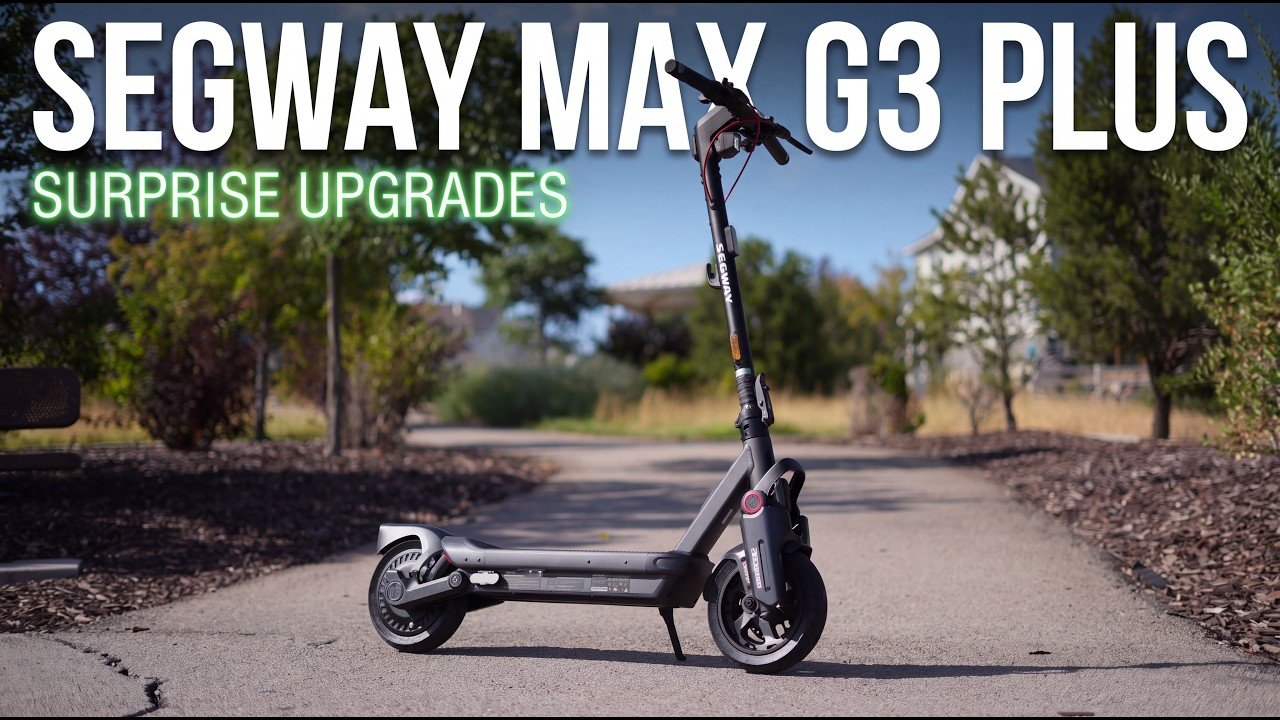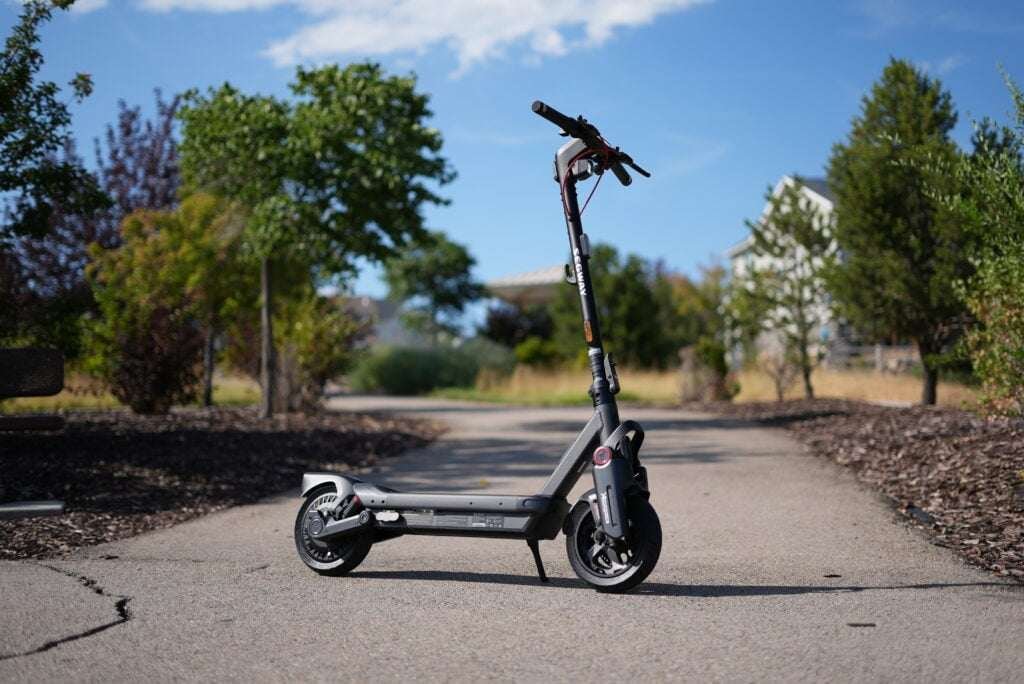
The Segway MAX G3 Plus is a mid-generation refresh that adds more power, range, safety equipment, and everyday usability to an already excellent commuter scooter.
It gets a larger 717Wh battery, a more powerful 2,200W peak rear motor, dedicated rear turn signals, and several smaller refinements while retaining the hydraulic suspension, 11-inch self-sealing tires, traction control, TFT display, Apple Find My integration, and extensive app customization that made the original MAX G3 stand out.
The advertised top speed is still 28 mph, but our testing showed that the G3 Plus is not really about gaining a few extra miles per hour on flat ground. Its biggest performance advantage is how well it maintains speed under load.
It completed our quarter-mile hill test in 37.52 seconds while holding approximately 25 to 27 mph for much of the climb. It also delivered 21.2 miles during our demanding real-world range test, stopped from approximately 16 mph in 13 to 14 feet, and weighed 55.1 pounds on our scale.
This is one of the most complete, comfortable, stable, and technologically advanced commuter scooters we have tested. It is not a lightweight last-mile model and it is not intended to replace a true off-road scooter, but as an end-to-end city commuter, it is extremely difficult to fault.
We covered the scooter before launch in our Segway MAX G3 Plus first impressions. This is the full tested review, with every number measured using our standard test protocol.
Review unit disclosure: Segway provided the MAX G3 Plus used for this review. Segway did not control our testing, conclusions, or final opinion.
Full video review:
Segway MAX G3 Plus: Quick Verdict
The Segway MAX G3 Plus is best for riders who want premium comfort, excellent hill-climbing performance, strong real-world range, sophisticated safety features, and a polished ownership experience without stepping up to a much heavier performance scooter.
Its hydraulic suspension and SegRide geometry make it unusually stable and comfortable, while its larger battery helps it maintain strong performance through most of the charge.
The biggest weaknesses are the awkward moving kicktail area, the temporary activation process for Boost mode, and a ride that becomes noticeably more unsettled on gravel or rough trails.
At its $1,499 MSRP, the G3 Plus faces substantial competition. At the $1,149 launch price, it becomes one of the strongest values in the premium commuter category.
What we liked
- Outstanding hydraulic suspension
- Exceptional hill-climbing performance
- Strong performance at lower battery levels
- Stable and confidence-inspiring handling
- Larger 717Wh battery
- Front and rear turn signals
- 11-inch self-sealing tires
- Traction control and anti-lock braking assistance
- Bright, readable TFT display
- Apple Find My and proximity unlocking
- Extensive app-based customization
- Reasonable 55.1-pound tested weight
What could be better
- Rear kicktail area moves with the suspension
- Boost mode must be reactivated and is unavailable at low battery
- Not especially comfortable on rough off-road terrain
- Claimed 56-mile range does not reflect fast, real-world riding
- Turn-by-turn navigation is less useful than a phone-based map
- Too heavy for riders who frequently carry a scooter upstairs
Segway MAX G3 Plus Tested Specifications
| Specification | Segway MAX G3 Plus |
|---|---|
| MSRP | $1,499.99 |
| Launch price | $1,149.99 |
| Motor | Single rear hub motor |
| Peak motor power | 2,200W |
| Advertised top speed | 28 mph |
| Tested indicated top speed | 28 mph |
| Battery | 717Wh |
| Advertised maximum range | 56 miles |
| Tested real-world range | 21.2 miles |
| Range before heavy throttling | Approximately 18 miles |
| Tested weight | 55.1 lb |
| Tires | 11-inch self-sealing tubeless |
| Suspension | Dual front and dual rear hydraulic |
| Brakes | Dual mechanical disc with electronic assistance |
| Tested braking distance | Approximately 13 to 14 ft |
| Water resistance | IPX6 |
| Display | 2.4-inch color TFT |
| Charging time | Approximately 4 hours |
| Faster optional charging | Approximately 3 hours |
| Front headlight output | 170 lux at 6 ft |
| Motor noise in Eco | 52 dB |
| Motor noise in Sport | 63 dB |
| Bell output | 73 dB |
| Handlebar width | 23 in |
| Handlebar height above deck | 41 in |
| Usable deck length | 21.5 in |
| Total deck and kicktail length | 32 in |
| Wheelbase | 36 in |
| Unloaded ground clearance | 5 in |
| Clearance with 200-pound rider | 4.5 in |
What Changed From the Original Segway MAX G3?
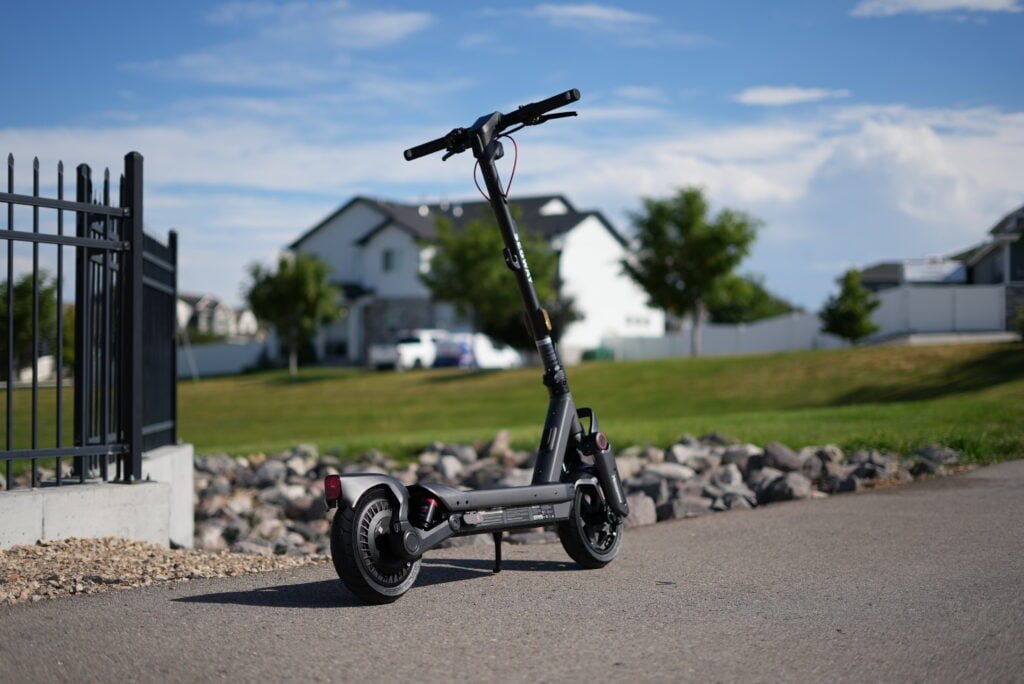
The regular MAX G3 was already one of Segway’s best commuter scooters. It combined a 597Wh battery, 2,000W peak rear motor, 28 mph claimed top speed, hydraulic suspension, 11-inch tires, dual disc brakes, a color display, traction control, and extensive smart features. You can see where it sits in the wider range in our Segway lineup guide.
The MAX G3 Plus improves the formula rather than replacing it.
Larger 717Wh Battery
Battery capacity increases from 597Wh to 717Wh, an increase of 120Wh or approximately 20%.
Segway claims up to 56 miles of range, although that figure should not be interpreted as the distance a typical adult will travel while riding at normal traffic speeds.
In our demanding test with an approximately 200-pound rider, frequent high-speed riding, hills, starts, stops, and Sport mode use, the scooter covered 21.2 miles. Approximately 18 miles were completed at relatively high speeds before the scooter began limiting performance more aggressively.
That is a useful improvement over the standard G3, particularly for commuters who want more reserve capacity rather than a scooter they must run down to its final few percent.
More Powerful 2,200W Rear Motor
Peak motor power rises from 2,000W to 2,200W.
That is not a dramatic numerical increase, but the motor, battery, and controller work extremely well together. The result is most apparent when the scooter is placed under sustained load.
The G3 Plus did not merely attack our hill quickly. It held close to its advertised top speed for much of the climb, which tells us the battery and controller can continue supplying the motor with substantial power rather than only producing a brief initial surge.
Dedicated Rear Turn Signals
The standard G3 already had handlebar-mounted front turn signals. The G3 Plus adds dedicated rear signals, making the rider’s intentions easier to see from behind.
This is one of those upgrades that does not make the spec sheet much more exciting but can make the scooter safer and easier to use in traffic.
Familiar Top Speed, Stronger Real-World Performance
The top-speed claim remains 28 mph.
On flat ground, the G3 Plus may not initially seem much faster than other premium single-motor commuter scooters. The difference becomes obvious on hills, into headwinds, and during the lower portion of the battery charge.
This is a scooter designed to sustain useful performance, not simply create a large peak-power number for marketing.
Hill-Climbing Performance
Our hill course is approximately one-quarter mile long and steep enough to expose weak controllers, inadequate batteries, and scooters that cannot manage heat or sustained current.
The MAX G3 Plus launched strongly and quickly reached 18 mph. It continued through 22, 24, and 25 mph before briefly showing 26 to 27 mph on its display. GPS readings were generally about 1 mph lower than the dashboard.
The scooter completed the hill in 37.52 seconds.
More importantly, it maintained approximately 25 to 26 mph through much of the climb. It even gained speed in the slightly flatter sections.
That is exceptional performance for a single-motor commuter scooter.
Peak motor output alone does not produce a result like this. The battery must be able to deliver sufficient current, and the controller must manage that output without cutting power prematurely.
The G3 Plus passed all three parts of that equation.
Hill-Climb Verdict
Riders who live in genuinely hilly areas should put the MAX G3 Plus near the top of their comparison list.
Segway’s Hill Hold function is also useful in this environment. When stopped on a slope, holding the brake levers for a few seconds electronically keeps the scooter from rolling while the rider prepares to continue.
Acceleration and Boost Mode Testing
Segway claims the MAX G3 Plus can accelerate from zero to 15 mph in approximately 2.4 seconds.
We tested the scooter with Boost mode disabled and enabled. Conditions included substantial headwind, so the results also demonstrate how effectively the scooter can continue accelerating against resistance.
Acceleration Without Boost
| Test | Result |
|---|---|
| 0 to 10 mph | 2.74 seconds |
| 0 to 20 mph | 7.12 seconds |
| 0 to 25 mph | 11.13 seconds |
| 1/8 mile | 20.97 seconds |
Acceleration without Boost is controlled and approachable. It feels strong enough for urban traffic without immediately becoming abrupt or intimidating.
Fastest Boost-Mode Run
| Test | Result |
|---|---|
| 0 to 10 mph | 1.98 seconds |
| 0 to 20 mph | 4.64 seconds |
| 0 to 25 mph | 6.30 seconds |
| 1/8 mile | 18.89 seconds |
Boost makes the initial response considerably stronger. The G3 Plus still feels stable and composed, but the rider should be prepared before engaging it.
One usability issue is that there is no dedicated Boost button. The rider must hold a brake lever and press the throttle while stopped, then wait for the display to show that Boost is ready.
Boost must also be prepared again rather than remaining permanently enabled, and it becomes unavailable once the battery is low.
That extra step may be intentional from a safety and battery-management perspective, but performance-focused riders may find it unnecessarily cumbersome.
Top-Speed Testing
The scooter repeatedly reached its advertised 28 mph indicated speed.
GPS generally read approximately 1 mph below the scooter’s display, which is a relatively small discrepancy. Heavy headwind occasionally held it around 27 mph. We track that gap across the category in our claimed vs tested top speed guide.
The more impressive result was its ability to reach or approach top speed while climbing and while the battery was partially depleted.
At approximately 23% charge on a mild incline, the G3 Plus could still accelerate toward 27 to 28 mph. At 21% charge during our formal low-battery acceleration test, it still reached approximately 25 to 26 mph.
That consistency is more valuable in daily riding than a scooter that hits a high number at 100% charge and rapidly loses performance afterward.
Real-World Range Test
Segway advertises up to 56 miles of range from the 717Wh battery.
As with almost every electric scooter range claim, the maximum figure depends heavily on speed, rider weight, temperature, terrain, tire pressure, stopping frequency, wind, and riding mode. We measured that gap across a dozen scooters in our claimed vs tested range study.
Our range test was intentionally demanding:
- Approximately 200-pound rider
- Sport mode
- Fast riding whenever conditions allowed
- Real hills, starts, and stops
- Normal traffic conditions
- Acceleration and performance testing during the ride
The G3 Plus covered 21.2 miles before becoming effectively depleted.
At 35% battery, it had traveled approximately 13.2 miles. At 11%, it had covered about 18.1 miles and began limiting performance more noticeably.
It then continued for roughly three additional miles at progressively lower speeds. At 1%, the scooter could still move at approximately 14 to 15 mph on flatter ground and around 10 mph on a mild incline, but it continued slowing as the remaining energy was exhausted.
Understanding the 21.2-Mile Result
The headline number requires context.
The scooter delivered approximately 18 miles of fast, useful riding. The final three miles were completed under increasingly heavy speed restriction.
That means a commuter should not plan a 21-mile one-way trip and expect full performance all the way home. A more practical high-speed working range is closer to the first 18 miles recorded in this test, with additional reserve available at reduced speed.
Riders traveling more slowly, using lower modes, weighing less, or riding on flatter routes should travel significantly farther.
SegRange Optimization
Segway says the scooter uses its SegRange optimization technology, though the company does not publish exactly how it works.
The most reasonable interpretation is that the system manages power delivery to improve efficiency under different riding conditions. Regardless of the underlying strategy, riders should expect a tradeoff between maximum acceleration and maximum range.
Low-Battery Performance
Many electric scooters feel substantially weaker once their battery reaches the final third of its charge. The MAX G3 Plus performed better than expected.
At approximately 21% battery, Boost was no longer available, but Sport mode remained usable.
The scooter recorded:
| Low-battery test | Result |
|---|---|
| 0 to 20 mph | 12.49 seconds |
| 1/8 mile | 24.35 seconds |
| Approximate top speed | 25 to 26 mph |
Acceleration was several seconds slower than the best full-battery run, but the scooter could still reach close to its advertised speed.
Our rider estimated that lower-battery torque felt only about 5% to 10% weaker through much of the usable charge. The more severe restriction began closer to 11%.
This strong low-battery behavior is one of the most practical benefits of the larger battery and well-managed controller.
Braking Test
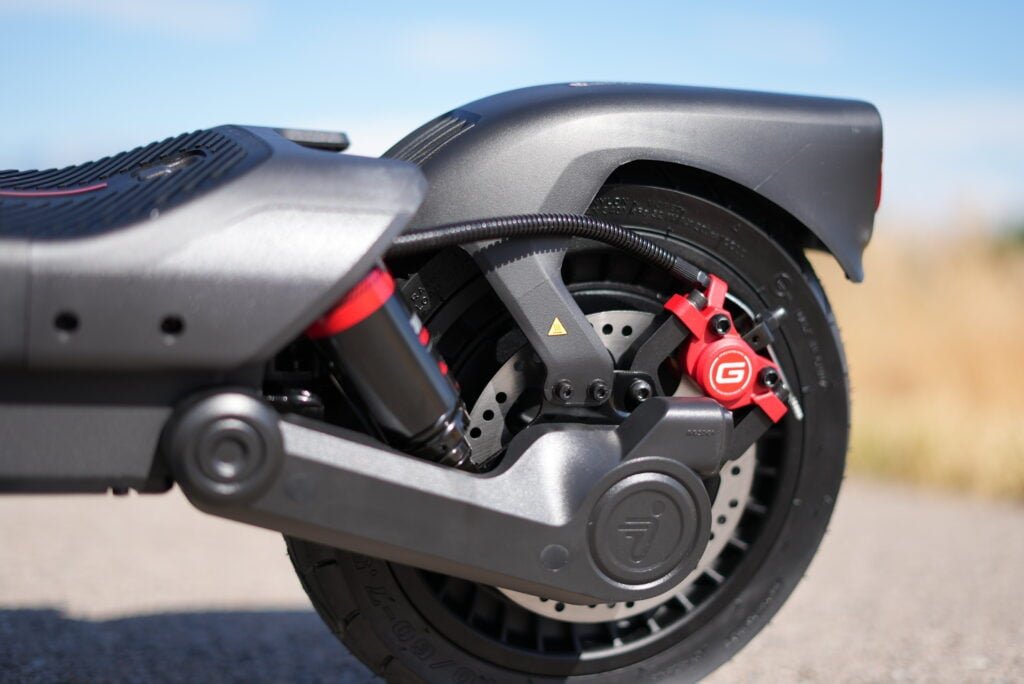
The MAX G3 Plus uses disc brakes supported by Segway’s electronic braking and anti-lock assistance.
From approximately 16 mph, the scooter stopped in roughly:
- 13 to 14 feet
- 1.5 to 1.6 seconds
The braking response felt strong, predictable, and well balanced. The scooter remained composed rather than pitching or feeling as though one wheel was doing most of the work.
Segway’s S-ABS function is designed to reduce the likelihood of full wheel lock during hard braking. Preventing a wheel from immediately locking is especially important on a two-wheeled vehicle, where a sliding tire can quickly reduce steering control and stability.
As always, no electronic system can overcome poor traction. Riders should increase following distance in rain, on loose surfaces, or when tires are cold.
Dynamic Traction Control
The G3 Plus includes Dynamic Traction Control, which can reduce wheel slip in wet or low-grip conditions.
Our tester preferred turning it off during dry riding because traction control can make throttle response feel slightly more restrained. During rain or on slick pavement, however, that intervention can help prevent the rear wheel from spinning excessively.
This is a relatively uncommon feature in the commuter scooter category and contributes to the G3 Plus feeling more like a complete transportation platform than a simple motor, battery, and throttle.
Hydraulic Suspension and Ride Comfort
The suspension is the first major reason to buy the MAX G3 Plus.
It uses two hydraulic suspension elements at the front and two at the rear. The movement feels controlled and fluid rather than bouncy.
The suspension absorbs cracks, expansion joints, and broken pavement while maintaining enough support for responsive steering. The rear preload is adjustable, allowing riders to compensate for different body weights and preferences. The front is not adjustable.
The result is one of the most comfortable city rides available in this class.
Some soft scooters feel vague or unstable when leaned into a corner. The G3 Plus avoids that problem. Its suspension compresses and rebounds without making the scooter feel disconnected from the road.
Once riders become accustomed to properly damped hydraulic suspension, returning to a basic spring-only system can be difficult.
Handling, Stability and SegRide Geometry
The MAX G3 Plus feels unusually balanced at both low and high speeds.
Segway refers to its geometry system as SegRide. One important part of the design is the axle offset relative to the steering stem, sometimes described as a trailing-arm arrangement.
In practical terms, the scooter wants to remain upright.
It feels planted while traveling straight, but it can still be leaned into turns. When carving, the suspension and steering naturally encourage the scooter to return to center rather than continuing to fall inward.
That makes the G3 Plus confidence-inspiring for newer riders without making it boring for experienced riders.
Agility and Turning
The scooter remains easy to flick around an obstacle despite its solid construction and large battery.
Measured steering angle was approximately 45 degrees. The handlebar is 23 inches wide and positioned 41 inches above the deck.
The handlebar itself has an aggressive 16-degree angle. Riders who prefer a very neutral or straight bar may need time to adjust, but the shape contributes to the controlled, forward-facing riding position.
11-Inch Self-Sealing Tires
The G3 Plus rolls on 11-inch self-sealing tubeless tires.
The rubber compound feels unusually soft and grippy. The tires remain quiet on pavement and provide excellent confidence while leaning.
The larger diameter also helps the wheels roll over cracks and small obstacles more easily than the 9-inch or 10-inch tires commonly found on lighter commuter scooters.
The self-sealing layer reduces the likelihood that a small puncture will immediately leave the rider stranded. It does not make the tires indestructible, so pressure should still be checked regularly.
Soft, grippy rubber may also wear more quickly than a harder compound, particularly for riders who brake aggressively or frequently spin the rear tire.
Street Comfort Versus Off-Road Riding
The MAX G3 Plus is exceptionally comfortable on pavement, but it should not be mistaken for a dedicated trail scooter.
On gravel, our rider experienced substantial high-frequency vibration through the scooter. Grass was somewhat more comfortable, but repeated vertical movement was still noticeable.
The suspension is tuned for urban surfaces, potholes, seams, and normal road impacts. It is less effective at isolating the constant small chatter produced by loose gravel or uneven off-road terrain.
The scooter can handle a shortcut across grass or a short gravel path. It is not the best choice for riders whose normal route consists primarily of trails, roots, rocks, or rough dirt roads.
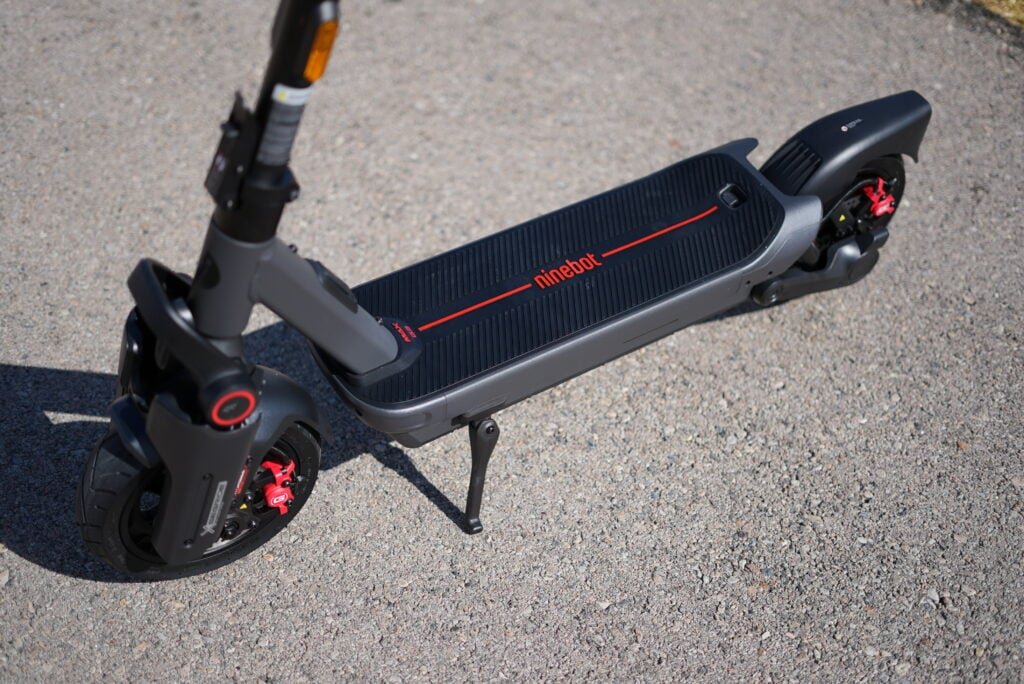
Deck Space and Kicktail Design
The main ergonomic criticism concerns the rear portion of the deck.
The primary deck is approximately 21.5 inches long. Counting the full raised rear section brings the total to around 32 inches.
The kicktail is shallow, and many riders will naturally place their rear foot on it. The issue is that the deck and rear cover do not move as one completely solid surface. Because the rear suspension is working beneath this area, the rider can feel the two sections moving relative to one another.
That can create the sensation that the rear foot is resting across two surfaces that are not always perfectly aligned.
It is not a deal breaker, and most riders will likely adapt. A longer fixed deck or more isolated rear-fender design would feel more natural.
Display, Controls and App Settings
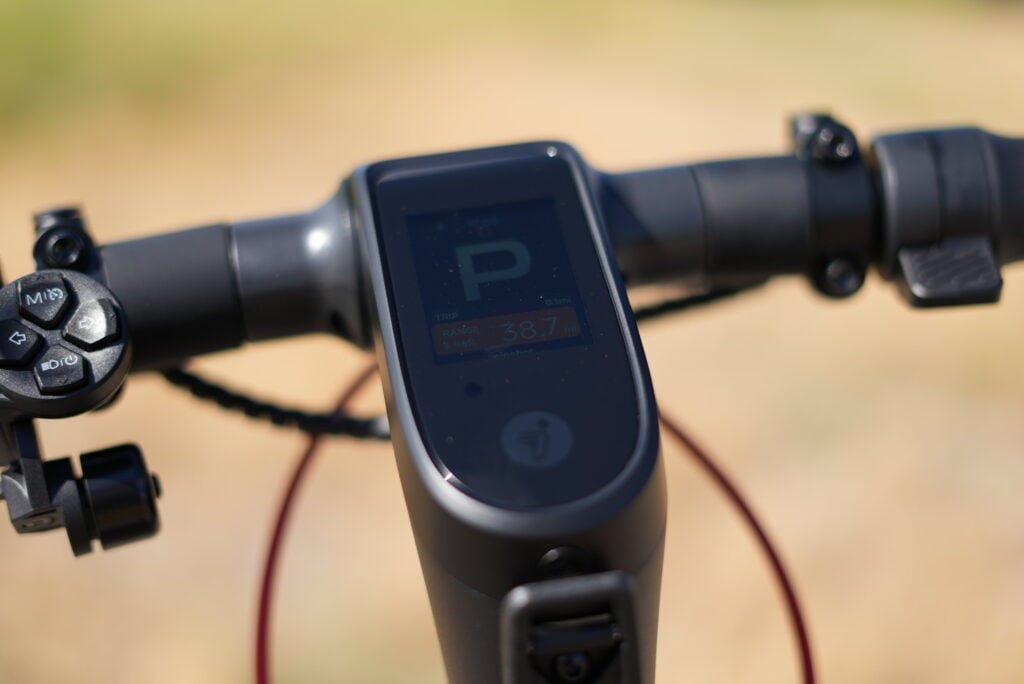
The 2.4-inch full-color TFT display is one of the best dashboards available on a commuter scooter.
It remains easy to read in daylight and can display:
- Current speed
- Battery level
- Estimated remaining range
- Trip distance
- Riding mode
- Light status
- Turn-signal status
- Charging information
- Basic turn-by-turn navigation
The range estimate was impressively accurate during testing.
The navigation system does not display a full map. It provides directional prompts instead. That can be useful when the rider wants to keep a phone in a pocket, but Google Maps or Apple Maps on a mounted phone remains more informative.
Handlebar Controls
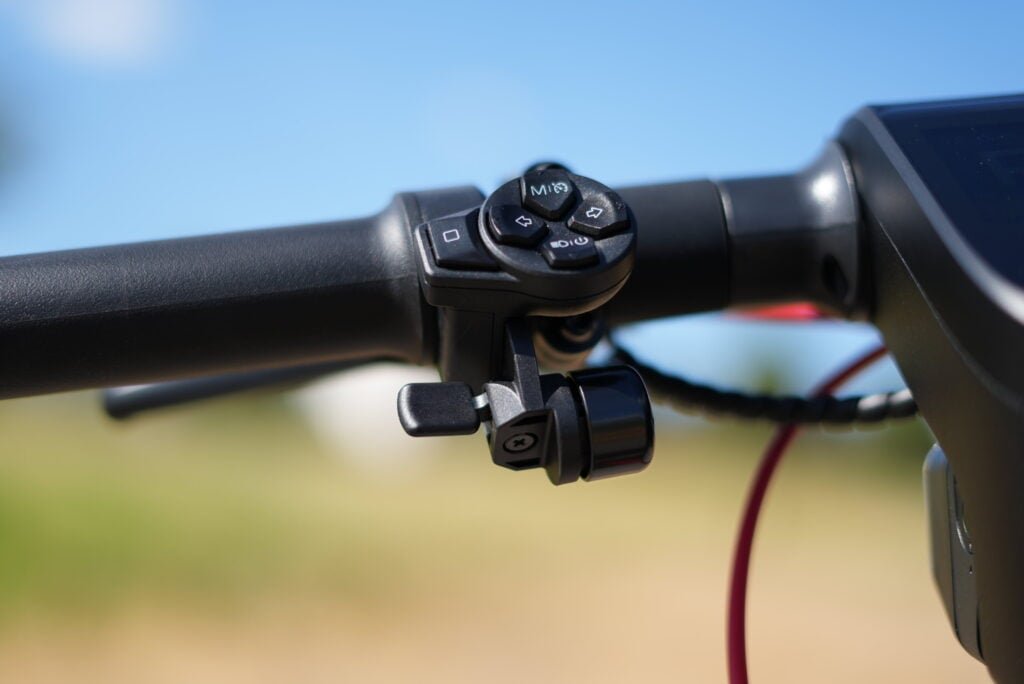
The controls include:
- Left and right turn signals
- Riding-mode selection
- Power and lighting control
- Electronic bell
- Programmable function button
- Throttle
- Brake levers
The programmable button can be assigned to different functions. Our test scooter had it configured to adjust regenerative braking.
The control layout is clean once learned, although the Boost activation process is less intuitive than a dedicated button would be.
App Settings and Customization
The Segway app provides an unusually deep level of customization.
Depending on software and regional availability, riders can adjust or monitor:
- Target charging percentage
- Scheduled charging
- Charging completion time
- Regenerative braking
- Rear-light behavior
- Brake-light brightness or flashing
- Ambient lighting
- Automatic headlight operation
- Riding modes
- Traction control
- Security functions
- Navigation
- Remaining range
- Firmware updates
- Proximity unlocking
The app can also show the estimated time at which charging will finish.
Limiting the battery’s maximum charge can be useful for owners who do not need the full range every day and want to reduce the amount of time the battery spends sitting at 100%.
Security, Lighting and Charging
The MAX G3 Plus supports Apple Find My, allowing compatible Apple users to locate the scooter through Apple’s network without paying a monthly tracking subscription.
It also includes proximity unlocking. When properly configured, the scooter recognizes the owner’s phone over Bluetooth and can unlock as the rider approaches.
The built-in alarm makes noise and resists being pushed when the security system is active.
These features add useful layers of deterrence and recovery, but they do not replace a high-quality physical lock. A determined thief can still lift a 55-pound scooter into a vehicle.
Lighting and Visibility
The MAX G3 Plus includes a bright headlight, a front daytime running light, rear lighting, and turn signals at both ends.
Our headlight test measured 170 lux from six feet away.
The rear light can be configured to brighten during braking or flash, depending on the rider’s preference and local regulations.
The addition of dedicated rear turn signals is especially important because handlebar-mounted front signals may be difficult for drivers behind the scooter to see.
The design is relatively restrained and does not include extensive RGB lighting. Some riders will consider that a negative, but commuters who prefer a more mature appearance may see it as an advantage.
Charging and Water Resistance
The standard charging setup requires approximately four hours for a full charge. An additional compatible charging cable can reduce the estimated time to roughly three hours.
That is relatively fast for a 717Wh battery and makes it easier to recharge during a workday or between two longer rides. The app can display an estimated charging-completion time and allows the owner to control when charging occurs and the percentage at which it stops.
The scooter carries an IPX6 water-resistance rating. That provides meaningful protection from splashing and wet-weather use, but it does not make the scooter waterproof. Riders should avoid deep standing water, pressure washing, or submerging electrical components.
Traction control, self-sealing tires, lighting, and controlled braking assistance make the scooter relatively well equipped for unpredictable commuting conditions, but wet surfaces always require lower speed and longer braking distances.
Thermal Testing, Noise and Weight
Thermal imaging was performed after the demanding range test.
The rear motor measured approximately 134°F, while the rear tire was around 130°F. The front tire measured approximately 123°F.
The battery enclosure was approximately 109°F and appeared to heat uniformly. We did not find suspicious hot cables, isolated battery hotspots, or other obvious thermal abnormalities.
The display and lighting components also produced some heat, with the warmest measured area around the headlight reaching approximately 130°F.
Overall, the thermal results appeared normal for a scooter that had just completed a high-output range test in hot weather.
Motor and Bell Noise
| Sound test | Result |
|---|---|
| Eco-mode motor noise | 52 dB |
| Sport-mode motor noise | 63 dB |
| Electronic bell | 73 dB |
The tires are notably quiet on pavement, and the scooter does not produce an excessive amount of drivetrain noise during normal cruising.
The 73 dB bell should be audible to nearby pedestrians in many situations, although riders should not assume it will be heard inside a vehicle or in loud traffic.
Weight and Portability
Our industrial scale measured the MAX G3 Plus at 55.1 pounds.
That is close to Segway’s stated weight and only a modest increase considering the larger 717Wh battery and added equipment.
A 55-pound scooter is manageable for loading into a vehicle, moving through a garage, or occasionally carrying up a short flight of stairs. It is not ideal for daily train transfers, frequent staircases, or riders living several floors above ground without an elevator.
The scooter makes more sense as an end-to-end commuter than as a lightweight last-mile companion.
Ground clearance measures approximately five inches without a rider and 4.5 inches with an approximately 200-pound rider aboard.
Segway MAX G3 Plus Versus MAX G3
The regular MAX G3 remains a good scooter, particularly when heavily discounted.
Choose the MAX G3 Plus for:
- The larger 717Wh battery
- Stronger 2,200W peak motor
- Better sustained hill performance
- Dedicated rear turn signals
- More usable range reserve
- The newest version of Segway’s commuter platform
Choose the standard MAX G3 when:
- It is substantially less expensive
- Your commute is relatively short
- You rarely encounter steep hills
- You do not need the additional battery capacity
- You already own one and are satisfied with its performance
The upgrade is meaningful, but it may not be large enough to justify immediately replacing a recently purchased MAX G3. For a new buyer choosing between the two at similar prices, the G3 Plus is the obvious choice.
Who Should Buy the Segway MAX G3 Plus?
The G3 Plus is an excellent fit for:
- Daily commuters traveling entirely by scooter
- Riders living in hilly cities
- Heavier riders who need strong sustained output
- Riders who value ride comfort over minimum weight
- Owners who want premium app and security features
- Riders who frequently encounter cracked or uneven pavement
- Buyers who want performance without moving to a huge dual-motor scooter
- Apple users who value Find My integration
Who Should Skip It?
Consider another scooter when:
- You must carry it upstairs every day
- Your route includes regular public-transit transfers
- You primarily ride rough trails
- You need substantially more than 28 mph
- You want a compact scooter under 40 pounds
- You already own a MAX G3 and only ride short, flat routes
- You do not need app features and would rather pay less for simpler hardware
If none of the above rules it out, the G3 Plus also earns a place on our best electric scooters shortlist.
RiderGuide Verdict
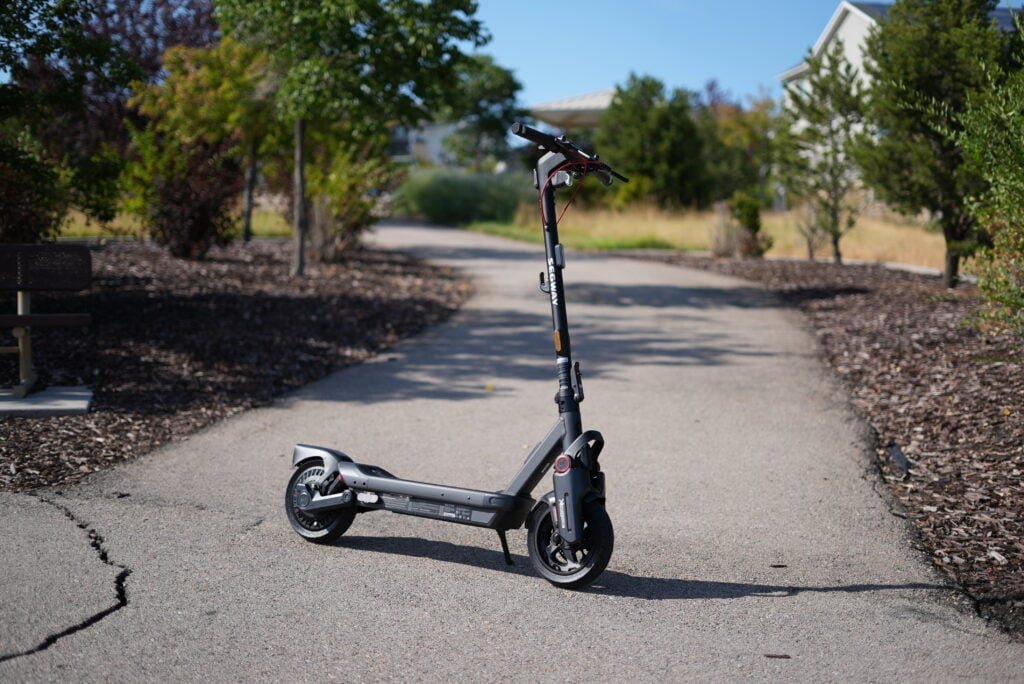
The Segway MAX G3 Plus takes one of the most polished commuter scooters and fixes several of the few areas where meaningful improvement was still possible.
The larger battery provides more usable reserve. The 2,200W motor, controller, and battery combination delivers exceptional hill-climbing performance. Rear turn signals improve visibility. Hydraulic suspension and SegRide geometry make the scooter both plush and remarkably stable.
Our testing produced a 37.52-second quarter-mile hill climb, a verified 28 mph indicated top speed, a best 0 to 20 mph time of 4.64 seconds, braking in approximately 13 to 14 feet, and 21.2 miles of demanding real-world range.
The final miles of the range test were heavily restricted, but the scooter maintained impressive performance through most of its charge and continued operating even at 1%.
There are limitations. The moving kicktail area feels unusual under the rear foot, Boost mode is unnecessarily complicated to activate, and the street-oriented suspension does not eliminate gravel vibration.
Those are relatively small criticisms compared with how complete the overall package feels.
At full MSRP, buyers should compare it carefully with every premium commuter scooter in the category. At the $1,149 launch price, the MAX G3 Plus is an outstanding value and one of the easiest premium commuter scooters to recommend.
Bottom line: The Segway MAX G3 Plus is one of the best city-riding electric scooters currently available for riders who prioritize comfort, hills, safety technology, and consistent real-world performance.
Segway MAX G3 Plus FAQ
How fast is the Segway MAX G3 Plus?
What range did the MAX G3 Plus achieve in testing?
How much does the Segway MAX G3 Plus cost?
What is the Segway MAX G3 Plus battery capacity?
How much does the MAX G3 Plus weigh?
Is the Segway MAX G3 Plus good on hills?
How quickly does it accelerate?
How well does it brake?
Does it have front and rear turn signals?
Does it work with Apple Find My?
Is the MAX G3 Plus suitable for off-road riding?
Is the MAX G3 Plus waterproof?
How long does charging take?
Is the Segway MAX G3 Plus worth buying?
Ride Safe
Wear a properly fitted helmet and appropriate protective gear. Follow local laws, inspect your scooter before riding, and only attempt performance riding in safe, controlled conditions. Performance testing shown here was conducted by experienced adult riders in controlled conditions. Do not attempt to recreate it.
Affiliate Disclosure
RiderGuide may earn a commission from purchases made through links in this article, at no additional cost to you. This supports our independent testing and content.
{“@context”:”https://schema.org”,”@graph”:[{“@type”:”Product”,”@id”:”https://riderguide.com/reviews/segway-max-g3-plus-review/#product”,”name”:”Segway MAX G3 Plus”,”brand”:{“@type”:”Brand”,”name”:”Segway”,”sameAs”:”https://www.segway.com”},”category”:”Electric Scooter”,”description”:”The Segway MAX G3 Plus is a premium commuter electric scooter with a 717Wh battery, a 2,200W peak rear hub motor, dual front and rear hydraulic suspension, 11-inch self-sealing tubeless tires, front and rear turn signals, traction control and Apple Find My integration.”,”image”:”https://materialsindustry.com/wp-content/uploads/2026/08/segway-max-g3-plus-review-one-of-the-best-commuter-scooters-just-got-better.jpg”,”sku”:”SEGWAY-MAX-G3-PLUS-2026″,”offers”:{“@type”:”Offer”,”url”:”https://riderguide.com/rgo/segway-max-g3-plus/43798/1/”,”price”:”1149.99″,”priceCurrency”:”USD”,”itemCondition”:”https://schema.org/NewCondition”,”priceValidUntil”:”2027-08-04″,”availability”:”https://schema.org/InStock”,”seller”:{“@type”:”Organization”,”name”:”Segway”}},”additionalProperty”:[{“@type”:”PropertyValue”,”name”:”Verified weight”,”value”:”55.1 lb”},{“@type”:”PropertyValue”,”name”:”Top speed (tested)”,”value”:”28 mph”},{“@type”:”PropertyValue”,”name”:”0-20 mph acceleration (Boost)”,”value”:”4.64 seconds”},{“@type”:”PropertyValue”,”name”:”Hill-climb time (quarter mile)”,”value”:”37.52 seconds”},{“@type”:”PropertyValue”,”name”:”Braking distance (16 mph)”,”value”:”Approximately 13 to 14 feet”},{“@type”:”PropertyValue”,”name”:”Measured range (worst-case)”,”value”:”21.2 miles”},{“@type”:”PropertyValue”,”name”:”Headlight output”,”value”:”170 lux at 6 feet”}],”aggregateRating”:{“@type”:”AggregateRating”,”ratingValue”:”98″,”bestRating”:”100″,”worstRating”:”1″,”reviewCount”:”1″,”ratingCount”:”1″}},{“@type”:”Review”,”@id”:”https://riderguide.com/reviews/segway-max-g3-plus-review/#review”,”itemReviewed”:{“@id”:”https://riderguide.com/reviews/segway-max-g3-plus-review/#product”},”name”:”Segway MAX G3 Plus Review: Tested Range, Speed, Hills and Braking”,”reviewBody”:”The Segway MAX G3 Plus is a mid-generation refresh that adds a 717Wh battery, a 2,200W peak rear motor and dedicated rear turn signals to an already excellent commuter scooter. In our testing it completed a quarter-mile hill climb in 37.52 seconds while holding roughly 25 to 27 mph, reached its advertised 28 mph indicated top speed, ran 0 to 20 mph in 4.64 seconds in Boost, stopped from about 16 mph in 13 to 14 feet, and weighed 55.1 pounds on our scale. A demanding range test with an approximately 200-pound rider in Sport mode returned 21.2 miles, with about 18 of those miles at full speed before heavy throttling began. The hydraulic suspension and SegRide geometry make it unusually stable and comfortable, and it holds power well at low state of charge. The moving kicktail, the awkward Boost activation process and gravel vibration are the main criticisms. At the $1,149 launch price it is one of the easiest premium commuter scooters to recommend.”,”datePublished”:”2026-08-04″,”author”:{“@type”:”Person”,”name”:”Matt Kaye”,”url”:”https://riderguide.com/author/matt-kaye/”,”jobTitle”:”Lead Tester”,”worksFor”:{“@type”:”Organization”,”name”:”RiderGuide”,”url”:”https://riderguide.com”}},”publisher”:{“@type”:”Organization”,”name”:”RiderGuide”,”url”:”https://riderguide.com”},”positiveNotes”:{“@type”:”ItemList”,”itemListElement”:[{“@type”:”ListItem”,”position”:1,”name”:”Exceptional sustained hill-climbing, 37.52 seconds up our quarter-mile hill”},{“@type”:”ListItem”,”position”:2,”name”:”Dual front and rear hydraulic suspension is the most comfortable in its class”},{“@type”:”ListItem”,”position”:3,”name”:”Larger 717Wh battery holds strong performance down to roughly 11 percent”},{“@type”:”ListItem”,”position”:4,”name”:”Dedicated rear turn signals added over the standard MAX G3″},{“@type”:”ListItem”,”position”:5,”name”:”Traction control, S-ABS braking assistance and Apple Find My built in”}]},”negativeNotes”:{“@type”:”ItemList”,”itemListElement”:[{“@type”:”ListItem”,”position”:1,”name”:”Rear kicktail moves with the suspension under the rear foot”},{“@type”:”ListItem”,”position”:2,”name”:”Boost mode must be re-armed and is unavailable at low battery”},{“@type”:”ListItem”,”position”:3,”name”:”Street-tuned suspension still transmits gravel vibration”}]},”reviewRating”:{“@type”:”Rating”,”ratingValue”:”98″,”bestRating”:”100″,”worstRating”:”1″}},{“@type”:”VideoObject”,”@id”:”https://riderguide.com/reviews/segway-max-g3-plus-review/#video-review”,”name”:”Segway Max G3 Plus Review – One of The Best eScooters Gets Even Better”,”description”:”RiderGuide’s full video review of the Segway MAX G3 Plus, covering hill climbing, acceleration, Boost mode, braking, range and thermal testing.”,”thumbnailUrl”:”https://materialsindustry.com/wp-content/uploads/2026/08/segway-max-g3-plus-review-one-of-the-best-commuter-scooters-just-got-better-7.jpg”,”uploadDate”:”2026-08-04T07:04:21-07:00″,”contentUrl”:”https://www.youtube.com/watch?v=rBXtuLnRnoo”,”embedUrl”:”https://www.youtube.com/embed/rBXtuLnRnoo”,”duration”:”PT20M24S”,”publisher”:{“@type”:”Organization”,”name”:”RiderGuide”,”logo”:{“@type”:”ImageObject”,”url”:”https://riderguide.com/wp-content/uploads/2024/04/RG-Logo.png”}}},{“@type”:”FAQPage”,”@id”:”https://riderguide.com/reviews/segway-max-g3-plus-review/#faq”,”mainEntity”:[{“@type”:”Question”,”name”:”How fast is the Segway MAX G3 Plus?”,”acceptedAnswer”:{“@type”:”Answer”,”text”:”Segway advertises a 28 mph top speed. Our test scooter repeatedly reached 28 mph indicated, while GPS generally measured approximately 1 mph less.”}},{“@type”:”Question”,”name”:”What range did the MAX G3 Plus achieve in testing?”,”acceptedAnswer”:{“@type”:”Answer”,”text”:”It covered 21.2 miles during a demanding test with an approximately 200-pound rider, Sport mode, hills, high speeds, and repeated acceleration. Approximately 18 miles were completed before heavy speed limiting began.”}},{“@type”:”Question”,”name”:”How much does the Segway MAX G3 Plus cost?”,”acceptedAnswer”:{“@type”:”Answer”,”text”:”The MSRP is $1,499.99, and Segway opened the launch at $1,149.99. Promotions change often, so check the current price before you order.”}},{“@type”:”Question”,”name”:”What is the Segway MAX G3 Plus battery capacity?”,”acceptedAnswer”:{“@type”:”Answer”,”text”:”The scooter has a 717Wh battery, compared with 597Wh in the standard MAX G3.”}},{“@type”:”Question”,”name”:”How much does the MAX G3 Plus weigh?”,”acceptedAnswer”:{“@type”:”Answer”,”text”:”Our industrial scale measured it at 55.1 pounds.”}},{“@type”:”Question”,”name”:”Is the Segway MAX G3 Plus good on hills?”,”acceptedAnswer”:{“@type”:”Answer”,”text”:”Yes. It completed our quarter-mile hill course in 37.52 seconds and maintained approximately 25 to 27 mph through much of the climb.”}},{“@type”:”Question”,”name”:”How well does it brake?”,”acceptedAnswer”:{“@type”:”Answer”,”text”:”From approximately 16 mph, it stopped in roughly 13 to 14 feet and 1.5 to 1.6 seconds.”}},{“@type”:”Question”,”name”:”Is the MAX G3 Plus suitable for off-road riding?”,”acceptedAnswer”:{“@type”:”Answer”,”text”:”It can cross short sections of gravel or grass, but its suspension is tuned primarily for city streets. Constant gravel vibration makes it less comfortable than a purpose-built off-road scooter.”}},{“@type”:”Question”,”name”:”Is the Segway MAX G3 Plus worth buying?”,”acceptedAnswer”:{“@type”:”Answer”,”text”:”It is a strong choice for riders who want excellent suspension, hills, safety technology, and a polished app experience. It is particularly competitive at the $1,149 launch price rather than the $1,499 MSRP.”}}]}]}
<p>The post Segway MAX G3 Plus Review: One of the Best Commuter Scooters Just Got Better first appeared on Rider Guide.</p>