
Rural Ontario municipalities are stepping up efforts to crack down on illegal truck yards showing up on farmland as commercial trucking activity continues to grow along the province’s major transportation corridors.
Why It Matters
With more than 200,000 trucks travelling Ontario highways each day, demand for truck parking and storage has increased, leading some operators to establish unauthorized truck yards on nearby farmland.
According to the Ministry of Transportation’s Transportation Planning Branch, key freight routes such as Highway 401 carry more than 40,000 commercial vehicles daily through their busiest sections, putting increasing pressure on communities located along these corridors.
“For residents living near illegal truck yards or other unauthorized commercial operations, the impacts can be significant. Concerns often include increased truck traffic, road damage, noise, lighting, environmental impacts, and the loss of agricultural land and rural character,” said Steve Pellegrini, mayor of King Township.
For farmers, there’s a health and safety impact, said OFA president Drew Spoelstra.
“Road competition between farm equipment and highway vehicles can be deadly. Farm vehicles are 3.8 to 4.8 times more likely to be involved in a fatal collision per kilometre travelled,” he says.
“Municipalities plan truck routes with designated networks for a reason,” he said, adding not all rural roads are designed to handle the strain of fast-moving heavy trucks and certain routes are not safe for large vehicles due to visibility, slopes and other infrastructure, like overhanging wires, particularly in older rural settlements, which traditionally have narrow roads.
Province and municipalities push for new enforcement tools
The province issued a statement earlier in 2026 supporting changes to the provincial Planning Act, which would allow municipalities to issue fines for illegal land use. However, the issue was put on hold when the provincial legislature recessed for the summer.
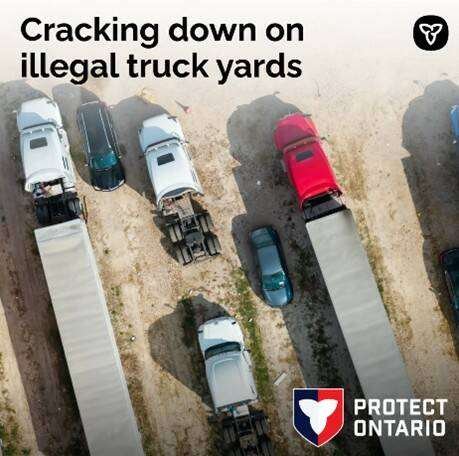
King Township supports the Government of Ontario’s proposed expansion of Administrative Monetary Penalties (AMPs) for illegal land uses.
“This is a significant step forward and reflects years of advocacy by King Township council and staff, working closely with the Small Urban Mayors of the Greater Toronto and Hamilton Area (SUM GTHA) group and provincial partners to strengthen municipal enforcement tools,” said Pellegrini.
Municipalities are doing what they can with the powers they have.
Earlier this year, the municipality of Halton Hills won its fight against Nishan GTA Inc., a transportation company that was operating an illegal truck terminal on the Eighth Line in Halton Hills. The municipality was awarded fines totalling $35,000, as well as a prohibition order banning continued illegal use and requiring the property to be restored.
Mayor Anne Lawlor says the win is not the end of the fight, which has seen other municipalities across the province face the same problem.
Spoelstra is encouraged by the action taken so far. He says the OFA continues to encourage communities to set the precedent that breaking the law and damaging irreplaceable farmland will be met with condemnation and swift government action.
Lawlor said the community of Halton Hills, which is adjacent to the Greenbelt and the Niagara Escarpment, has approximately 50 illegal truck yards, many of which have been established on agricultural land, despite zoning laws, and have caused significant environmental damage.
“I would say it was during Covid that this started up and really kind of got rolling just afterwards. Farms started to be sold and parcels of our rural areas began being used for truck parking. People would simply move on to the land, regardless of the zoning being agricultural, and just take up shop,” she said.
Due to the volume and lack of resources available to municipalities, Lawlor says the municipality faces challenges in prosecuting these illegal activities because of limited enforcement capacity and court delays.
Logistics boom pushes truck parking onto farm fields
In recent years, Halton Hills and neighbouring Mississauga have become major hubs for goods movement and distribution. Mississauga, Milton and Brampton are home to numerous large distribution centres, including Amazon facilities. As shipping activity has increased across the region, so has the demand for truck parking. Many trucking companies are seeking nearby locations to park their vehicles between runs and stay on schedule for deliveries.

|
“These days with next-day delivery from everything from groceries to furniture, then there’s a great demand for trucks and truck deliveries.” Anne Lawlor, Halton Hills mayor |
The establishment of illegal truck yards was a gradual process, according to Lawlor, who said the town began getting complaints from neighbours. She said over time, companies operating the illegal yards began altering the land, causing significant environmental damage.
“In some cases, they were bulldozing over streams and really significantly damaging both the land and the way the natural water was flowing. They were purchasing the land and they were somewhat misrepresenting their intentions,” she said, noting that since real estate transactions do not go through the municipality, it was difficult to prevent the illegal yards ahead of time.
Even when the illegal yards are identified, Lawlor said it is difficult for municipalities to prosecute landowners.
“Not only do you have to gather the evidence about what they are doing, but then you have to issue a charge and then you have to wait for a court date and our courts are quite clogged,” she said.
Until then, she says the yards can continue to operate. She says municipalities are working together to advocate for administrative penalties to address the issue more efficiently.
Illegal truck yards: what municipalities are up against
- Highway 401 carries more than 40,000 commercial vehicles daily through its busiest sections.
- Halton Hills has approximately 50 illegal truck yards, many on agricultural land.
- Halton Hills was awarded $35,000 in fines plus a prohibition order against one operator (Nishan GTA Inc.).
- King Township court ordered occupants of one property to pay $225,000 in costs and remove all unauthorized fill (2024).
- King Township has hired four full-time enforcement officers, two qualified for zoning and property-standards investigations.
Despite fines being issued by the courts, Lawlor doesn’t see them as a big enough deterrent to put an end to the practice.
“The fines really aren’t very significant and we’re not allowed to block them from entering their property,” she said, adding she encourages neighbours to continue to alert the municipality when they suspect an illegal truck yard.
She says Halton Hills is using drone technology to help identify illegal yards, but there are few other resources available to them.
Lawlor warns municipalities north of Halton Hills to be prepared for similar issues as the demand for goods continues to grow.
King Township flags one active investigation, warns of broader threat
King Township is heeding this warning and has one active investigation involving a suspected illegal trucking yard operation on rural or agricultural land.
“King is one of Ontario’s most environmentally protected municipalities, with significant agricultural lands, Greenbelt lands, and Oak Ridges Moraine lands. Protecting these lands remains a top priority for Council, and we appreciate the province’s willingness to work with municipalities to provide stronger tools to address illegal land uses,” Pellegrini said.
In 2024, the court ordered the occupants of 7305 King Road to remove all garbage, debris and unauthorized fill from the property. The owners were also ordered to pay the township a total of $225,000 in costs.
He said the township’s experience in taking landowners to task has shown that meaningful court orders, financial consequences, and strong enforcement actions can be effective in bringing properties into compliance.
Pellegrini says that the area has become a hot spot for illegal yards for a variety of reasons, including its location in a transportation corridor within one of Canada’s busiest logistics regions.
He added there is also significant demand for trucking and storage operations and a limited supply of appropriately zoned industrial land.
He notes, however, that these issues extend beyond trucking operations. He said municipalities across the Greater Toronto and Hamilton Area continue to experience pressure from unauthorized commercial activities on agricultural and rural lands.

|
“For King Township, protecting farmland, natural heritage features, and the rural character of our community remains a top priority.” Steve Pellegrini, King Township mayor |
To help combat the illegal yards, the community has hired four full-time officers, two of whom are qualified to conduct zoning and property-standards investigations.
Pellegrini noted that, like many municipalities, King operates primarily under a complaint-based enforcement model, meaning residents play an important role in identifying potential violations.
As this issue continues to become a challenge for municipalities, Pellegrini says the proposed introduction of AMPs has the potential to help close the gap between community impacts and enforcement outcomes by providing municipalities with a faster compliance tool.
Soil damage and land costs squeeze farmers out
Spoelstra notes the truck yards pose a land-use compatibility issue and are often illegal in many municipalities outside designated high-truck-traffic areas.
“The highest and best use of Ontario’s arable land is farming.”
He said changes to the landscape to accommodate truck yards, such as grading and compaction, can alter drainage characteristics and permanently damage the agricultural land base.
“Even if the site is not altered, driving and parking heavy vehicles on farmland can harm drainage, create ruts, expose the soil to erosion and kill windbreak trees,” he said.
As farmers find it more difficult to compete with trucking companies for farmland, Spoelstra says illegal truck yards and other non-agricultural uses in rural areas put additional pressure on farmland availability and may contribute to overheating real estate markets.
“The price of farmland can make it difficult for new and young farmers to acquire enough land to make their farm economically viable. Like farmland loss trends, illegal truck yards are not the only factor, but they certainly have an unwelcome contributing effect,” he said.
In addition to the proposed monetary penalties, Spoelstra says municipalities can use truck-route bylaws to direct truck traffic and make it clearer when drivers are not following the intended local transportation plan. He says strong municipal bylaw enforcement is critical.
Spoelstra suggests existing greyfields (underperforming or vacant industrial and commercial sites) could be redeveloped into in-demand uses, such as trucking facilities, to relieve development pressure on farmland.
The post Farmland under pressure as illegal truck yards spread across Ontario appeared first on Farmtario.


