Ranked: World Currencies vs. the U.S. Dollar in 2026
Key Takeaways
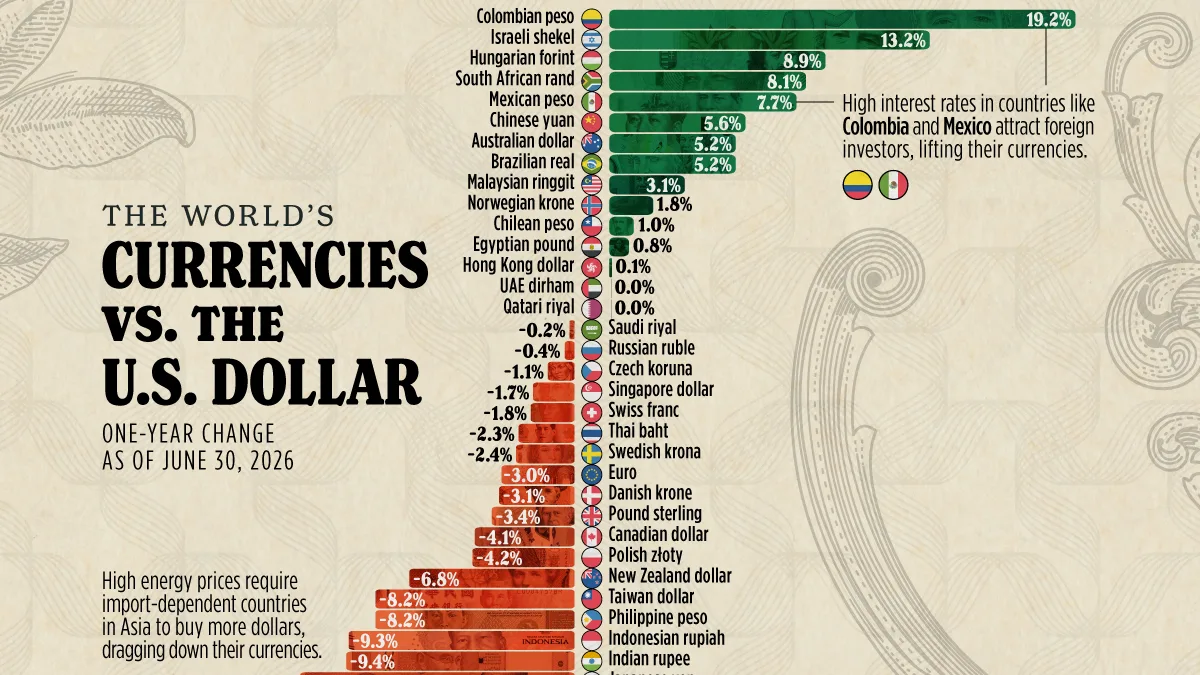
- The Colombian peso leads 36 currencies, gaining 19.2% against the U.S. dollar over the past year.
- Latin America spans both extremes of the ranking, with a 38.1 percentage-point gap between Colombia and Argentina.
- Six Asian currencies rank among the eight biggest decliners, amid pressure from higher energy import costs.
Currency markets have produced some striking winners and losers over the past year, with gains and declines approaching 20% against the U.S. dollar.
This graphic ranks the one-year performance of 36 major currencies through June 30, 2026, based on data from Deutsche Bank. The results highlight sharp regional contrasts, particularly across Latin America and Asia.
The Colombian Peso Has Appreciated the Most
Colombia sits well ahead of the rest of the ranking. Its peso gained 19.2% against the U.S. dollar over the past year, six percentage points more than the second-place Israeli shekel.
| Currency | June 2026 One-Year Change |
|---|---|
 Colombian peso Colombian peso |
19.2% |
 Israeli shekel Israeli shekel |
13.2% |
 Hungarian forint Hungarian forint |
8.9% |
 South African rand South African rand |
8.1% |
 Mexican peso Mexican peso |
7.7% |
 Chinese yuan Chinese yuan |
5.6% |
 Australian dollar Australian dollar |
5.2% |
 Brazilian real Brazilian real |
5.2% |
 Malaysian ringgit Malaysian ringgit |
3.1% |
 Norwegian krone Norwegian krone |
1.8% |
 Chilean peso Chilean peso |
1.0% |
 Egyptian pound Egyptian pound |
0.8% |
 Hong Kong dollar Hong Kong dollar |
0.1% |
 UAE dirham UAE dirham |
0.0% |
 Qatari riyal Qatari riyal |
0.0% |
 Saudi riyal Saudi riyal |
-0.2% |
 Russian ruble Russian ruble |
-0.4% |
 Czech koruna Czech koruna |
-1.1% |
 Singapore dollar Singapore dollar |
-1.7% |
 Swiss franc Swiss franc |
-1.8% |
 Thai baht Thai baht |
-2.3% |
 Swedish krona Swedish krona |
-2.4% |
 Euro Euro |
-3.0% |
 Danish krone Danish krone |
-3.1% |
 Pound sterling Pound sterling |
-3.4% |
 Canadian dollar Canadian dollar |
-4.1% |
 Polish złoty Polish złoty |
-4.2% |
 New Zealand dollar New Zealand dollar |
-6.8% |
 Taiwan dollar Taiwan dollar |
-8.2% |
 Philippine peso Philippine peso |
-8.2% |
 Indonesian rupiah Indonesian rupiah |
-9.3% |
 Indian rupee Indian rupee |
-9.4% |
 Japanese yen Japanese yen |
-11.3% |
 South Korean won South Korean won |
-12.6% |
 Turkish lira Turkish lira |
-14.6% |
 Argentine peso Argentine peso |
-18.9% |
The Israeli shekel gained 13.2%, while the Hungarian forint, South African rand, and Mexican peso round out the top five. Higher interest rates can make currencies more attractive to foreign investors seeking higher yields, increasing demand for the local currency.
Latin America contains both the ranking’s biggest winner and biggest loser. While Colombia’s peso gained 19.2%, Argentina’s fell 18.9%, creating a striking 38.1 percentage-point gap between the two currencies.
Asian Currencies Are Falling Against the Dollar
Asia dominates the bottom of the ranking, accounting for six of the eight weakest currencies shown. The South Korean won fell 12.6% against the dollar, while the Japanese yen declined 11.3%.
One factor is the region’s dependence on imported energy. Higher energy prices raise import costs and demand for dollars, putting pressure on currencies in countries such as Japan, South Korea, and India.
Japan and South Korea, for instance, have energy self-sufficiency rates of just 13% and 19%, respectively.
Why Some Currencies Barely Move Against the Dollar
Four currencies have moved by less than 0.2% against the dollar: the Hong Kong dollar, UAE dirham, Qatari riyal, and Saudi riyal.
This stability is largely by design. All four are pegged or closely tied to the U.S. dollar, limiting exchange-rate fluctuations. For Gulf economies, dollar pegs are particularly significant because oil exports, the backbone of their economies, are predominantly priced in dollars.
As a result, some of the most stable currencies in the ranking are not outperforming the dollar. They are designed to move with it.
Learn More on the Voronoi App
To learn more about this topic, check out this graphic on the world’s biggest reserve currencies.