Ranked: The Biggest Risks to the U.S. Economy in 2026
Key Takeaways
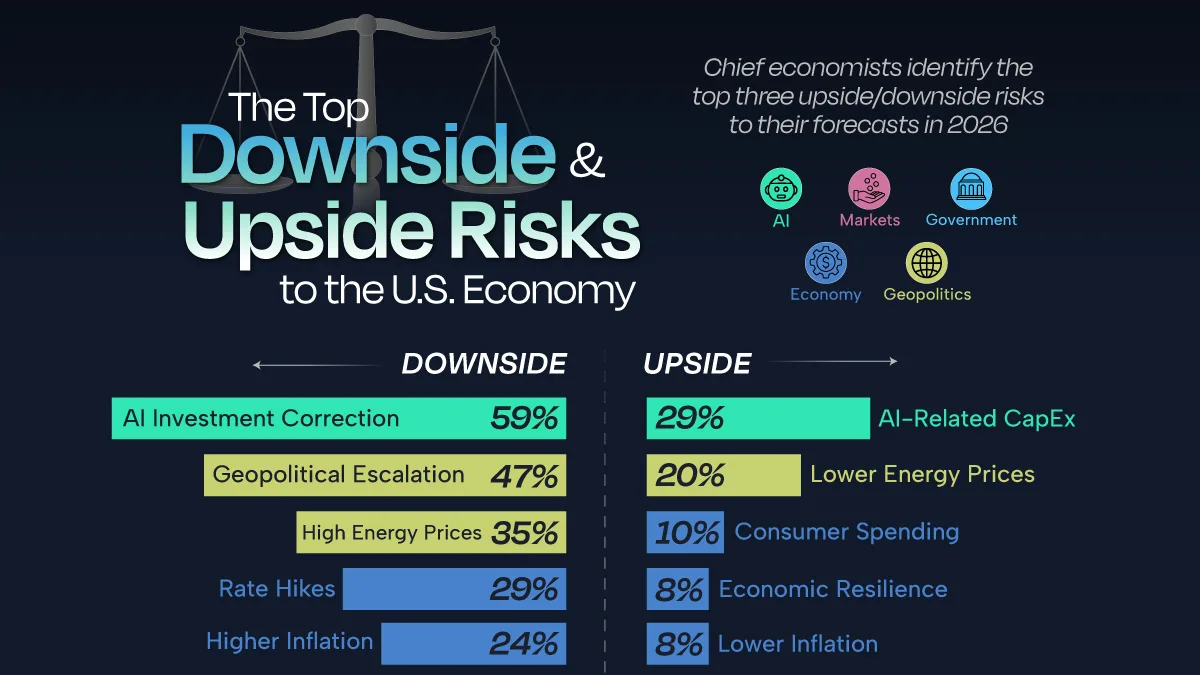
- 59% of economists cite an AI investment correction as a downside risk, making it the top threat to the 2026 U.S. economic outlook.
- AI also ranks as the biggest potential upside, with 29% citing continued AI-related capital investment.
- Beyond AI, geopolitical escalation (47%) and higher energy prices (35%) rank among the biggest threats to the outlook.
Few forces loom as large over the 2026 U.S. economic outlook as AI investment.
While economists see a potential pullback in AI spending as a major threat, continued investment could also provide a boost to growth.
This graphic ranks the top upside and downside risks to U.S. economic forecasts in 2026, based on SIFMA’s midyear survey of chief economists at U.S. financial institutions.
AI Correction Leads the Downside Risks
A correction in AI investment stands out as the biggest concern, cited by 59% of respondents.
| Downside Risk | Share of Respondents (H1 2026) |
|---|---|
| AI Investment Correction | 59% |
| Geopolitical Escalation | 47% |
| Higher Energy Prices | 35% |
| Rate Hikes | 29% |
| Equity Market Drop | 24% |
| Higher Inflation | 24% |
| Market Stress | 18% |
| Weak Labor Market | 18% |
| Fiscal Spending Cuts | 12% |
| Elections | 12% |
| Tariffs/Trade | 12% |
The scale of recent AI spending helps explain the concern. Capital expenditures by Amazon, Google, Meta, Microsoft, and Oracle reached $412 billion in 2025, equivalent to 1.3% of U.S. GDP.
At that scale, AI spending is no longer just a technology-sector story. A slowdown in data centers, computing equipment, and related infrastructure could reduce business investment and weigh on economic growth.
The remaining risks largely point to higher costs. Geopolitical escalation ranks second at 47%, while higher energy prices (35%) could squeeze household budgets and business margins. Rate hikes (29%) would make mortgages, loans, and business investment more expensive.
AI Also Tops the Economic Upside
Despite leading the downside ranking, AI also represents economists’ biggest potential source of upside for the U.S. economy.
| Upside Risk | Share of Respondents (H1 2026) |
|---|---|
| AI-Related CapEx | 29% |
| Lower Energy Prices | 20% |
| Consumer Spending | 10% |
| Economic Resilience | 8% |
| Lower Inflation | 8% |
| Strong Employment | 8% |
| Productivity Gains | 6% |
| Fiscal Policy | 4% |
| Equity Market Strength | 4% |
| Lower Rates | 4% |
The economic bet is that today’s enormous AI investments eventually translate into higher productivity. In the meantime, spending on AI infrastructure is supporting business investment and economic activity.
Tech investment has accounted for 25% of real U.S. GDP growth since 2023, with its contribution accelerating sharply through early 2026.
For Americans, the other upside scenarios would hit closer to home. Lower inflation and energy prices would leave households with more money to spend elsewhere, while strong employment would support incomes and lower rates would make mortgages and other borrowing cheaper.
The U.S. Economy’s Growing Bet on AI
Taken together, the rankings highlight how important AI investment has become to the 2026 economic outlook.
If the boom continues and delivers broader productivity gains, it could remain an important engine of growth. If spending reverses sharply, however, the same investment supporting the economy today could become a source of weakness.
Learn More on the Voronoi App
To learn more about this topic, check out this graphic on business AI adoption by state in 2026.