Ranked: Countries With the Highest Senior Poverty Rates
Key Takeaways
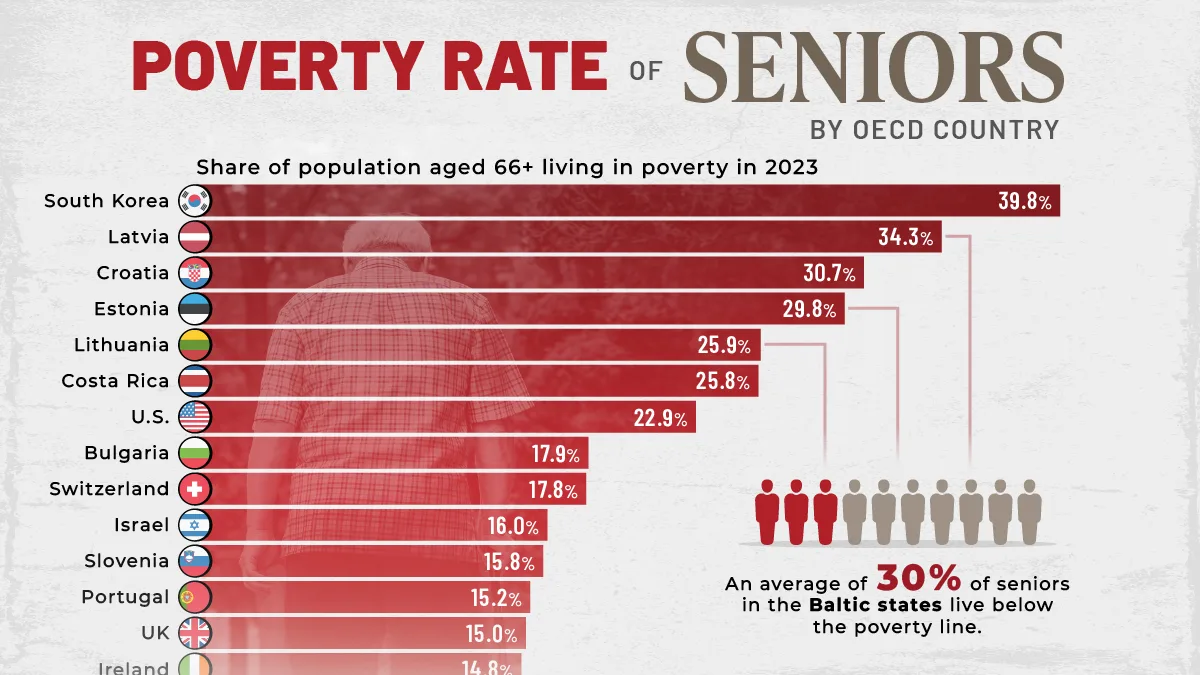
- South Korea has the highest senior poverty rate of any OECD country, with nearly 40% of seniors living below the poverty line.
- The Baltic states have an average senior poverty rate of 30%, with Latvia ranking second overall.
- The U.S. ranks seventh, with 22.9% of people aged 66 and older living below the poverty line.
Senior poverty differs significantly across OECD economies, with several countries reporting rates above 20% while others remain below 5%.
This visualization ranks OECD countries by the share of people aged 66 and older living below the poverty line in 2023. The poverty line is defined as half the median household income of the total population, meaning the measure is relative to living standards within each country.
The data for this visualization comes from the OECD Income Distribution Database. It presents 2023 data, the latest available as of August 2026, covering OECD member countries as well as Bulgaria, Croatia, and Romania, which are currently in the accession process.
South Korea Has the Highest Senior Poverty Rate in the OECD
With 39.8% of people aged 66 and older living below the poverty line, South Korea stands out as the clear outlier among OECD countries.
The data table below shows the share of seniors who live below the poverty line in OECD countries:
| Rank | Country | Living Below the Poverty Line (%, Aged 66+) |
|---|---|---|
| 1 |  South Korea South Korea |
39.8 |
| 2 |  Latvia Latvia |
34.3 |
| 3 |  Croatia Croatia |
30.7 |
| 4 |  Estonia Estonia |
29.8 |
| 5 |  Lithuania Lithuania |
25.9 |
| 6 |  Costa Rica Costa Rica |
25.8 |
| 7 |  United States United States |
22.9 |
| 8 |  Bulgaria Bulgaria |
17.9 |
| 9 |  Switzerland Switzerland |
17.8 |
| 10 |  Israel Israel |
16.0 |
| 11 |  Slovenia Slovenia |
15.8 |
| 12 |  Portugal Portugal |
15.2 |
| 13 |  United Kingdom United Kingdom |
15.0 |
| 14 |  Ireland Ireland |
14.8 |
| 15 |  Germany Germany |
14.5 |
| 16 |  Spain Spain |
13.1 |
| 17 |  Austria Austria |
12.3 |
| 18 |  Italy Italy |
12.3 |
| 19 |  Romania Romania |
12.3 |
| 20 |  Greece Greece |
11.5 |
| 21 |  Poland Poland |
10.9 |
| 22 |  Canada Canada |
10.1 |
| 23 |  Hungary Hungary |
10.1 |
| 24 |  Sweden Sweden |
7.3 |
| 25 |  France France |
6.2 |
| 26 |  Luxembourg Luxembourg |
5.9 |
| 27 |  Belgium Belgium |
5.4 |
| 28 |  Finland Finland |
4.8 |
| 29 |  Slovakia Slovakia |
4.7 |
| 30 |  Netherlands Netherlands |
4.6 |
| 31 |  Czechia Czechia |
3.6 |
| 32 |  Norway Norway |
3.2 |
One factor behind South Korea’s high senior poverty rate is the relatively recent development of its public pension system. Established in 1988, the system left many of today’s oldest residents with limited time to accumulate sufficient pension entitlements.
South Korea’s senior poverty rate is also much higher than its overall poverty rate of 14.9%, while the child poverty rate is even lower at 8.5%.
South Korea’s senior poverty rate is 5.5 percentage points higher than Latvia’s, the next-highest country in the ranking.
Baltic Countries Rank Near the Top
Latvia, Estonia, and Lithuania all appear near the top of the ranking.
An average of 30% of seniors in the three Baltic states live below the poverty line, well above the 14.8% average across the 32 countries in the dataset.
Latvia ranks second overall at 34.3%, while Estonia ranks fourth at 29.8% and Lithuania ranks fifth at 25.9%.
More Than One in Five American Seniors Lives in Poverty
The United States had the seventh-highest senior poverty rate among OECD countries at 22.9%, placing it between Costa Rica and Bulgaria in the ranking.
Despite the country’s high overall wealth, more than one in five U.S. seniors lived in households with incomes below half the national median. Poverty rates in the U.S. also vary significantly by state.
At 22.9%, the U.S. rate is roughly eight percentage points above the 14.8% average across the 32 countries in the dataset. It is also higher than the rates in the UK (15.0%), Germany (14.5%), Italy (12.3%), and the other G7 countries shown.
Senior Poverty Rates Are Below 5% in Several OECD Countries
At the other end of the ranking, five countries had senior poverty rates below 5%. Norway had the lowest rate at 3.2%, followed by Czechia at 3.6%, the Netherlands at 4.6%, and Slovakia at 4.7%.
South Korea’s 39.8% senior poverty rate was more than 12 times Norway’s 3.2%. Seven countries in the ranking had rates above 20%, while nine had rates below 8%.
Because the OECD measure is relative to each country’s median income, these differences reflect how seniors fare within their own national income distribution rather than absolute differences in living standards between countries.
Learn More on the Voronoi App
If you found this topic interesting, read Working Hours Needed to Exit Poverty in OECD Countries on Voronoi.