
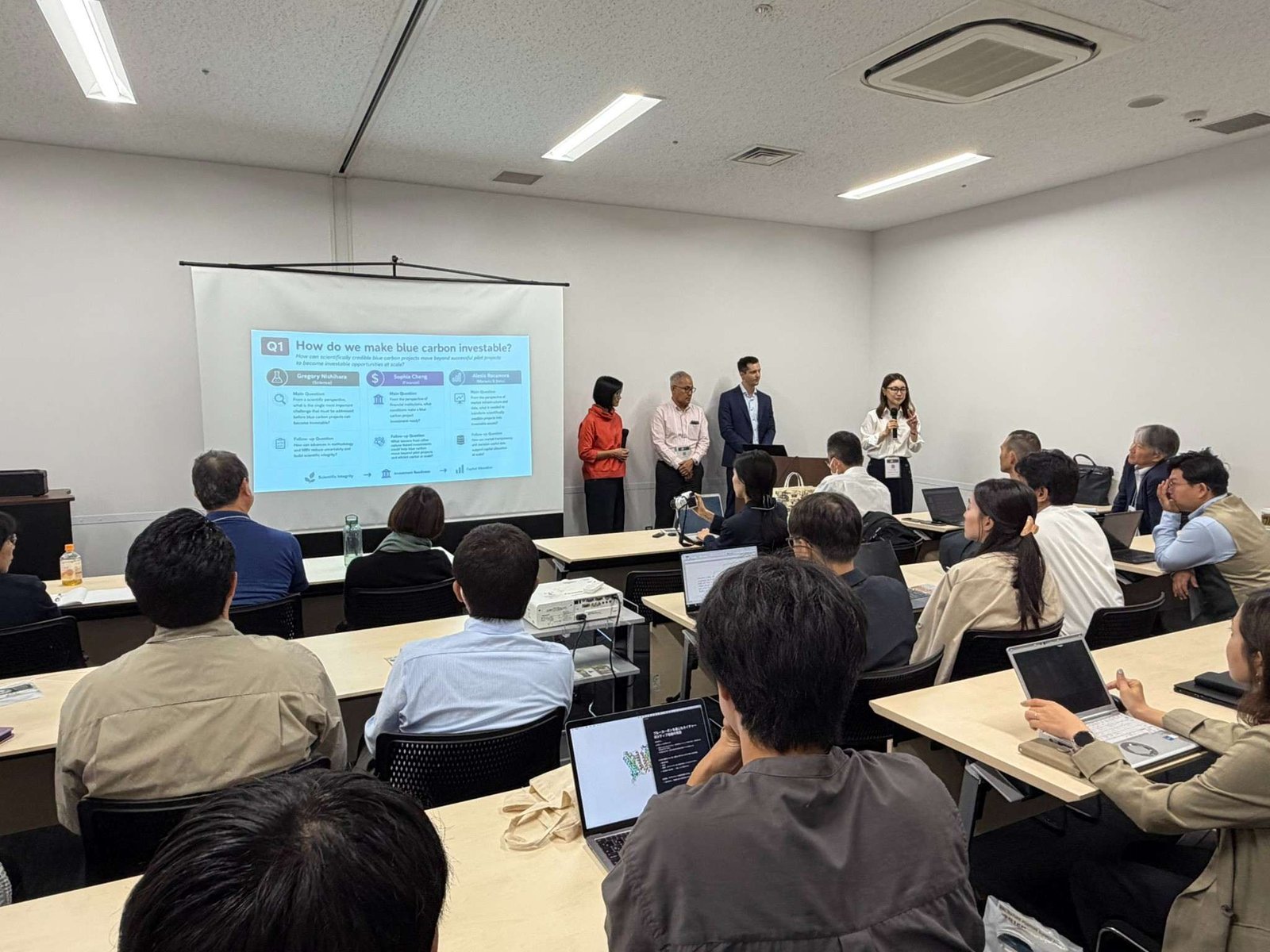
How can blue carbon move beyond individual conservation projects and become part of a scalable nature-positive financial system?
This question was at the heart of an official side event at the Global Nature Positive Summit 2026 (GNPS 2026), in Kumamoto, Japan, where researchers, financial institutions, and market experts came together to explore what it would take to turn the ecological value of coastal and marine ecosystems into credible investment opportunities.Blue carbon offers a compelling starting point. Coastal and marine ecosystems can contribute to climate mitigation while also supporting biodiversity and other ecosystem functions. But recognizing these values is one thing; translating them into investment decisions is another. To do that credibly, science, data, and finance need to work together.
That interdependence became clear throughout the session, “Operationalizing Nature Positive Finance through Blue Carbon: From Local Ecosystems to Scalable Investment Frameworks.”
Professor Gregory N. Nishihara of Nagasaki University opened the discussion from a scientific perspective, examining the carbon dioxide removal potential of blue carbon ecosystems and the challenges involved in identifying and quantifying carbon originating from seaweed. His contribution underscored a fundamental point: credible finance begins with credible measurement. Before environmental claims can be translated into financial value, we need to understand what is being measured and how confidently the results can be verified.
Sophia Cheng, Senior Advisor at Cathay Financial Holdings, approached the challenge from the perspective of financial institutions. Drawing on examples of blue finance and Nature-based Solutions (NbS), she explored the mechanisms that can help nature-related projects become viable investment opportunities.
Alexis R. Rocamora, Head of Sustainable Finance, APAC at LSEG Data & Analytics, brought a third perspective: the role of data and market infrastructure. For investors to act, data needs to be consistent, comparable, and meaningful for financial decision-making. This raises questions about common standards, metrics, benchmarks needed, as well as how information can be used beyond individual projects to assess risks and opportunities across portfolios.

I moderated the discussion from the perspective of Future Earth F&E KAN and Nagasaki University, connecting these perspectives around two central questions: How can we make blue carbon investable? And how can we make it scalable?
The discussion pointed to a clear message: scaling nature-positive finance requires more than creating new financial products or carbon credits. Scientific credibility, market transparency and finance need to develop together. Credible science and measurement provide the foundation; data and disclosure make nature-related risks and opportunities visible to markets; and financial mechanisms help translate this information into capital allocation.
Blue carbon provides a practical test case for a much broader challenge facing nature-positive finance. The long-term opportunity is not simply to create a niche market for individual blue carbon projects, but to develop systems in which the value of healthy ecosystems can increasingly inform economic and investment decisions.
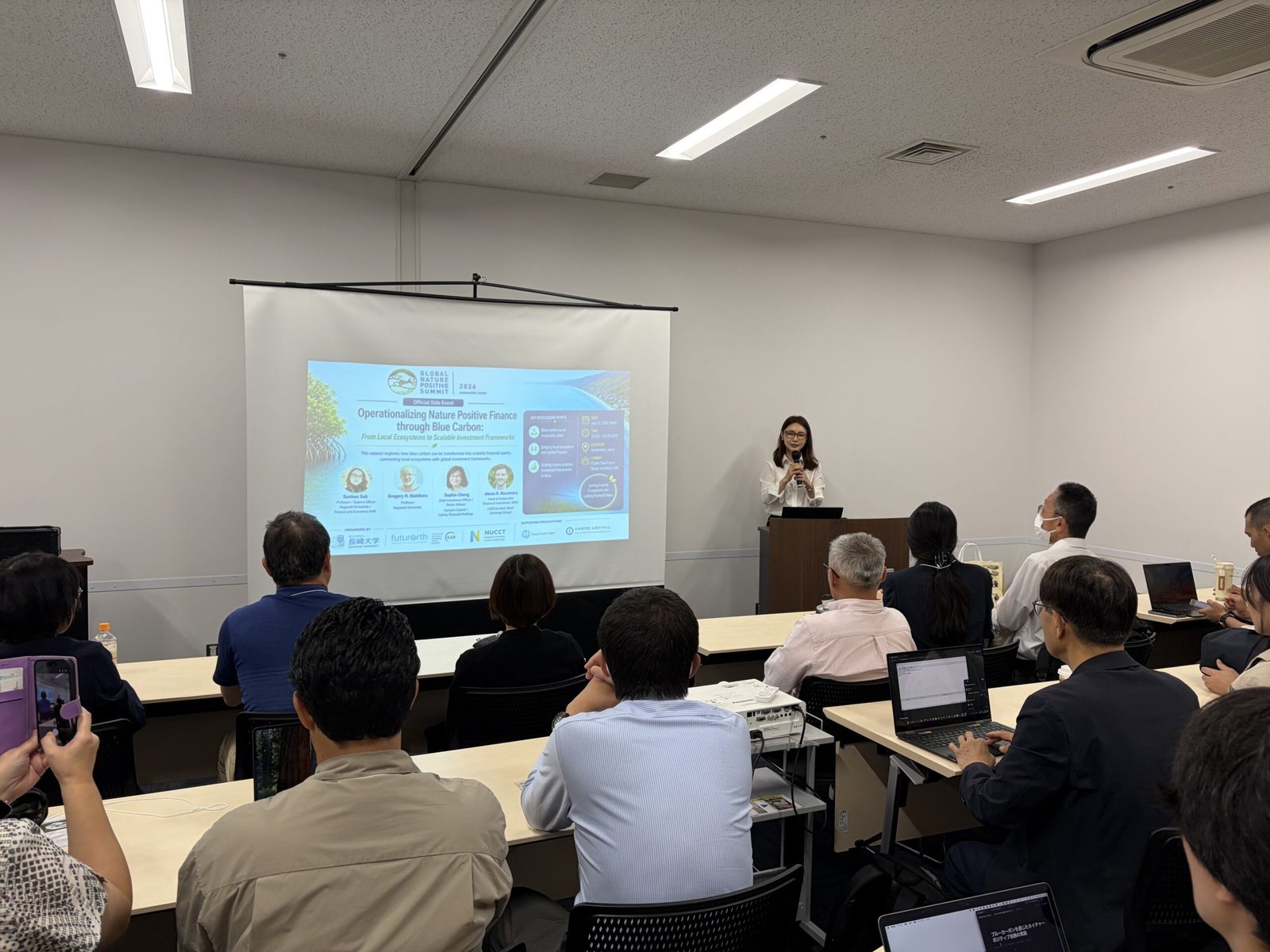
The side event was organized by Nagasaki University, the Future Earth Finance and Economics Knowledge-Action Network (F&E KAN), and the Nagasaki University Carbon Credit Team (NUCCT), with support from Future Earth Taipei and the Center for Sustainability Science, Academia Sinica. Bringing these communities together was itself part of the experiment: what happens when scientific knowledge, financial expertise, and market infrastructure are considered as parts of the same system?
Related information
Nagasaki University report on the Global Nature Positive Summit 2026 and NATURE TECH!


