

Researchers from the University of L’Aquila in Italy have designed a reversible Carnot battery (R-CB) integrating a heat pump (HP) and Organic Rankine Cycle (ORC)-based units.
Their concept leverages the complementary operation of both systems: the reversible heat pump can deliver heating or cooling depending on seasonal demand, while the ORC system enables the recovery and conversion of low-grade thermal energy into electricity.
ORC is a thermodynamic process that generates electricity by using an organic working fluid with a low boiling point to convert low-temperature heat sources into mechanical work, which is then transformed into electrical power. Compared with the conventional Rankine cycle, it is better suited for low- and medium-grade heat recovery applications because the working fluids can efficiently vaporize at relatively low temperatures, enabling effective energy conversion from waste heat sources such as industrial exhaust, geothermal energy, or solar thermal systems.
Carnot batteries are systems that store electricity in the form of heat, using storage media such as water or molten salts, and convert the stored heat back into electricity when needed. This category includes liquid air energy storage (LAES) systems and Brayton– or Rankine-based pumped thermal energy storage (PTES) systems. It also includes Lamm-Honigmann storage, a sorption-based technology that can be charged and discharged using both heat and electricity, as well as systems combining resistive heating with power cycles.
These storage technologies can support a broad range of applications in power systems, including energy arbitrage, ancillary services and peak shaving. Depending on the technology and system configuration, Carnot batteries may also provide opportunities for sector coupling by integrating industrial waste heat or supplying useful heat alongside electricity.
“The system is described as reversible because the heat pump and ORC share the same components but operate them in opposite ways,” the research’s lead author, Fabio Fatigati, told pv magazine. “In heat pump mode, during the charging phase, the two heat exchangers operate as the condenser and evaporator, respectively. Their functions are reversed in ORC mode during the discharging phase, when they operate as the evaporator and condenser.”
During heat pump operation, corresponding to the charging phase, surplus PV electricity powers the compressor, which drives the working fluid through a reverse thermodynamic cycle. The heat pump extracts thermal energy from a low-temperature source and transfers it to a high-temperature storage medium, typically pressurized water in a tank. In this way, surplus PV electricity is converted into thermal energy and stored in the tank.
“When electricity is required, the stored thermal energy is used to drive the system in ORC mode, effectively reversing the heat pump operation,” Fatigati explained. “During this discharging phase, the rotating machine operates as an expander rather than a compressor. The working fluid expands through the machine to generate electricity, which can supply the load when PV generation is unavailable or insufficient.”
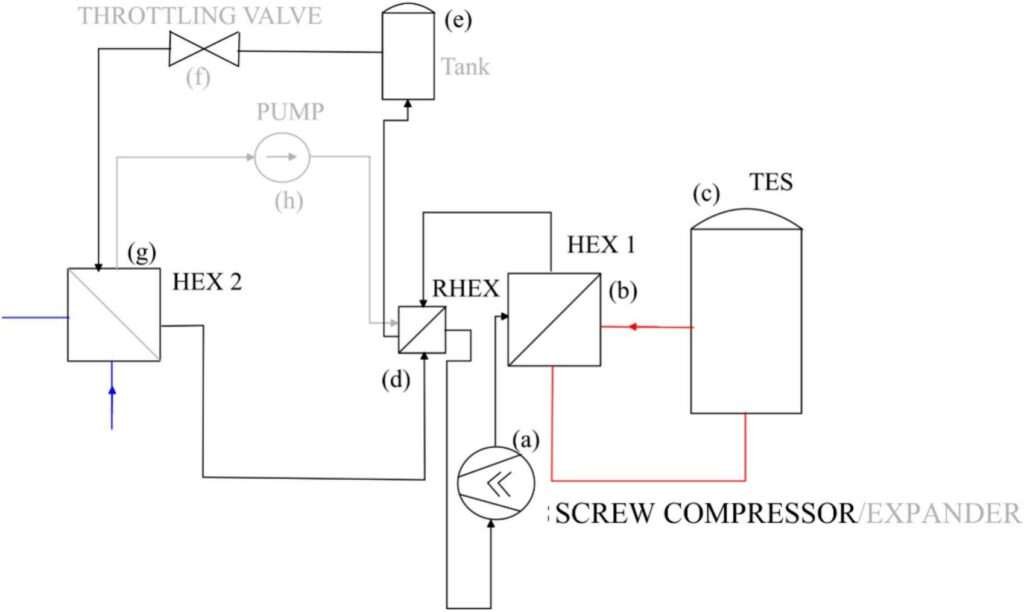
The system was designed to use R1233zd(E) as the working fluid and a Bitzer OSK5361-K reversible screw machine, operating as a compressor in HP mode and an expander in ORC mode. The heat pump delivers 4 kW to 31 kW of thermal output, with compressor power ranging from 1.6 kW to 5.1 kW. It operates with heat-source temperatures of 50 C to 90 C and heat-sink temperatures of 60 C to 110 C, with a temperature lift of 10 K to 25 K.
The heat pump reaches a maximum coefficient of performance (COP) of 9.5 at a temperature lift of about 15 K. During discharge, hot water from the pressurized hot-water tank supplies heat to the ORC, reversing the functions of the main heat exchangers and volumetric machine. In ORC mode, the system receives 24 kW to 67 kW of thermal input, while the reversible screw expander produces 0.3 kW to 3.7 kW of electricity. A recuperative heat exchanger is used in both operating modes to recover internal heat and preheat the working fluid, improving overall cycle performance.
The heat pump and ORC sections have dedicated control systems. In heat pump mode, surplus PV electricity available after meeting the load is used to power the compressor and charge the thermal energy storage system. The heat pump controller adjusts compressor torque according to the available PV surplus and imposed compressor speed. During discharge, the ORC operates with heat supplied by the hot-water tank, whose water temperature progressively decreases from 110 C to 70 C. The ORC controller therefore targets a constant 10 C superheating at the expander inlet, a condition identified as favorable for expander efficiency.
The resulting control strategy enables stable HP charging and ORC discharging despite variations in PV surplus and tank temperature, according to the research team.
“We validated the model comparing the theoretical prediction and experimental data founds in literature,” Fatigati said, noting that the assessment considered a reversible HP-ORC Carnot battery coupled with a 60 m² residential PV system in central Italy. The analysis focused on January, when surplus PV power was mainly available between 06:00 and 15:00 and used to charge a pressurized hot-water tank. Capacities of 8,000, 12,000 and 16,000 liters were tested, with the 8,000-liter tank selected because it reached the target temperature of 100 C.
The analysis showed that, during discharge, increasing the hot-water flow rate from 20 to 30 liters/minute raised stored surplus electricity from 2 kWh to 4 kWh, while improving round-trip efficiency from 22% to 26% and exergy efficiency from 16.4% to 19.8%. Further optimization showed that reducing the ORC expander speed slows tank depletion and extends operating time. At 1,000 rpm, the system accumulated around 5 kWh after nine hours of ORC operation and was able to cover the entire electricity load. At this speed, ORC efficiency approached 7%, while round-trip efficiency reached 35% and exergy efficiency 26%.
“The system’s performance improves as the expander speed is reduced,” Fatigati explained. “In particular, lowering the expander speed from 1,900 rpm in the baseline case to 1,000 rpm enables the reversible Carnot battery, when integrated with an energy storage system, to fully meet the daily electricity demand, with 1.5 kWh of residual energy remaining at the end of the discharge period. Reducing the expander speed from 2,000 rpm to 1,000 rpm also approximately doubles both the round-trip efficiency and the exergy efficiency.”
“As a further development, we are evaluating the impact of PV panel installation and system configuration on overall performance, as well as extending the analysis to the entire year,” he concluded. “Thanks to the model’s high accuracy and reliability, we can perform detailed dynamic analyses and assess potential improvements to individual system components.”
The system was presented in “Model-based optimisation of a reversible heat pump-Organic Rankine cycle Carnot battery for residential applications,” published in Energy Conversion and Management.
The post Heat pump-Carnot battery system for residential PV storage appeared first on pv magazine Global.


