
Tesla is moving deeper into autonomous transport and energy as it prepares to launch its purpose-built Cybercab robotaxi and rebuild its residential solar business around batteries.
Three recent developments show the shift. Tesla is preparing to launch the Cybercab in Austin; Nevada regulators have approved a limited 10-vehicle robotaxi operation, and the company is reshaping its solar business around its Powerwall 3 home battery.
For the clean energy market, the story goes beyond electric cars. Tesla is increasingly combining electric mobility, solar power, and energy storage into a single business model.
Cybercab Moves Closer to Commercial Launch
Tesla appears to be nearing the launch of its Cybercab, a purpose-built electric vehicle designed for autonomous ride-hailing. The EV giant plans to launch the Cybercab in Austin, Texas, on September 3. The company has already tested Cybercabs on public roads and begun preparing for the rollout.
The Cybercab differs from Tesla’s current robotaxi vehicles because it was designed specifically for autonomous operation. That could make it more important to Tesla’s long-term strategy than simply adding self-driving software to existing vehicles.
Tesla has already identified the Cybercab as part of its future autonomous mobility business. The company’s latest annual filing states it is developing a purpose-built Robotaxi. This effort aims to expand its autonomous driving capabilities.
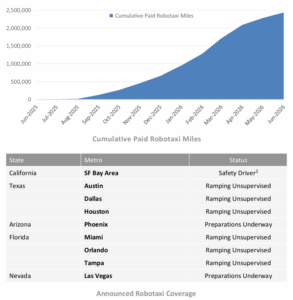
The company reported almost 2.5 million cumulative paid robotaxi miles driven as of June 2026. If Tesla scales the service, electric robotaxis could lower emissions per passenger trip. This is especially true when they use cleaner electricity, compared to traditional gasoline cars.
The climate impact will depend on a few factors. It hinges on how much the vehicles are driven, the electricity used for charging, and whether autonomous ride-hailing replaces private car trips or creates more trips.
Nevada Gives Tesla a 10-Car Autonomous Test
Tesla has also gained regulatory progress in Nevada, although the initial approval is far smaller than the company wanted. Nevada regulators approved Tesla to operate 10 robotaxis in a limited area. The company had sought approval for as many as 5,000 vehicles in Clark County.
The permit limits the initial operation to a defined geographic area. That makes the approval more of a test than a full commercial rollout.
Still, regulatory approval gives Tesla another market in which to test its autonomous technology. The company will need to show that its vehicles can operate safely and reliably before regulators are likely to allow a much larger fleet.
For Tesla, that scale-up matters. A successful robotaxi network could turn electric vehicles from products that consumers buy into a mobility service that generates recurring revenue.
Tesla Puts Solar on a New Battery-First Track
Tesla’s other major shift is happening in solar. Its residential solar business has declined for years since Tesla absorbed SolarCity in 2016.
Electrek reports that Tesla is now trying to rebuild the business around its own solar panels and Powerwall 3, while moving away from the Solar Roof product.
Tesla’s Solar Roof never reached large-scale adoption. Electrek says the company installed about 3,000 Solar Roofs in the U.S. by the end of 2022. This is around 0.17% of all residential solar setups that year.
The new strategy puts more focus on conventional solar panels paired with batteries. That fits Tesla’s wider energy business because customers can generate electricity during the day, store it, and use it later.
Tesla says Powerwall can store solar energy for use at night or during power outages. The model could also help households reduce their reliance on grid electricity and increase their use of renewable power.
Batteries Emerge as Tesla’s Energy Star
While residential solar has struggled, Tesla’s energy storage business has grown much faster.
Tesla’s 2025 annual report shows that energy generation and storage revenue rose 27% to $12.77 billion in 2025. Energy storage deployments reached 46.7 GWh, up from 31.4 GWh in 2024.
The business also became more profitable. Tesla reported $3.80 billion in gross profit from energy generation and storage in 2025, compared with $2.64 billion in 2024. Its gross margin rose from 26.2% to 29.8%.
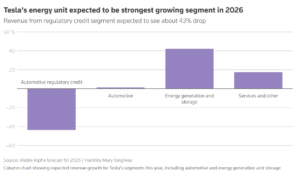
That makes energy storage an increasingly important part of Tesla’s business. The company is expanding beyond household batteries with Megapack, its utility-scale battery system.
The EV maker says more than 77 GWh of Megapack capacity is operational globally, with projects operating in more than 65 countries.
Megapack can store electricity when renewable generation is high and release it when demand rises. This helps grids use more solar and wind power without relying as heavily on fossil-fuel plants during periods of peak demand.
From Robotaxis to Powerwalls: Tesla’s Bigger Energy Play
These three developments may look unrelated, but they point toward a common strategy.
- Cybercab targets electric transportation. Solar produces renewable electricity. Powerwall and Megapack store that electricity.
Together, they create a broader clean energy ecosystem.
Tesla’s own filings describe energy storage as a way to improve the use of existing generation and transmission capacity. The company also says its storage products can support grids as electricity demand rises.
That becomes especially relevant as electricity demand grows from electric vehicles, data centers, and industrial electrification. Large batteries can help shift electricity from periods of high renewable generation to periods when demand is higher.
For carbon markets, this matters because greater renewable generation and storage can help reduce fossil fuel use in power systems. Yet, battery deployment itself does not automatically create carbon credits. The emissions benefit depends on the electricity sources the batteries charge from and the grid services they provide.
Tesla Stock Slips as Investors Watch the Transition
Tesla shares were down on August 26 from the previous session. The TSLA stock was around $345.62 in overnight trading early on August 27. The modest decline came even as Tesla moved forward with its robotaxi plans and energy strategy.
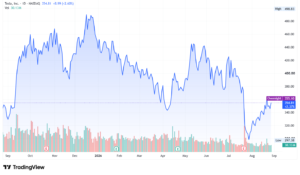
Investors continue to weigh the firm’s large spending on autonomous driving and AI against the growth of its energy business and the potential for new revenue from robotaxis.
Tesla’s stock remains highly sensitive to expectations around autonomous vehicles, rather than only its traditional car business.
The Bigger Clean Energy Story
Tesla’s latest moves show a company trying to expand beyond selling electric cars. The Cybercab could turn electric vehicles into an autonomous transport service. The Nevada permit gives Tesla a small but important regulatory test.
Meanwhile, the solar business is shifting toward a simpler solar-plus-battery model, while energy storage is already producing billions of dollars in annual revenue.
If Tesla can continue scaling batteries while adding renewable generation and autonomous electric transport, it could build a much broader clean energy platform.
The key question is whether the automaker can turn its growing mix of electric vehicles, robotaxis, solar and batteries into a scalable system that cuts emissions while also creating durable growth.
- READ MORE: Tesla’s (TSLA Stock) $10.1 Billion Solar Factory in Texas Signals a New U.S. Manufacturing Push
The post Tesla’s Cybercab, Robotaxi Push and Solar Pivot Point to a Broader Clean Energy Play appeared first on Carbon Credits.


