Seattle-based Carbon Robotics is aiming to become a publicly traded company as it continues to scale its laser weeding and tractor autonomy business.
The firm, which passed the $100 million revenue mark in the year to March 2026, is also developing an as-yet-unannounced machine—also in the ag robotics field—and says it may raise additional capital to grow its tractor autonomy platform.
While there is potential to move into different industries, the company does not need to diversify beyond agriculture to build a sizable business, says founder and CEO Paul Mikesell, pointing to a market of thousands of laser weeders a year and potentially 30,000–40,000 tractors annually for its autonomy technology.
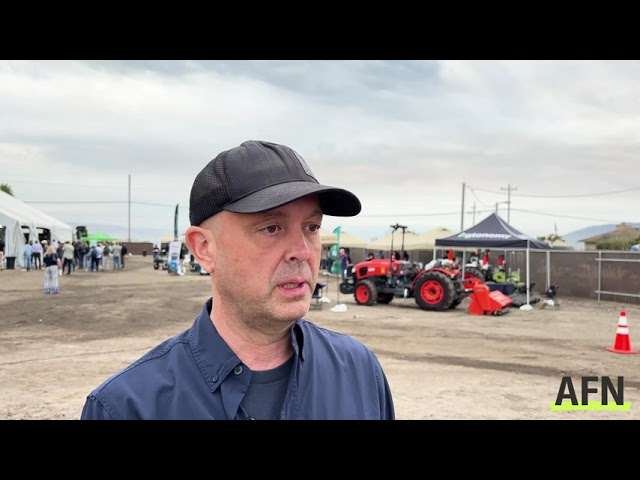
AgFunderNews (AFN) caught up with Mikesell (PM) at the inaugural Ruggedize ag robotics conference at Reservoir Farms in Salinas to discuss Carbon’s path toward an IPO, the economics of laser weeding, and its autonomy program.
AFN: Can you share an update on your revenues and plans?
PM: Last year, we crossed over $100 million in revenue and we intend to keep scaling from there. It’s our intention to get to the point that we’re an independently publicly traded company, so that would involve going through an IPO. That’s the path that we’re on.
Do we need to have our technology into other things beyond agriculture? I don’t think we need to. There may be a thing we’ll do at some point, particularly on the autonomy side, but it’s not our focus right now. And I think there is plenty of room to make a completely independent, publicly traded company in agriculture. And that’s coming. That’s our goal.
AFN: What’s your addressable market?
PM: The addressable market in terms of number of machines would be thousands of machines a year. And then on the autonomy side, we’re talking probably 30 to 40,000 tractors per year. That’s kind of where we’re going to get to, and so there is a lot of room for us to grow.
We are currently available in about 20 countries around the world, and we’re seeing the most traction in the United States, and then Western Europe, and Australia is pretty strong also. Laser weeders work in all the major growing regions where there’s a lot of vegetables grown.
AFN: How has your offering evolved?
PM: We came out with our second generation G2 LaserWeeder early last year, and we now have multiple sizes of machines. So the smallest would probably be [suitable for farms of] about 50 acres, and then the largest [ones make sense for] farms [that] are hundreds of thousands of acres, and anything in between.
The design of the G2 is more modular, which allows us to fit weeding modules onto a bar, and create something that’s of the appropriate size for the farmer.
There is another machine that we’re building that is independent from that that we haven’t announced yet. But it’s still in the ag space.
AFN: You’re also building new autonomy systems for tractors?
PM: We’re moving pretty quickly in our autonomy systems as well, so we make an autonomous tractor product, and that is where we’re starting to think about raising some [additional] money to continue to expand that product line [following the recent $20 million Series D extension].
It takes an existing tractor and converts it to a completely autonomous system [via advanced perception that combines camera, radar, and lidar inputs with software to create fully autonomous tractor operations]. And so that’s not just for laser weeding, but also for tillage, for cultivation, for irrigation, anything you might want to do.
AFN: Where’s the ROI coming from?
PM: A lot of it is reduced labor, and then a lot of it is if you’re using herbicides today instead of applying herbicides, running a laser weeder has dramatic yield improvements. So 30 or 40, 50% yield improvement in the same field, and that comes from not spraying, which knocks back the crops. And even just not having hand labor in the field will also mean more crops with more vigor because people stepping around and herbicides obviously damage crops.
So dramatic yield improvements [from using laser weeding] have been documented time and time again through university studies and other grower experiences.
The other thing that happens is because you’re not knocking the crops back, they’ll come up two weeks earlier, and so that means you get to market earlier. You have a jump on the market. It means that you’re using less water and less fertilizer also to grow those crops, because again you’re not beating them up as they’re trying to grow.
So a lot of the benefit, a lot of the value comes from yield improvement and getting to market earlier, and higher quality crops overall.
We’ve also been doing things like helping folks go from transplants to direct seeding. Transplanting can cost a lot of money, and if you can direct seed, it’s a much cheaper way to go. But a lot of places they can’t do that because of weed pressure. They wind up having the transplant after the crop is big enough to handle herbicide spray. But instead [with laser weeding], you can just direct seed. We keep the crops clean, and then that saves a lot of money as well.
AFN: How quickly can farmers using the LaserWeeder expect to see a payback?
PM: It should certainly be in less than three years, but our fastest paybacks are less than a year.
AFN: Does the hefty price tag put customers off?
PM: The machines were so successful that we started getting more and more customers and eventually, the banks were coming to us saying, Okay, how do we help finance these things because we understand what this machine is, we see the residual value and we understand there’s a resale value. We’d like to help these farmers get access to them. So once you hit that point, it becomes easier.
Now some of these banks are doing things like writing an operating lease for LaserWeeders. With an operating lease, you don’t have to put capital up front; you just pay a certain amount every month, and then as long as you’re making more money than that off the benefits from the LaserWeeder, you’re cash positive immediately.
AFN: Talk a bit about what you’ve learned about the business model that works for you…
PM: Going through a dealership to do something like service and support puts you one step removed from your customer. And we just didn’t like that model at all. We want to feel like if the customer has something wrong, something they need, if a farmer or a grower has something they need to understand better, we want them to communicate with us directly, rather than a sort of hands-off approach.
AFN: Doesn’t selling direct restrict the speed with which you can grow in international markets?
PM: In international markets, we do the same [direct sales] model. So everywhere that we have LaserWeeders, we have our own sales force and we have our own support team, and those people are on the ground in the region.
A lot of them came from a farming background in the region, so they know the crops, they know the soil type, they know the farmers, and so that works really well for us.
Further reading:
🎥 ‘The whole system is now more investable’: Reservoir makes the case for ag robotics
Castoro Cellars deploys Saga Robotics’ UV-C bots across 600 organic acres
The post 🎥 Carbon Robotics: $100m+ revenue, new machine and a path to IPO appeared first on AgFunderNews.
- Source: https://agfundernews.com/%f0%9f%8e%a5-carbon-robotics-100m-revenue-new-machine-and-a-path-to-ipo