

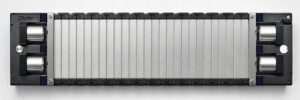
hofer powertrain has built a battery module that varies the mechanical preload on each cell in operation, a value normally fixed by the module’s physical design. How much pressure, or preload, a cell sees affects how quickly it ages, and hofer powertrain says holding it in the right range can extend how long a cell maintains its performance.
The module uses a freely programmable force map that lets the pressure on the cells change with the operating condition instead of staying constant. That turns a fixed mechanical design parameter into one the battery system can actively control.
The work draws on more than five years of hofer powertrain research and a range of customer projects that studied how cell preload, breathing, swelling and deformation change the cycle life and performance of different cells. To measure those effects the company built programmable test equipment that records parameters including a cell’s deformation, temperature, voltage, capacity and impedance under defined charge and load profiles, and it says the readings flag early which mechanical constraints suit a given cell technology. The method has already been applied to cell technologies including NMC, LFP and next-generation solid-state cells.
No single ideal pressure works for every cell. Too little or too much can accelerate degradation, hofer says, and cell chemistry, format, state of charge, temperature and operating profile have to be treated as one system.
University of Cambridge research found that carefully controlled mechanical loading can significantly reduce the aging of lithium-ion cells, and that under certain test conditions the service life of the cells tested was significantly extended. The company puts the potential of its own approach at up to double the cycle life at double the energy density, an assessment it bases on current NMC and solid-state cells. How much of that gain appears, it adds, depends on the cell technology, operating profile and initial system design.
Applications extend beyond conventional EVs to commercial vehicles, stationary storage, marine and future aviation and aerospace systems. The mechanics are especially relevant, hofer says, for solid-state cells in stationary storage, and for vehicle batteries that support vehicle-to-home (V2H) and vehicle-to-grid (V2G) operation, which can demand many charge and discharge cycles.
Source: hofer powertrain


