
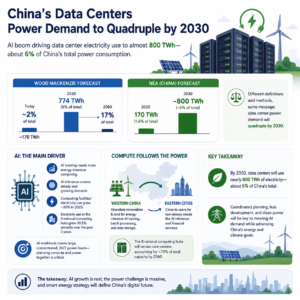
China’s data centers could quadruple their electricity use to 774 terawatt-hours (TWh) by 2030, as artificial intelligence (AI) drives a rapid increase in computing demand.
The forecast comes from Wood Mackenzie’s “Rewiring China’s Grid for the AI Era” report. It says data centers could account for 6% of China’s total electricity use by 2030, up from about 2% today. Their share could rise to 17% by 2060.
China’s government sees a similar trend. The National Energy Administration (NEA) says computing facilities used about 170 billion kilowatt-hours, or 170 TWh, in 2025, equal to 1.6% of national electricity use. The NEA expects computing power demand to reach about 800 TWh by 2030, or around 6% of national electricity use.
The small difference between the 774 TWh Wood Mackenzie estimate and the NEA’s 800 TWh forecast reflects different definitions and methods for measuring data center and computing electricity use. Yet, both point to the same sharp rise in demand.
AI Turns Computing Into a Power-Hungry Business
AI is the main force behind the expected increase. Wood Mackenzie says AI training needs more energy-intensive computing systems. At the same time, AI inference is creating a steady stream of electricity demand as businesses and consumers use AI services more often.
The NEA reported that China’s computing facilities increased their electricity use by about 30% in 2025. Electricity use at the eight national computing hubs has jumped by 39.5% each year over the last three years. This growth is much quicker than the overall electricity demand in the country.
This fast growth is changing power planning. Data centers need reliable electricity around the clock. AI workloads can also create large and concentrated power loads. That means China needs to plan computing capacity and electricity supply together.
Data Centers Are Coming for 6% of China’s Power
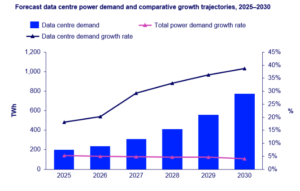
Wood Mackenzie expects data centers to account for 6% of China’s total power consumption by 2030. By 2060, that share could reach 17%. The figures show how quickly computing could become a major part of China’s energy system.
China’s government is already preparing for this shift. The country’s 15th Five-Year Plan calls for coordinated development of computing infrastructure and green electricity.
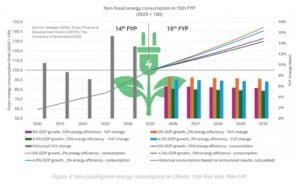
The government also wants stronger links between computing demand and the power system. Recent policies encourage direct renewable power supply for computing facilities and better use of flexible computing loads. This could help China meet AI demand without relying solely on new fossil-fuel generation.
The New Rule: Compute Follows the Power
Data centers have traditionally followed customers. They often cluster around large cities and technology centers where businesses, workers, and network connections are available.
AI could change that model.
Wood Mackenzie expects more “compute follows power” development, especially for workloads that do not need instant results. Western China has large renewable energy resources and available land. That makes the region attractive for energy-intensive AI training, batch processing, and data storage.
Eastern cities will still matter for applications that need fast connections. These include AI inference and financial services. This could create a split between eastern computing centers and western regions with greater power availability.
Wood Mackenzie expects China’s eight national computing hubs to remain the main centers of data center capacity through 2060. The hubs could account for more than 70% of total capacity.
Can Clean Power Keep AI’s Carbon Footprint in Check?
More electricity demand does not automatically mean equal growth in emissions. The key factor is the source of the power.
Wood Mackenzie expects data center carbon emissions in China to peak by 2035 as renewable power expands and green power requirements become stricter.
China already has a huge renewable energy base. By June 2026, the country had over 4 billion kilowatts in total power generation capacity. This included more than 2.4 billion kilowatts from renewable sources, as reported by the NEA.
The world’s largest emitter is also expanding its green-power market. In July 2026, the NEA issued 306 million green electricity certificates, or green certificates, covering renewable energy projects. The country traded 54.68 million certificates during the month.
These systems can help data center operators use and track renewable electricity.
China Wants Computing and Power to Work Together
China is also testing ways to make data centers more flexible for power users. Wood Mackenzie says the following could allow some data centers to shift electricity use to periods when renewable power is plentiful, or prices are lower:
- Battery storage,
- Smarter power systems, and
- Intelligent workload scheduling
The NEA is pushing a similar idea. Government guidance calls for data centers in western regions to connect their development with large renewable energy projects. In eastern regions, the government wants closer links between distributed computing, distributed power, microgrids and virtual power plants.
China has also introduced rules for multi-user direct green power connections. The policy prioritizes computing facilities and other new industries. It requires participating projects to use storage and flexible loads to improve the local use of renewable power.
These steps could help data centers become more active participants in the power market instead of simply adding demand.
Grid Investment Will Be Critical
The scale of growth will require more than data centers and renewable projects. China will also need stronger transmission networks, energy storage, and grid control.
The NEA expects computing electricity use to add more than 100 billion kWh each year on average during the 2026–2030 period. By 2030, it expects computing facilities to consume about 800 billion kWh.
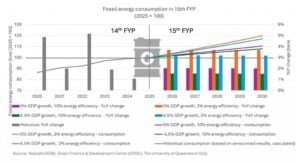
This growth comes as China’s wider electricity demand continues to rise from electric vehicles, industrial activity, and other new loads. That makes the location of new data centers increasingly important.
Building an AI facility where power is scarce can require expensive new grid investments. Building it near renewable generation may lower some of those costs, but operators still need reliable connections and high-quality power.
Carbon Markets Could Benefit from the Shift
China’s AI power boom could also create opportunities for the carbon market. Growing electricity demand can increase emissions when fossil fuels provide the extra power. Renewable energy, storage, and efficiency can reduce that carbon impact.
This could support demand for projects involving renewable power, energy storage, grid efficiency, and other emissions-reduction measures.
However, higher renewable power use does not automatically create carbon credits. Projects must meet the rules of the relevant carbon market and prove that they deliver eligible emissions reductions.
China already operates a national emissions trading system covering major power-sector emitters. As power demand from computing grows, stronger carbon pricing and emissions tracking could become more important.
AI Could Reshape China’s Energy System
Wood Mackenzie’s 774 TWh forecast shows the scale of China’s AI power challenge. China’s own forecast is close, with the NEA expecting computing electricity demand to reach 800 TWh by 2030.
With these estimates, the message is clear: AI is becoming a major part of China’s energy system. The country is responding by linking data center planning with renewable power, storage, and grid development.
For carbon markets and the clean energy industry, this creates both a challenge and an opportunity. The faster AI demand grows, the more important clean electricity and flexible power systems will become in keeping that growth from driving a matching rise in emissions.
The post China’s Data Center Power Demand Could Quadruple by 2030 as AI Boom Accelerates appeared first on Carbon Credits.


