

The Trump Administration is following Biden’s lead with major investments in a US-based lithium-ion battery supply chain and recycling capacity. But now comes a different approach—banning the export of lithium-ion battery waste when EV batteries are retired. This raises the question of whether the US has enough capacity to recycle these waste batteries. And what will happen to the minerals if we don’t? Domestic recycling capacity growth is important to spur local job creation, increase domestic mineral supply, and assure that battery recycling meets local environmental standards and isn’t polluting other countries. With many different approaches adopted by governments around the world, such as mandated recycling and mineral recovery, why are we hoping the market and controlled trade will solve the issue instead of tackling this through straightforward recycling requirements?
As of August 27, 2026, the US government banned export of black mass from the United States for one year to increase the recovery of critical minerals. Black mass is a powder substance from lithium-ion batteries that contains critical minerals such as cobalt, lithium, manganese, and nickel. While the ban can help build up the United States black mass recycling industry in the long term, our research demonstrates that there is currently an undercapacity. Without reconsidering this timeline and pairing it with complementary recycling requirements, this ban doesn’t do much to increase domestic recovery of minerals from our waste stream.
Lithium-ion battery recycling capacity in North America
Published in the Journal of Resource, Conservation, and Recycling, our research explores those questions. The research estimates lithium-ion battery recycling capacity in North America and whether this is enough to process batteries from our products in circulation, such as electronic devices, electric vehicles, and stationary storage, as well as from manufacturing losses. This is an important exploration when planning for the emission-reducing transition to electric vehicles and a renewable energy grid. Utilizing minerals from our recycling system has a much lower impact than newly mined ones but requires expansion.
Recycling of the critical minerals in these batteries can be split into two steps, with capacity allocated between them: pre-processing and black mass refining.
Pre-processing consists of breaking down the batteries. There are a wide variety of processing methods, but they can be categorized as shredding or smelting. Shredding is the preferred process due to smelting’s high energy consumption, increased emissions, and lithium loss. There is also variation in the shredding process used to separate the black mass. Some companies use pyrometallurgical processes, such as calcination or pyrolysis, to burn graphite and the binder, while others use chemical processes to separate the foils from the black mass. This pre-processing can be done in a separate facility from the black mass refining.
Black mass refining is also carried out using various processes, yielding different products. All these processes involve dissolving black mass in a reductant (typically hydrogen peroxide), then combining it with an acid (typically sulfuric acid) to recover the constituent minerals or recovering them in a combined form that can be used in battery cathode (electrolyte) manufacturing.
Our research demonstrates that North America’s current and planned capacity results in an overcapacity of pre-processing infrastructure but an undercapacity of black mass refining (see the figure below). The refining capacity isn’t large enough to handle the black mass inputs until 2030 and is estimated to be slightly over capacity until 2033. As of 2026, we estimate about 7,000 metric tons of black mass refining capacity, with 65,000 metric tons of black mass feedstock to be processed. The refining capacity is not public knowledge but was gathered from NaatBatt, Bloomberg, and other sources, with the remaining capacities estimated.
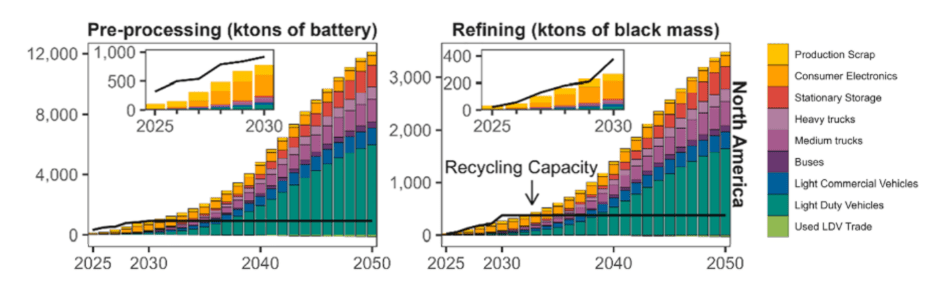
This forecast demonstrates that the export ban that went into effect for one year is not a realistic timeline for the industry to meet. While this order signals the US government’s ambition to increase recovery of critical minerals from batteries retired from use, the short implementation timeline doesn’t take into account that the United States = doesn’t yet have adequate infrastructure for this recovery, and this may dissuade real mineral recovery, which is not yet a requirement for lithium-ion batteries.
The companies that do have limited black mass refining capacity in the United States are likely to be in high demand and to charge a premium for black mass refining. While that may bring in additional funds to support current processing capacity, the ban is guaranteed for only one year and is therefore unlikely to spur increased outside investment and competition. The pre-processing companies that are unable to find a domestic processor for the black mass are left with the option of storing until the ban expires in a year (storage time limits vary based on whether it is a large or small processor), requesting an exception or adjustment from the Bureau of Industry and Security, or sending the materials to hazardous waste landfills.
Policy to build a domestic recycling industry
This type of export ban could be effective if set for several years in the future, allowing automakers and recyclers to plan and build US capacity for black mass processing. But this policy isn’t enough and 1) doesn’t consider that recycling of these batteries isn’t a requirement and 2) the black mass refined in the US doesn’t have to recover high rates of the critical minerals.
To effectively create a domestic recycling industry that increases US production of lithium-ion battery minerals, these other areas need to be addressed. The following policies are necessary inclusions.
Required recycling: Policy should require batteries to be recycled. Extended producer responsibility, such as the recently passed policy in Colorado or policy implemented in the European Union, requires the manufacturer of the product to ensure it is recycled and plan accordingly. In addition, for the export ban to be effective, the pre-processing must also be required to occur domestically.
Recovery rates: Recycling is only effective at promoting the reuse of minerals if the minerals are recovered. Mineral recovery from black mass currently depends on market prices, therefore, it is not undertaken if there is no profit. For example, while graphite is technologically viable to recover, it isn’t due to low market value. Lithium prices are also variable and therefore aren’t always recovered. Setting high recovery rates, as the European Union does, will ensure that the specified minerals are actually recovered.
Prioritizing domestic production: Domestic recovery can ensure that minerals aren’t processed and pollute in countries with lower environmental standards. As domestic recovery is prioritized, emissions from these facilities need to be monitored and reduced. The batteries contain PFAS, which can be released into the air, water, or product outputs. PFAS exposure is known to cause liver disease, kidney disease, reproductive issues, and cancer. PFAS is found throughout many products in our economy and, at this time, is not sufficiently controlled.
A better path forward
As we transition to an electric transportation system and a renewable energy grid, it is important to consider mineral sources and how we can reduce system-wide impacts. Recycling of lithium-ion batteries has the potential to create a domestic, lower-impact source of minerals. At this time, the US is attempting to build up this industry through grants, loans, and export bans. This is a partial solution that complements battery recycling requirements, mineral recovery requirements, and increased environmental controls. These solutions are modeled in the European Union and China. Further, states are taking on this issue with Colorado passing legislation earlier this year and efforts are ongoing in California. Without their implementation in the United States, we are likely to see minerals wasted and batteries improperly disposed of.


