

Verra has gained key backing for its Verified Carbon Standard (VCS) Version 5. The Integrity Council for the Voluntary Carbon Market (ICVCM) recognized VCS Version 5 as CCP-Eligible on September 2, 2026. The decision shows that the latest version of Verra’s program meets the ICVCM’s Core Carbon Principles (CCPs). These principles set a global standard for trustworthy carbon markets.
The decision is important. Verra runs the world’s largest voluntary carbon credit program. It has issued about 1.3 billion Verified Carbon Units (VCUs) across 2,579 VCS projects in 132 countries. This comes as the voluntary carbon market shifts to stricter rules on credit quality, transparency, and community protections.
However, the approval does not mean every VCS credit can now carry the CCP label. The ICVCM uses a two-step process. First, it assesses the crediting program. It then assesses the specific methodologies and credit categories used to generate credits.
Verra Raises the Bar for Carbon Credit Quality
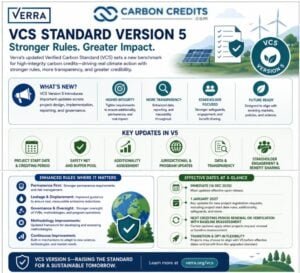
Verra launched VCS Version 5 in December 2025 as a major update to its carbon crediting rules. The new version aims to improve program integrity, usability, and climate impact. It also strengthens social and environmental safeguards and places more focus on the rights and role of local communities.
Verra developed the new version through three public consultations, which generated nearly 5,000 comments from around 200 respondents. The company says this was the highest response rate for a VCS program consultation.
- The updated rules cover the entire project lifecycle. They include project design, validation, monitoring, verification, and credit issuance.
Verra states that projects must create carbon credits that are additional, properly measured, durable, independently verified, traceable, and not double-counted. These requirements address some of the main concerns that have affected confidence in voluntary carbon markets.
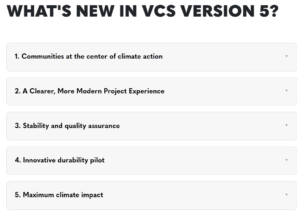
Community Safeguards Take a Bigger Role
One of the biggest changes in Version 5 is its focus on people living in and around carbon projects. Verra says the new rules strengthen protections for Indigenous Peoples and local communities. Projects must improve stakeholder engagement, assess social and environmental risks, and put safeguards in place.
The standard also calls for clearer financial transparency and fair benefit-sharing arrangements before projects begin. This is important because many carbon projects involve forests, farmland, or other land used by local communities.
A project may deliver a measurable climate benefit but still face serious concerns if it does not respect land rights or share benefits fairly. By putting these safeguards directly into the program rules, Verra is trying to make social performance a core part of credit quality rather than a separate add-on.
ICVCM Approval Comes With an Important Catch
The distinction between CCP-Eligible and CCP-Approved is critical.
The ICVCM first checks if a crediting program has good governance, transparency, tracking, third-party verification, and clear rules for measuring emissions reductions and removals. After that, it assesses the methodologies used to create different types of credits.
Only credits from a CCP-Eligible program and a CCP-Approved methodology may bear the CCP label. This means VCS Version 5’s new status strengthens the program, but buyers still need to check the methodology behind a specific credit.
That two-step system is designed to avoid assigning a single broad quality label to credits that use very different methods.
ICVCM Approves 13 Verra Methodologies
Alongside VCS Version 5, the ICVCM has approved 13 methodologies and one VCS Jurisdictional and Nested REDD+ Framework that are active in Verra’s program. The approved methodologies cover several project types, including:
- Afforestation, reforestation and revegetation, biochar, improved forest management, REDD+, cookstoves, rice production, landfill gas, renewable electricity and coal-mine methane.
The approved methodologies are the following:
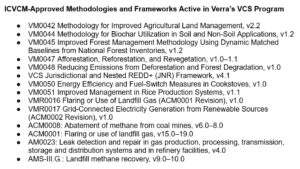
As of August 12, 2026, the ICVCM’s broader assessment program had approved 44 methodologies in total, per its assessment-status page. That means Verra’s approved methodologies now form a meaningful part of the CCP-approved market.
Version 5 Is Not Fully Mandatory Yet
Another important detail is timing. Verra launched VCS Version 5 in December 2025, but many of its project-level requirements do not become mandatory until January 1, 2027.
Verra fully operationalized Version 5 in June 2026 by publishing the updated templates and guidance needed for project developers. This allows projects to begin using the new system.
- Existing projects have transition paths, while new projects registering after January 1, 2027 generally must use Version 5 requirements.
- All existing projects must transition to Version 5 safeguard requirements after January 1, 2030. Some projects have a longer transition period.
This staged approach gives developers time to adapt while gradually moving the whole program toward the new rules.
Carbon Reversal Risk Gets a New Option
Version 5 also introduces a pilot for managing non-permanence risk. Land-based carbon projects can face the risk that stored carbon is released later through events such as fires, drought, or land-use changes.
Verra’s traditional system uses a pooled buffer approach to manage some of this risk. Version 5 allows a pilot using insurance or fund-based approaches as alternatives.
The goal is to give project developers more ways to protect against carbon reversals. Verra says this could help unlock more financing for projects that use these approaches.
The move is especially relevant for nature-based projects, where long-term storage remains one of the biggest concerns for carbon buyers.
Can Tougher Rules Restore Confidence in the VCM?
The ICVCM’s endorsement comes at a critical time for voluntary carbon markets. Buyers increasingly want proof that credits provide real climate benefits. They also want clearer information about project risks, community impacts, and how credits are measured.
The ICVCM created the CCP framework partly to address those concerns. It says the CCP label should make it easier for buyers to identify and price high-integrity credits across different standards and project types. That could help reduce confusion in a market where credits can vary widely in quality and price.
For Verra, the decision also provides external recognition of the changes it has made to its flagship standard. However, the approval does not eliminate the need for project-level scrutiny.
A CCP-eligible program includes many projects. Individual credits rely on the methodology, project design, monitoring, and verification used.
What It Means for Carbon Credit Buyers
For buyers, the new VCS status could make some Verra credits easier to evaluate. However, they still need to check whether the specific methodology and credit category have CCP approval. They also need to consider the project’s location, vintage, environmental risks, and social impacts.
This is especially important because Verra has a very large existing project base. Its program has issued about 1.3 billion VCUs, but those credits span many project types and years.
New Version 5 projects will face stricter rules, but existing projects will transition over time. That means the voluntary market will have a mix of credits operating under older and newer requirements for several years.
The market will need clear communication about those differences.
For the wider VCM, the next question is whether these stricter rules translate into more buyer confidence, better project practices, and greater demand for high-integrity credits.
The ICVCM approval is therefore more than a standards update. It is another step toward a carbon market where quality, transparency, and community protections play a larger role in determining which credits attract buyers and climate finance.
The post Verra Wins ICVCM Approval for VCS Version 5 as Carbon Market Integrity Tightens appeared first on Carbon Credits.


