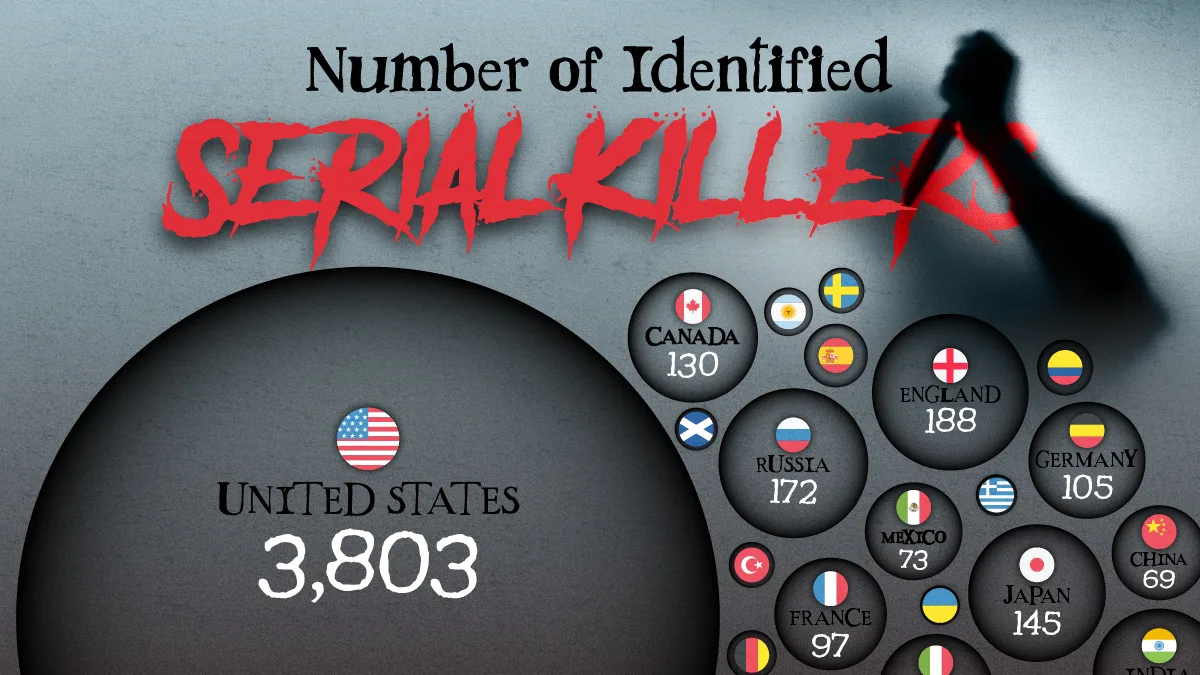
Ranked: Countries With the Most Serial Killers
Key Takeaways:
- The United States has 3,803 documented serial killers since 1900, accounting for 62.9% of the total in the dataset.
- No other country has 200 documented cases, with England (188) and Russia (172) ranking a distant second and third.
- Known U.S. serial killers have declined sharply: fewer than 50 were active in the 2010s, compared with nearly 300 in the 1970s.
The United States stands out dramatically in the 2026 Radford/FGCU Report on Serial Killer Statistics, which compiles identified serial killers by country.
These figures reflect documented cases rather than the true prevalence of serial murder. Differences in law enforcement, case classification, record accessibility, and reporting can significantly affect country totals.
The U.S. Dominates Documented Cases
The following table shows countries with at least 10 identified serial killers, excluding offenders whose crimes spanned multiple countries. Radford University defines a serial killer as an offender who commits the unlawful killing of two or more victims in separate events.
| Rank | Country | Identified Serial Killers | % of Serial Killers |
|---|---|---|---|
| 1 |  United States United States |
3,803 | 62.91 |
| 2 |  England England |
188 | 3.11 |
| 3 |  Russia Russia |
172 | 2.85 |
| 4 |  Australia Australia |
153 | 2.53 |
| 5 |  Japan Japan |
145 | 2.40 |
| 6 |  India India |
135 | 2.23 |
| 7 |  South Africa South Africa |
132 | 2.18 |
| 8 |  Canada Canada |
130 | 2.15 |
| 9 |  Germany Germany |
105 | 1.74 |
| 10 |  Italy Italy |
102 | 1.69 |
| 11 |  France France |
97 | 1.60 |
| 12 |  Mexico Mexico |
73 | 1.21 |
| 13 |  China China |
69 | 1.14 |
| 14 |  Brazil Brazil |
46 | 0.76 |
| 15 |  Poland Poland |
31 | 0.51 |
| 16 |  Spain Spain |
31 | 0.51 |
| 17 |  Hungary Hungary |
30 | 0.50 |
| 18 |  Austria Austria |
25 | 0.41 |
| 19 |  Colombia Colombia |
24 | 0.40 |
| 20 |  Netherlands Netherlands |
21 | 0.35 |
| 21 |  Belgium Belgium |
19 | 0.31 |
| 22 |  Czech Republic Czech Republic |
18 | 0.30 |
| 23 |  Argentina Argentina |
18 | 0.30 |
| 24 |  Sweden Sweden |
16 | 0.26 |
| 25 |  Türkiye Türkiye |
16 | 0.26 |
| 26 |  Thailand Thailand |
15 | 0.25 |
| 27 |  Scotland Scotland |
14 | 0.23 |
| 28 |  Nigeria Nigeria |
14 | 0.23 |
| 29 |  Pakistan Pakistan |
14 | 0.23 |
| 30 |  Greece Greece |
13 | 0.22 |
| 31 |  Kenya Kenya |
13 | 0.22 |
| 32 |  Iran Iran |
13 | 0.22 |
| 33 |  Ukraine Ukraine |
12 | 0.20 |
| 34 |  South Korea South Korea |
11 | 0.18 |
The gap between first and second place is enormous. The U.S. has 3,803 identified serial killers, more than 20 times England’s total of 188. Russia ranks third with 172, followed by Australia (153) and Japan (145).
This disparity does not necessarily mean Americans are inherently more likely to become serial killers. Radford University researcher Mike Aamodt has argued that U.S. cases are easier to identify and document because police, prison, and public records are relatively accessible.
As a result, these figures are best understood as a ranking of identified cases, not the true prevalence of serial murder. Countries with less accessible records may have cases that were never identified or documented. Similar measurement challenges affect comparisons of the world’s most dangerous countries, where results depend heavily on which crimes are measured and recorded.
Why Have Serial Killings Declined?
Serial killing in the U.S. peaked decades ago. Research cited by Northeastern University estimates that nearly 300 known serial killers were active during the 1970s, compared with fewer than 50 during the 2010s, a decline of more than 80%.
Several factors may explain the decline. DNA evidence, surveillance cameras, and improved information sharing between police departments have made it considerably harder for repeat offenders to remain unidentified across multiple crimes.
Changing social behavior may have played a role as well. Hitchhiking and other situations that left people isolated with strangers were more common during the peak decades. The decline also occurred alongside broader changes in violent crime, though homicide rates across regions show that lethal violence remains highly uneven around the world.
Other explanations remain debated. Author Caroline Fraser has explored environmental lead exposure as one potential contributor to the earlier surge in violent behavior, while criminologist James Alan Fox has emphasized factors including demographics, improved policing, and advances in forensics. No single theory fully explains the rise and subsequent decline.
Learn More on the Voronoi App
For another data-driven look at mortality, see The Top Causes of Death in the United States on the Voronoi app.