

Africa’s solar panel manufacturing capacity is set to increase to quadruple this year, according to a new report from thinktank Ember.
Ember’s latest report, developed in collaboration with Africa Tech Futures Lab, says solar panel manufacturing output will quadruple as 2 GW of manufacturing plants in Egypt and around 500 MW in Tanzania come online. Panel manufacturing capacity across a further six countries – Morocco, South Africa, Algeria, Tunisia, Nigeria and Kenya – is expected to reach around 1 GW.
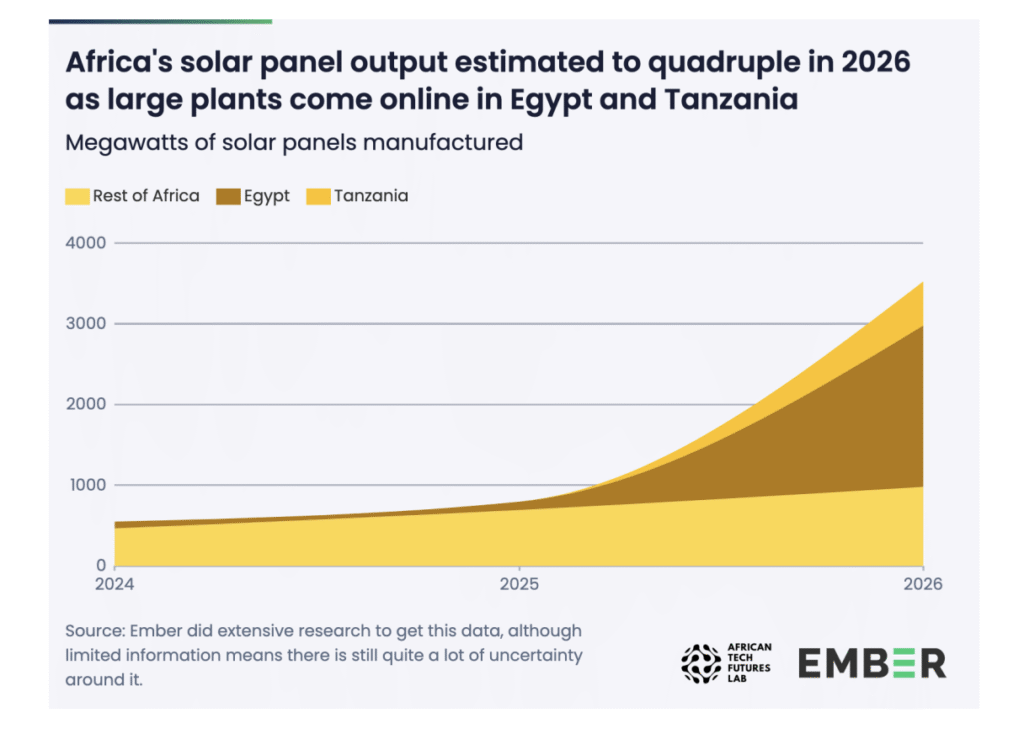
The report points out that data for assessing solar panel manufacturing capacity in Africa is extremely limited, with little publicly-available documentation.
Dave Jones, Ember chief analyst and co-author of the report, told pv magazine that Africa’s large-scale solar manufacturing factories in Egypt, Ethiopia and Tanzania are likely trying to keep a low profile to avoid unwanted attention from the US authorities, who are aiming to reduce solar imports into the country.
“However, many smaller solar manufacturing plants across Africa are increasing capacity, and although companies are keen to make press announcements, these announcements offer very little detail on manufacturing line capacity and even less on actual manufacturing volume,” he added.
The report adds that the new panel manufacturing capacity in Egypt and Tanzania is predominantly geared toward export to the US, where prices are much higher for Chinese panels due to US tariffs on Chinese goods.
While the other six mentioned countries are geared more towards supporting domestic growth, the report adds that up to 94% of the panels installed in Africa today are still imported from China.
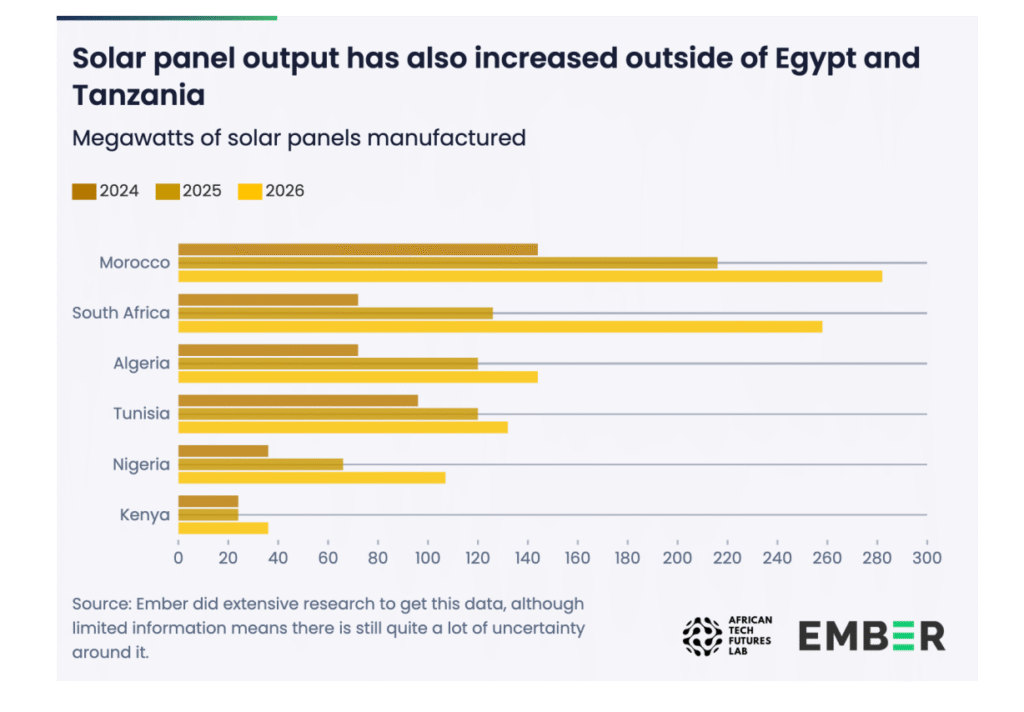
According to data from Ember’s China’s Solar PV Export Explorer, China imported 19 GW of PV cells and 9 GW of PV wafers into Africa in the the 2.5 years to June 2026. Over the same time period, Africa manufactured just 2.7 GW of PV panels.
“We think that, in a small part, this reflects the step-up in African solar manufacturing that will continue into late 2026 and beyond. But we think the majority would not actually be imported into the country, but rather re-shipped most likely to the US,” the report says. “Customs in most African countries do not report imports of cells and wafers, so there is no data there that helps to clarify.”
Upcoming changes to US tariffs, which are set to make imports of PV cells and panels more expensive from December this year, could reduce the ability of African nations to sell cells and panels into the US. The tariff changes follows China’s removal of its 9% export VAT earlier this year.
“This could mean solar panels end up being used domestically,” the report continues. “This would replace Chinese imports and ultimately mean Africa becomes more directly self-sufficient.”
Jones also told pv magazine that Chinese solar panels remain the biggest barrier to building solar supply chains in Africa.
“[Chinese panels] are extremely high quality and, at $80 or so a panel, fall into the ‘ridiculously cheap’ category,” he explained. “Africa imported just $2.4 billion of solar panels in the last 12 months, so the import bill is not big, and the value-add that countries can achieve will be small, so when countries consider solar, they need to do it in a cheap and long-term way.”
Jones added the complimenting clean technologies justify more urgency in terms of supply chains. The report highlights that Africa is already importing more dollars of batteries than solar panels from China, while Jones said that EVs, grid tech and wind turbines are also rising.
“African countries should be developing an overall cleantech industrial supply chain that seeks to leapfrog the old energy world of ‘import oil and gas, import cars, import power plants’,” Jones said.
Additional headline figures from the report indicate that a record 17 GW of solar will be installed in Africa this year, equivalent to around 100,000 solar panels a day, with a total 36 of Africa’s 54 countries on track to install a record amount of solar in 2026.
The report adds that three quarters of Africa’s solar growth is distributed solar, made up of small-scale customer-side PV systems installed mostly on rooftops. Of the estimated 26 GW of solar added in Africa between 2023 and 2025, the report says distributed solar accounted for 20 GW.
The post Africa’s solar panel manufacturing capacity to reach 3.5 GW this year appeared first on pv magazine Global.


