

The new Audi A2 e-tron will be capable of supplying power to homes and electrical appliances as the German brand embraces bidirectional charging for its most efficient electric vehicle yet.
Audi’s reborn compact hatchback will offer both vehicle-to-load (V2L) and vehicle-to-home (V2H) capability, allowing its battery to do more than simply power the car.
V2L enables the A2 e-tron to run appliances, tools, camping equipment or e-bikes through a power outlet in the luggage compartment or an adaptor connected to its external charging port.
READ MORE: Audi A2 e-tron revealed: Reborn compact EV offers up to 646km range, record efficiency and will lower the entry-price to electric Audis
READ MORE: Massive discounts! Overhauled Audi Q4 e-tron line-up reshaped with price cuts up to $18,168*
READ MORE: Full speed ahead! While Porsche Boxster EV hits reverse, reborn electric Audi TT powers on
V2H goes a step further by allowing electricity stored in the vehicle’s high-voltage battery to be transferred into a household electricity system through a compatible DC wallbox.
That could allow owners to store cheaper off-peak electricity or surplus power generated by home solar panels and use it later to run the house.
However, Audi has initially confirmed V2H operation only for Germany, Austria and Switzerland. Australian availability remains unconfirmed and would require compatible charging hardware and regulatory approval.
The A2 e-tron will permit V2H discharging while its battery state of charge is between 20 and 80 per cent.
If the battery falls below 20 per cent, the system will only allow it to charge. Above 80 per cent, it will only discharge until it returns to the nominated operating range.
An “Instant Charge” function allows owners to override the home-energy strategy and charge the battery to 100 per cent when maximum driving range is required.
Audi says energy discharged by the vehicle will be recorded and displayed as a virtual odometer, providing owners with a record of the battery’s use as a household energy source.
V2L operation also requires the battery to retain a minimum 20 per cent state of charge.
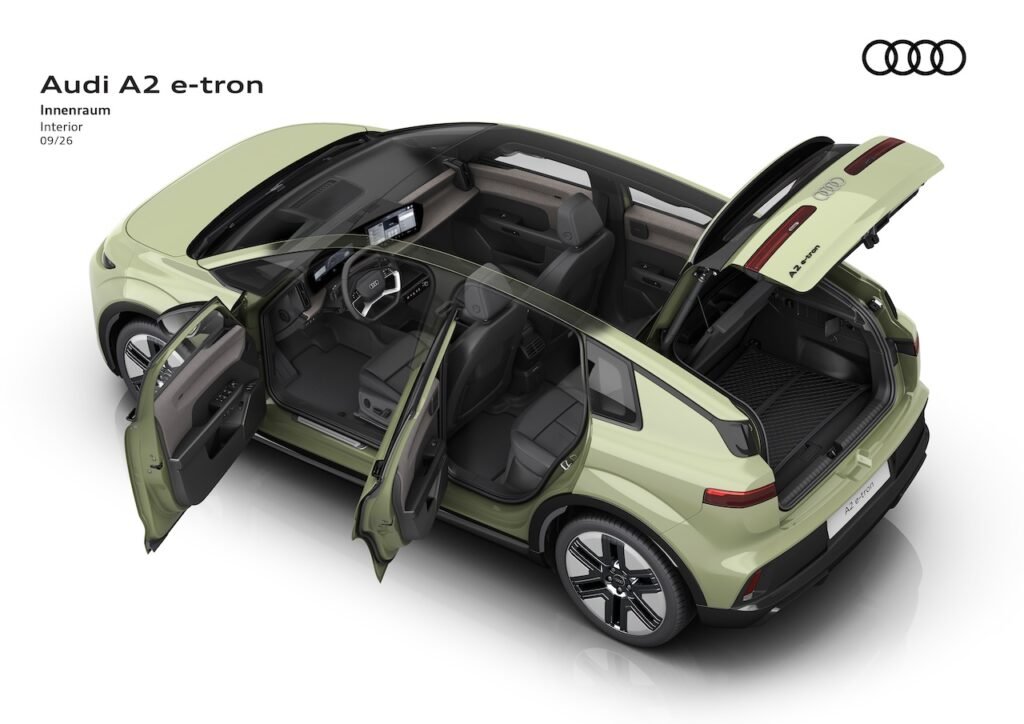
The bidirectional charging technology will be offered across an A2 e-tron range comprising three battery sizes and four rear-wheel drive powertrains.
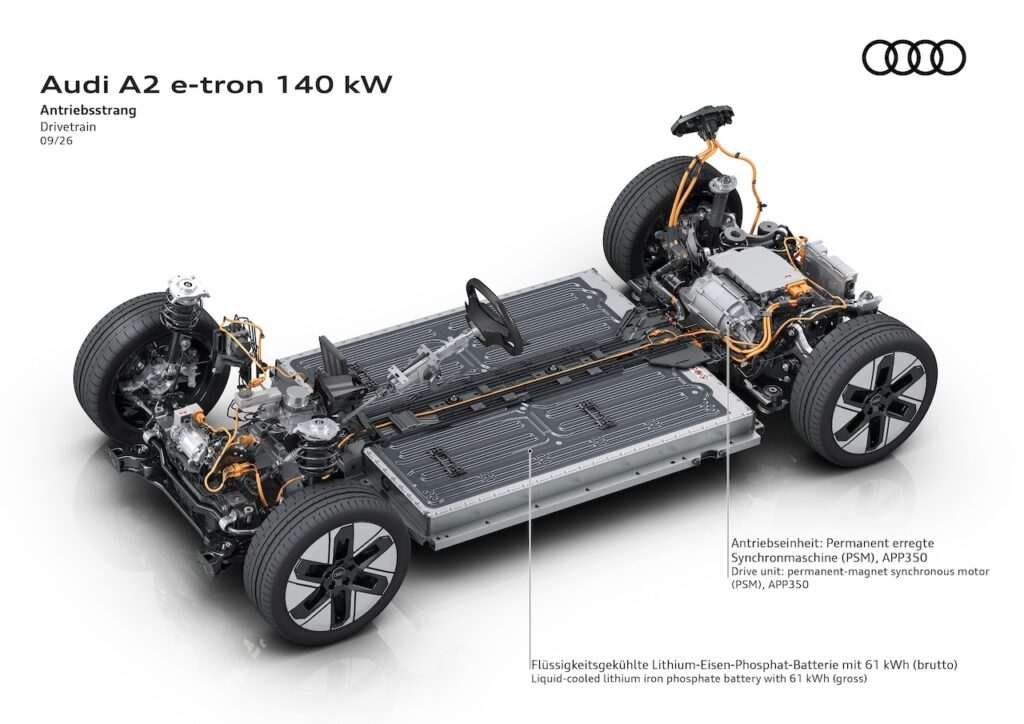
Entry-level versions use a 52kWh lithium iron phosphate battery, while the next step up receives a larger 61kWh LFP pack.
The two most powerful models adopt an 84kWh nickel manganese cobalt battery.
Audi has used a cell-to-pack design for the two LFP batteries, installing the cells directly into the battery housing rather than grouping them into separate modules.
The company says this increases packaging density while reducing the amount of space required by the battery.
The resulting lower battery height is claimed to improve rear legroom and seating position inside the compact EV.
The 84kWh NMC battery retains a more conventional modular construction and is reserved for the 170kW and 240kW A2 e-tron variants.
The 170kW model provides the longest driving range at up to 646km on the WLTP cycle, while the more powerful 240kW version claims 630km.
Both support DC fast-charging at up to 183kW and require a claimed 29 minutes to charge from 10 to 80 per cent.
The 52kWh battery accepts up to 100kW and completes the same recharge in 24 minutes. The 61kWh version increases peak charging power to 105kW and takes 26 minutes.
Those peak charging figures are modest compared with the fastest-charging new EVs, but Audi argues the A2 e-tron reduces the need for large batteries and extreme charging outputs by using energy more efficiently.
The most economical version is the 140kW A2 e-tron with the 61kWh battery and optional efficiency package.
It consumes a claimed 12.8kWh/100km on the WLTP test cycle, making it the most energy-efficient series-production Audi yet.
The same version has a claimed range of up to 515km, while the entry-level 125kW model combines its 52kWh battery with a maximum 423km range.
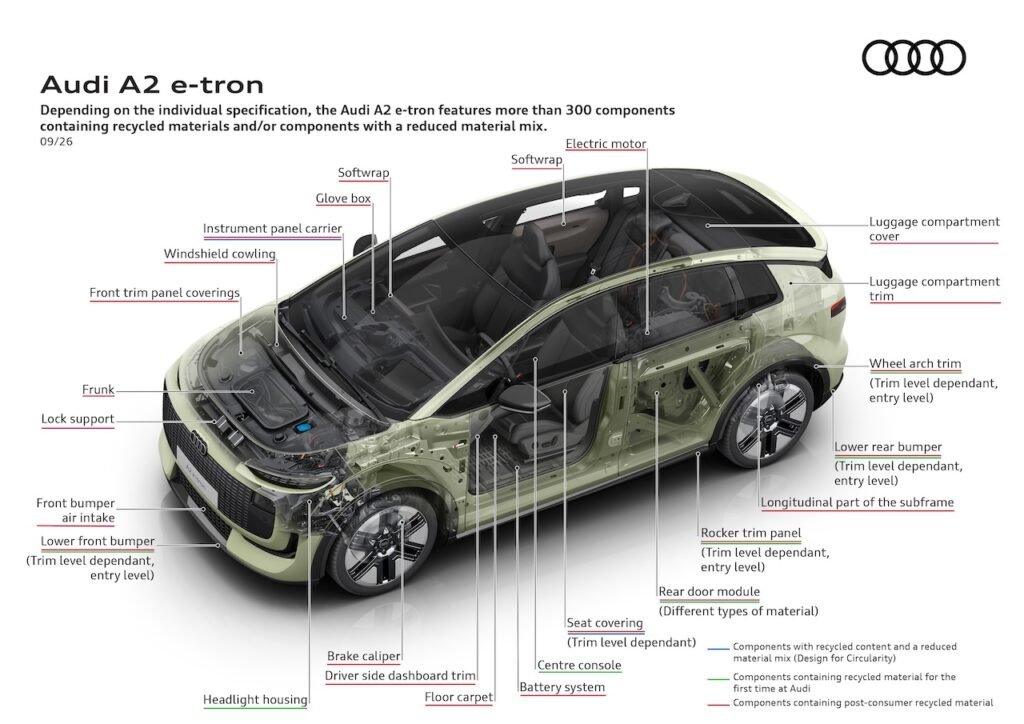
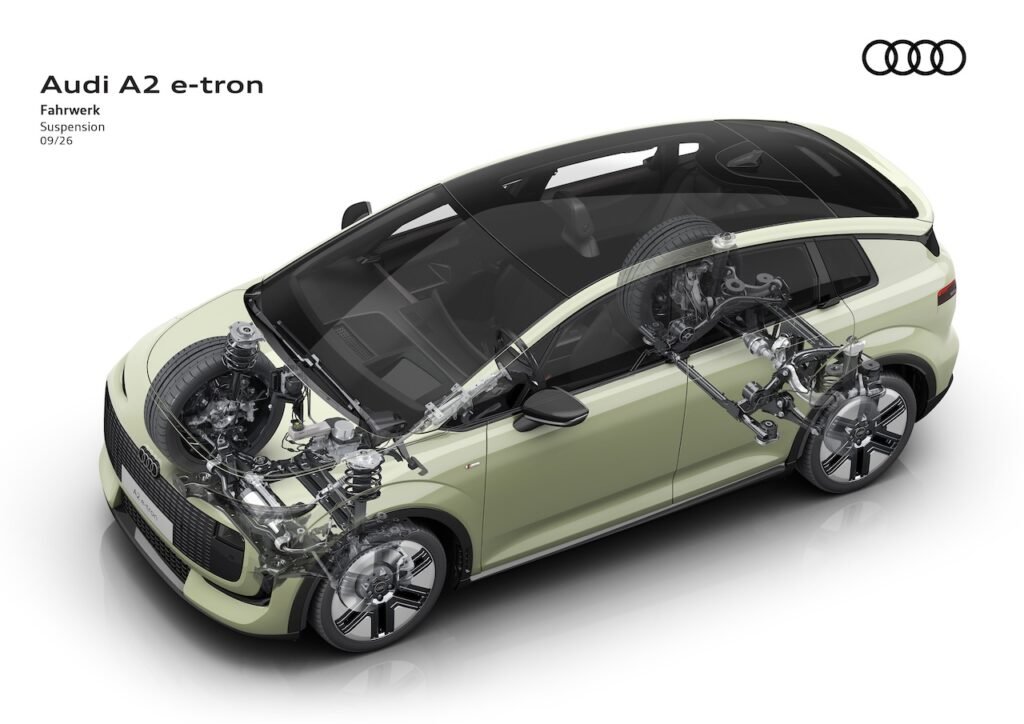
Aerodynamic efficiency plays a significant role. Audi claims a drag coefficient of 0.24, helped by a largely enclosed underbody, an active cooling-air intake and aerodynamically optimised wheels.
Small “gap reducers” fitted inside the wheel-arch trims narrow the space between the wheels and bodywork to smooth the airflow and reduce turbulence.
The A2 e-tron also uses silicon carbide semiconductors in its power electronics to reduce conversion losses.
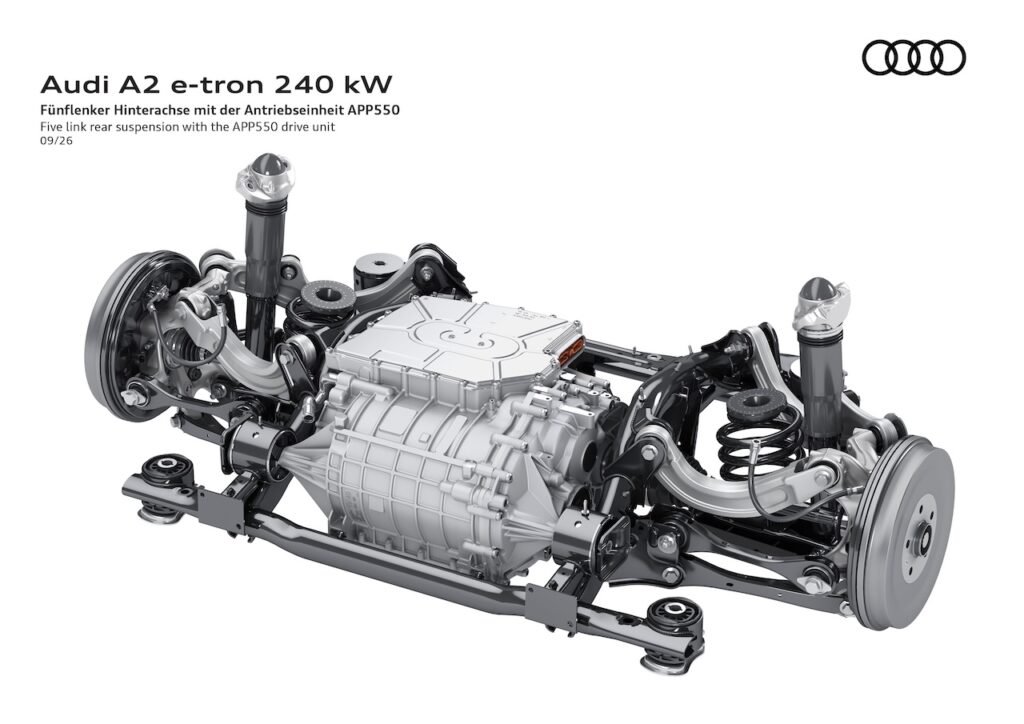
Its rear-mounted permanent-magnet synchronous motor is available in 125kW, 140kW, 170kW and 240kW forms, with every version driving the rear wheels.
Audi says it also reduced drivetrain losses through polished transmission gear teeth, lower-friction bearings and specially developed low-viscosity lubricants.
Four levels of regenerative braking are provided. Drivers can select three levels using steering-wheel paddles, while choosing the transmission’s B setting enables one-pedal driving that can bring the vehicle to a complete stop.
“The result is the most efficient Audi we have ever built,” Audi chief executive Gernot Döllner said.
“It translates directly into everyday usability: more range, less charging, fewer stops.”
The A2 e-tron will be available to order in Germany from September 10, priced from €38,200 ($A67,300), with European deliveries beginning in December 2026.
Audi Australia has not confirmed whether the compact EV or its bidirectional charging functions will be offered locally.


