

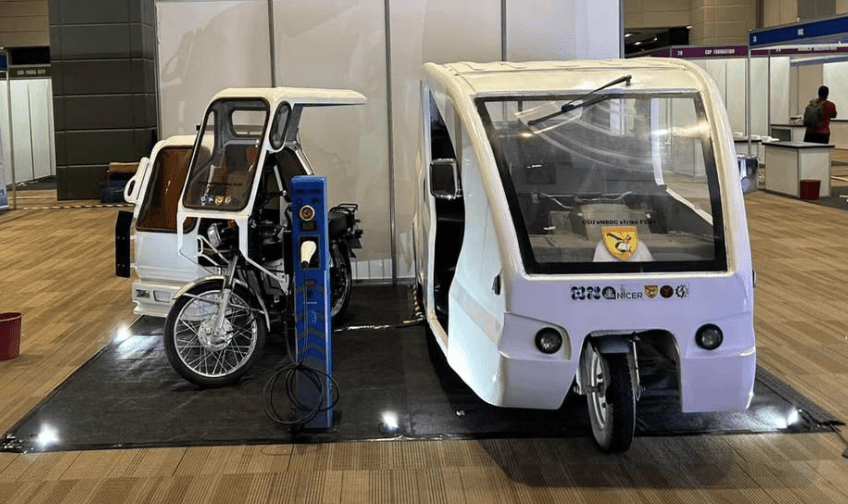
MANILA, Philippines – Cagayan State University (CSU) has made its locally developed electric vehicle prototypes available to commercial investors, representing a practical step forward in expanding domestic manufacturing and clean transportation across the Philippines.
At the Sustainability Expo 2026 in Manila, the university’s ElectroMobility Research and Development Center (EMRDC) showcased two key innovations: a custom-built seven-seater electric tricycle and a converted conventional trike. While the initial build cost for the seven-seater prototype reached 600,000 pesos ($10,400), Department of Science and Technology (DOST) Secretary Renato Solidum Jr. pointed out that commercial production will remove upfront research expenses. Scaling production and increasing mechanization are expected to lower material and labor costs significantly.
Developed under the government’s Science for Change Program, the initiative received over 51 million pesos ($884,000) in state funding and included collaboration with the University of the Philippines Diliman, whose Power Electronics Laboratory developed the core electrical systems. Five pilot units were built and deployed across several provinces for field testing. Subsequent performance studies published in the Philippine Journal of Science analyzed energy efficiency and climbing capacity while confirming that high initial acquisition costs remain the largest barrier to adoption.
To bridge the gap between academic research and market deployment, Cagayan State University signed technology licensing agreements with private sector partners to handle commercial fabrication, assembly, and regional distribution. The push aligns directly with broader economic policies set by President Ferdinand Marcos Jr., who has advocated for localized clean vehicle manufacturing to insulate public transport from global petroleum price volatility. Small utility transport platforms remain a logical priority for electrification due to their high urban density and fixed daily routes that fit depot-based charging models.
Long-term viability will depend on several economic and operational variables beyond vehicle prices. Fleet operators must evaluate total cost of ownership factors, including electricity rates, financing terms, maintenance overhead, and battery replacement cycles. Domestic suppliers must also establish dependable local supply chains for power electronics, motors, and battery cells to maximize local manufacturing value.
The DOST continues to fund parallel electric mobility efforts, including a solar-powered boat with Mapua University and an electric ferry project with the University of the Philippines. Private sector investors will ultimately determine whether these locally engineered technologies can achieve the scale and price parity necessary to transform Philippine public transport.


