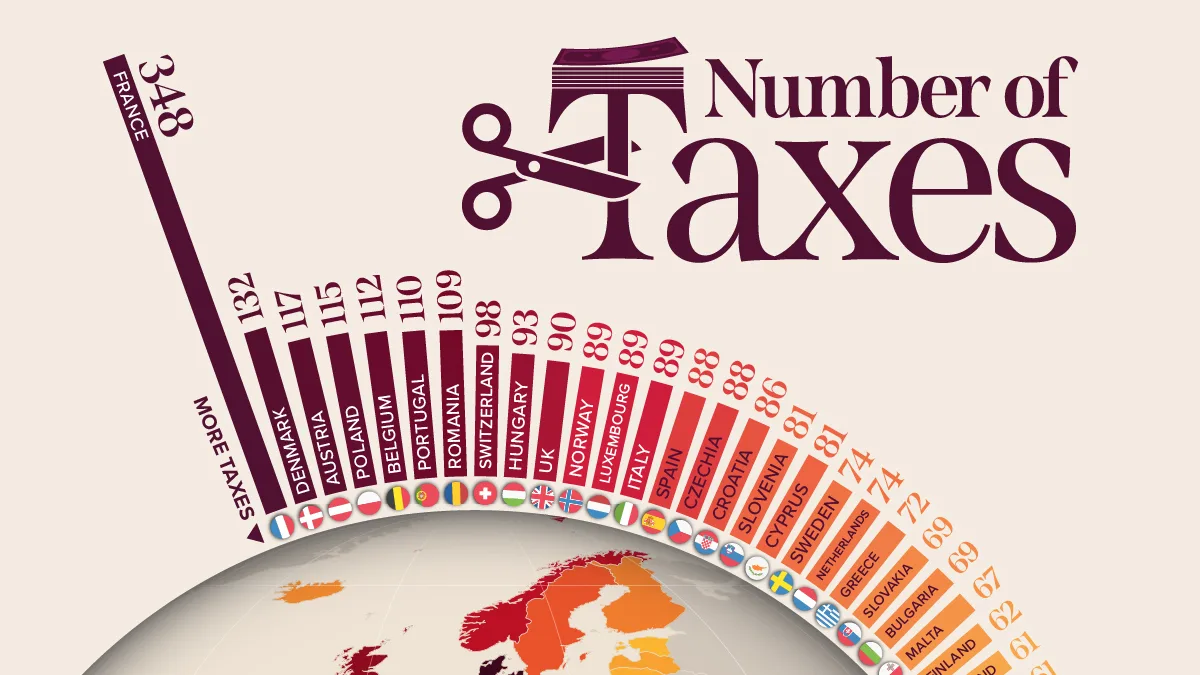
Ranked: European Countries With the Most Taxes
Key Takeaways
- France has more individual taxes (348) than any other European country.
- Estonia (34) and Lithuania (35) have the fewest individual taxes in Europe.
- Germany levies just 60 taxes, partly reflecting major postwar reforms.
European tax systems vary dramatically in how many individual taxes they impose, ranging from a few dozen to several hundred.
This visualization ranks European countries by their number of individual taxes, using the latest available data (2024) from Tax Policy Associates.
Importantly, the number of taxes does not indicate how heavily a country is taxed. Instead, it offers one way to compare the structure and complexity of national tax systems.
Why Does France Have So Many Taxes?
France is a clear outlier in the ranking. Its 348 individual taxes are more than double Denmark’s 132 in second place and nearly four times the European average of about 90.
Of the 348 taxes levied by France, 243 are “low-yield taxes,” which collectively bring in relatively little revenue compared with the country’s largest tax categories. In contrast, employment taxes brought in more than €800 billion in 2024, while taxes on goods and services added another €300 billion in revenue.
The table below ranks European countries by their number of individual taxes.
| Rank | Country | Number of Taxes |
|---|---|---|
| 1 |  France France |
348 |
| 2 |  Denmark Denmark |
132 |
| 3 |  Austria Austria |
117 |
| 4 |  Poland Poland |
115 |
| 5 |  Belgium Belgium |
112 |
| 6 |  Portugal Portugal |
110 |
| 7 |  Romania Romania |
109 |
| 8 |  Switzerland Switzerland |
98 |
| 9 |  Hungary Hungary |
93 |
| 10 |  United Kingdom United Kingdom |
90 |
| 11 |  Norway Norway |
89 |
| 11 |  Luxembourg Luxembourg |
89 |
| 11 |  Italy Italy |
89 |
| 14 |  Spain Spain |
88 |
| 14 |  Czechia Czechia |
88 |
| 16 |  Croatia Croatia |
86 |
| 17 |  Slovenia Slovenia |
81 |
| 17 |  Cyprus Cyprus |
81 |
| 19 |  Sweden Sweden |
74 |
| 19 |  Netherlands Netherlands |
74 |
| 21 |  Greece Greece |
72 |
| 22 |  Slovakia Slovakia |
69 |
| 22 |  Bulgaria Bulgaria |
69 |
| 24 |  Malta Malta |
67 |
| 25 |  Finland Finland |
62 |
| 26 |  Iceland Iceland |
61 |
| 26 |  Ireland Ireland |
61 |
| 28 |  Germany Germany |
60 |
| 29 |  Latvia Latvia |
54 |
| 30 |  Lithuania Lithuania |
35 |
| 31 |  Estonia Estonia |
34 |
Centuries of political compromises across various French republics led to the creation of numerous highly specialized industry taxes. While they do not raise significant revenue, these taxes add to the complexity of the French tax system.
Insurance and training levies, chamber taxes, and even nuclear or gambling taxes are among these smaller, industry-specific levies.
Notably, France ranks second only to Denmark among Organisation for Economic Co-operation and Development (OECD) countries for its overall tax revenue as a share of GDP.
The Baltic Tax Systems
At the other end of the spectrum are the three Baltic states: Estonia, Latvia, and Lithuania. Of the three, Latvia has the highest number of individual taxes (54), still far below the European average.
Estonia has the fewest taxes in Europe (34), one fewer than neighboring Lithuania (35). The country ranks first among OECD countries in the Tax Foundation’s International Tax Competitiveness Index, in part due to its simple filing system, which includes pre-filing by the central government.
Estonia levies a flat individual income tax without complex brackets or deductions. Reinvested corporate earnings, meanwhile, face a 0% tax rate, adding to the country’s attractiveness for businesses.
The German Tax Oddity
Germany is another interesting example. Europe’s largest economy collects substantial tax revenue, equal to roughly 42% of GDP, yet the country levies only 60 individual taxes. That’s less than one-fifth of neighboring France’s total and is especially notable given Germany’s federal structure.
Major reforms following both world wars helped consolidate Germany’s tax system. A 1919–1920 reform following World War I harmonized taxation across a country that had unified only decades earlier.
After World War II, Germany’s new Basic Law further consolidated the system by centralizing tax legislation and establishing how revenue from certain shared taxes would be allocated between the federal government and the states. These reforms help explain why Germany has one of Europe’s smaller tax systems by number of individual taxes.
Learn More on the Voronoi App
To compare how families fare across these countries, check out Visualized: How Family Incomes Compare to Taxes in Europe on Voronoi.