Which G20 Countries Rely Most on the U.S. for Exports?
Key Takeaways
- The U.S. absorbs 18% of the average G20 economy’s exports.
- Canada and Mexico each ship roughly three-quarters of their goods exports to the U.S.
- Just 0.9% of Russia’s exports go to the U.S., the lowest share among G20 countries.
Access to the United States, the world’s largest economy, remains crucial for countries around the world. However, America’s closest neighbors rely far more heavily on the U.S. market than other major global economies.
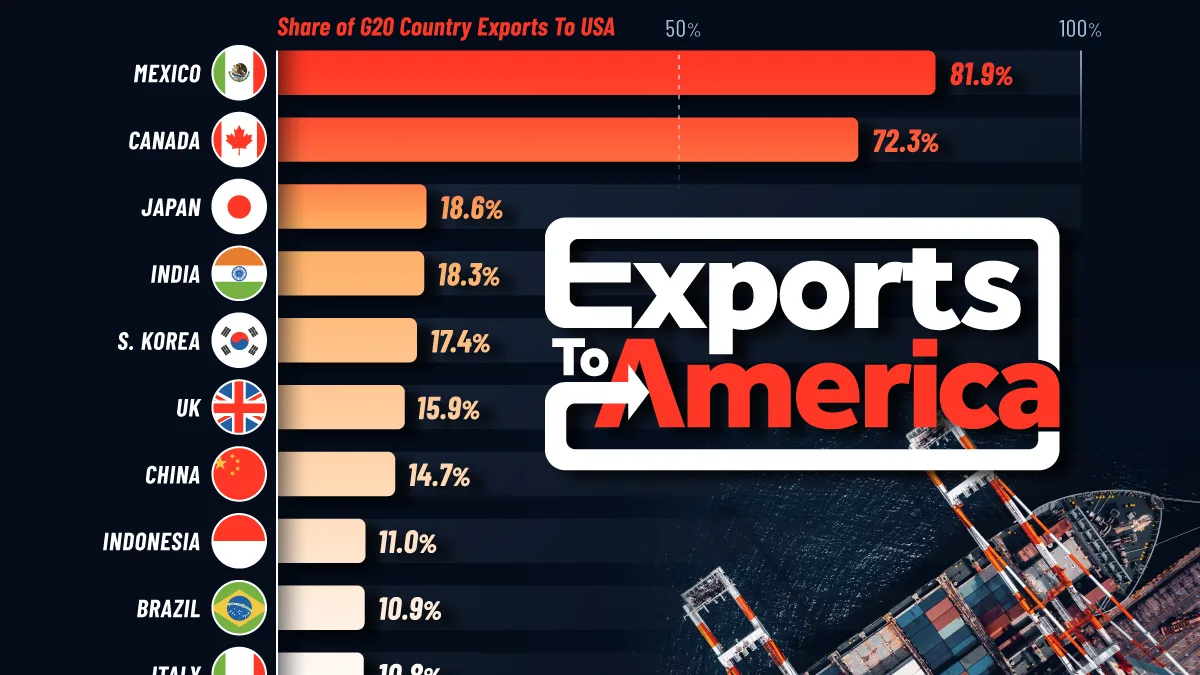
This visualization ranks Group of 20 (G20) countries by the share of their goods exports sent to the U.S., using the latest available data (2025) from UN Comtrade and the Observatory for Economic Complexity.
Only goods trade is included. The African Union and European Union are excluded despite being G20 members.
Why Canada and Mexico Rank So High
Canada and Mexico are particularly exposed to shifts in U.S. trade policy because of their deeply integrated trade relationships with the United States.
The U.S. absorbs 72.3% of Canadian exports and 81.9% of Mexican exports, compared with just 18.1% for the average G20 economy. This makes both countries particularly vulnerable to changes in U.S. trade policy.
The table below lists G20 economies alongside the U.S. share of their exports in 2025.
| Rank | Country | Share of Exports Going to U.S. |
|---|---|---|
| 1 |  Mexico Mexico |
81.9% |
| 2 |  Canada Canada |
72.3% |
| 3 |  Japan Japan |
18.6% |
| 4 |  India India |
18.3% |
| 5 |  South Korea South Korea |
17.4% |
| 6 |  United Kingdom United Kingdom |
15.9% |
| 7 |  China China |
14.7% |
| 8 |  Indonesia Indonesia |
11.0% |
| 9 |  Brazil Brazil |
10.9% |
| 10 |  Italy Italy |
10.8% |
| 11 |  Argentina Argentina |
9.6% |
| 12 |  Germany Germany |
9.4% |
| 13 |  France France |
8.6% |
| 14 |  Australia Australia |
7.4% |
| 15 |  South Africa South Africa |
7.1% |
| 16 |  Turkiye Turkiye |
6.0% |
| 17 |  Saudi Arabia Saudi Arabia |
4.3% |
| 18 |  Russia Russia |
0.9% |
Decades of economic integration have helped produce this concentration. The North American Free Trade Agreement (NAFTA), which entered into force in 1994, reduced trade barriers between Canada, Mexico, and the United States. It was replaced by the USMCA in 2020.
More recently, the second Trump administration has imposed tariffs on both U.S. neighbors. Talks between Ottawa and Washington have broken down, leading to the imposition of retaliatory tariffs.
Meanwhile, Mexico, the most exposed G20 country, continues negotiations with the U.S. in an effort to avoid further tariffs on its agricultural and automotive sectors.
G20 Exports to the U.S.
Outside North America, no G20 country sends a comparable share of its exports to the United States. However, traditional U.S. allies including Japan (18.6%), South Korea (17.4%), and the United Kingdom (15.9%) still send substantial portions of their goods exports to the U.S.
European Union member states tend to have lower exposure to the U.S. market because of extensive trade within the bloc. Germany, the EU’s largest economy, sends 9.4% of its exports to the U.S., behind Italy (10.8%) but ahead of France (8.6%).
In Latin America, Argentina (9.6%) and Brazil (10.9%) send much smaller shares of their exports to the U.S. than Mexico does. China, the world’s largest exporter, sends less than 15% of its exports to the U.S.
Energy Exports to America
Saudi Arabia (4.3%) and Russia (0.9%) have the smallest U.S. shares among the G20 countries in the ranking. Both are major oil and gas exporters with large markets elsewhere, particularly in Asia and Europe.
The U.S. also sources significant amounts of energy closer to home. In addition to its own sizable oil and gas production, the country imports substantial quantities of oil from Canada. Canadian energy products have received different tariff treatment than many other imports during the ongoing trade dispute.
Canada’s role as a major U.S. oil supplier has also become part of the broader trade debate. Some prominent Canadian politicians have floated taxing oil exports to the U.S. as a way to pressure Washington.
Learn More on the Voronoi App
To explore the main exports of EU countries, check out Cars and Petroleum Dominate EU Exports on Voronoi.