

JAC will expand its new Hunter PHEV range with a cab-chassis version in early 2027, giving tradies and fleet operators a plug-in hybrid alternative to the BYD Shark 6 Dynamic Cab Chassis.
The new Hunter PHEV Cab Chassis has been confirmed for Australia following what JAC says has been strong demand from prospective fleet customers, more than half of whom have expressed interest in a cab-chassis version.
It will follow the Hunter PHEV dual-cab that has just gone on sale locally and is expected to retain the same petrol-electric drivetrain and core mechanical specification.
READ MORE: Electric SUVs on the agenda: Chinese giant JAC reveals Australian expansion plans
READ MORE: 2026 JAC Hunter X PHEV Review: Australia’s cheapest PHEV ute combines serious capability with useful EV range
READ MORE: Australia’s JAC Hunter PHEV tune goes global: Local engineering adopted for overseas markets
The announcement means the BYD Shark 6 will no longer have the Australian PHEV cab-chassis market to itself.
BYD launched its Shark 6 Dynamic Cab Chassis earlier this year priced from $55,900 plus on-road costs, making it the first PHEV cab-chassis ute offered locally.
JAC has not announced pricing for its cab-chassis, but there is potential for it to substantially undercut the BYD given the existing Hunter PHEV Pro dual-cab is priced from $49,988 plus on-road costs, while the better-equipped Hunter X costs $54,844 plus on-roads.
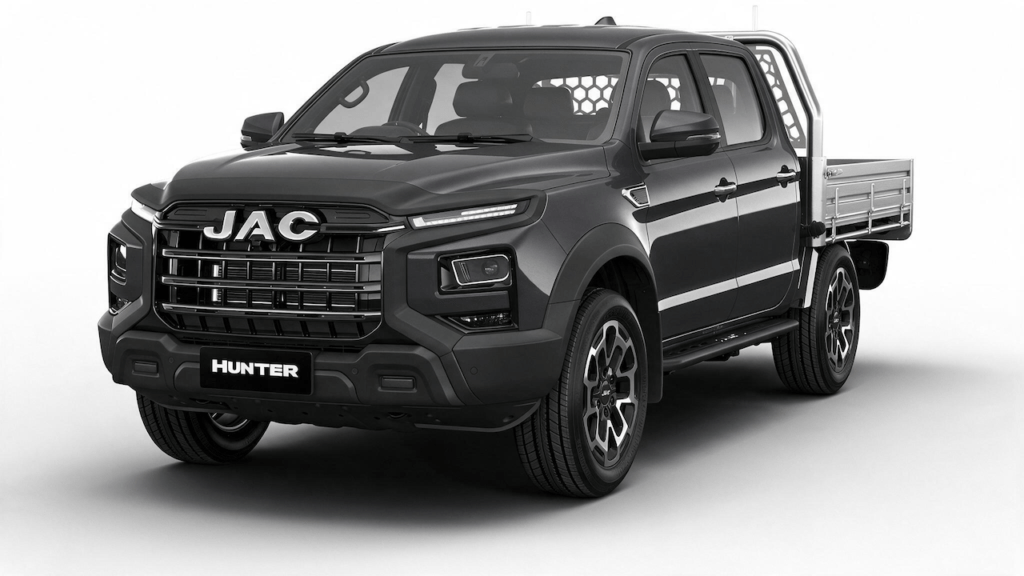
Final pricing, specifications and available configurations for the Cab Chassis will be announced closer to its early-2027 arrival. JAC says it will also announce genuine tray and body options before launch.
Rather than the factory tub fitted to the Hunter dual-cab, the Cab Chassis will provide an exposed rear platform allowing owners to install trays, canopies, toolboxes and other specialised bodies.
The Hunter Cab Chassis is expected to carry over the dual-cab’s plug-in hybrid drivetrain, which combines a 2.0-litre turbo-petrol engine with electric motors on the front and rear axles.
JAC claims maximum combined output of 360kW and quotes 1010Nm of driveline torque for the existing Hunter, although that torque figure is calculated by adding the outputs of the engine and electric motors rather than representing a directly measured system output.
A 31.2kWh lithium iron phosphate battery provides a claimed electric driving range of up to 100km, while the combination of the battery and 77-litre petrol tank produces a theoretical combined range of up to 1005km. Both range figures use the more generous NEDC testing standard.
JAC also quotes fuel consumption of 1.6L/100km under ADR81/02 testing, although, as with other PHEVs, the result depends heavily on starting the test with a charged battery and is not representative of fuel consumption once the battery’s usable charge has been depleted. The company itself notes the laboratory figure should be used for comparative purposes rather than as an indication of real-world consumption.
Importantly for commercial buyers, JAC expects the Cab Chassis to retain the Hunter’s 3500kg braked towing capacity. The competing $55,900 BYD Shark 6 Dynamic Cab Chassis is rated to tow 2500kg braked.
The JAC will also retain 3.3kW vehicle-to-load (V2L) capability, allowing its high-voltage battery to run compatible tools and other electrical equipment.
An Idle Charge function can use the petrol engine to replenish the battery while the vehicle is stationary, potentially allowing V2L equipment to continue operating at remote worksites where external electricity isn’t available.
JAC has yet to reveal the Cab Chassis’s payload, kerb weight or gross vehicle mass, figures that will be particularly important given its commercial focus.
The existing Hunter PHEV dual-cab has a payload of up to 915kg and a 3500kg braked towing capacity.
The Cab Chassis will also be covered by JAC’s seven-year/unlimited-kilometre vehicle warranty, including commercial use, as well as seven years of capped-price servicing and roadside assistance. The high-voltage battery is covered for eight years or 150,000km.
The post JAC Hunter PHEV Cab Chassis confirmed: Australia’s cheapest plug-in ute gets work-focused BYD Shark 6 rival appeared first on EV Central.


