
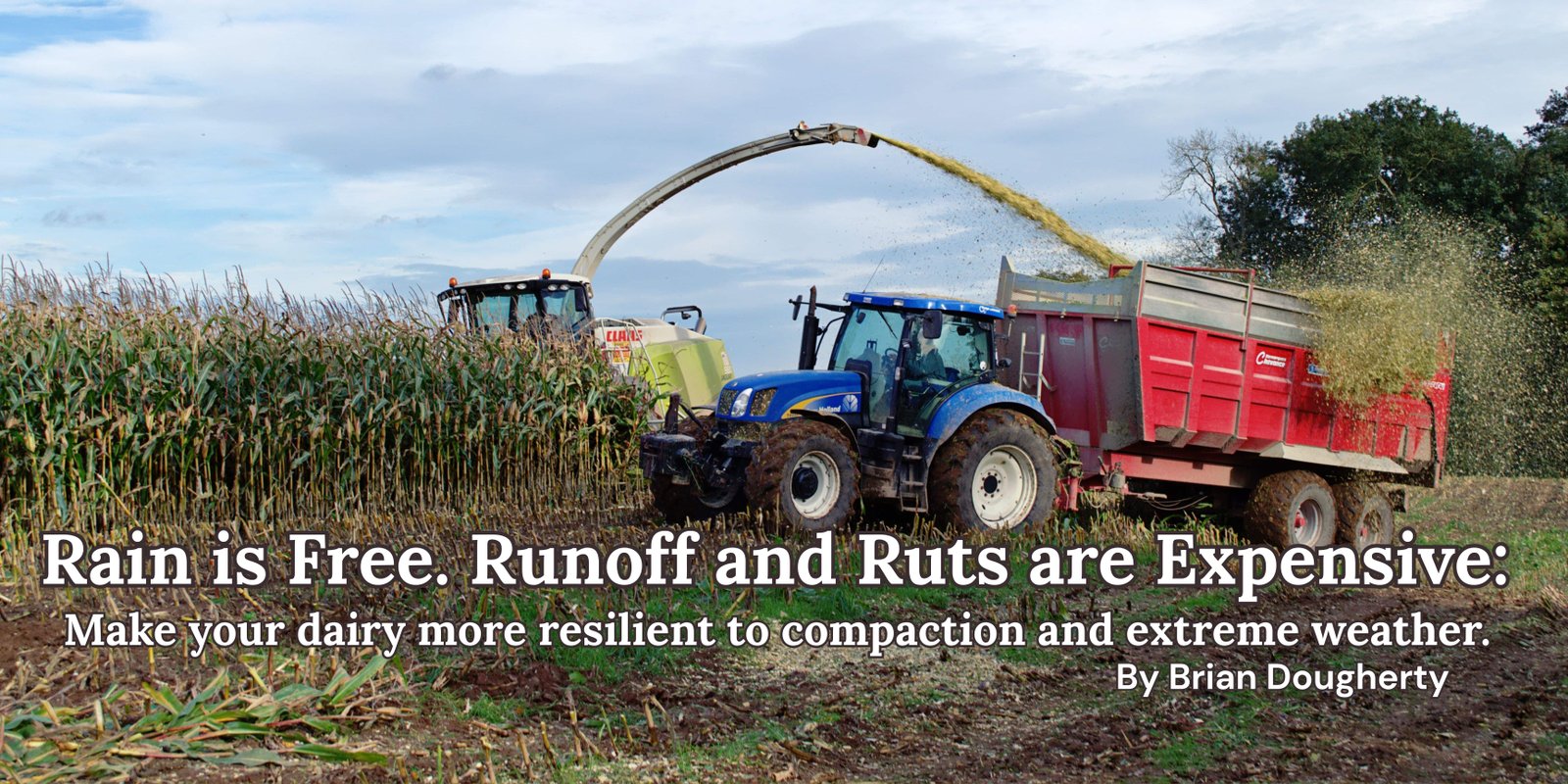
Rain is Free. Runoff and Ruts are Expensive:
Make your dairy more resilient to compaction and extreme weather.
By Brian Dougherty
Soil Compaction Is a Growing Challenge for Dairy Farms
Where would compaction rank on your dairy farm’s list of top challenges? Recent research suggests it should rank higher than most of us admit. The 2025 Iowa Farm and Rural Life Poll, which surveyed 945 farmers, found that 80 percent are concerned about soil compaction on the land they farm, up from 70 percent in 2013, and 81 percent are concerned about the impact of heavy equipment on soil health. Poll director J. Arbuckle summed up the reason in a way every dairy farmer will recognize: fieldwork windows are shrinking due to changing weather patterns, and equipment keeps getting bigger and heavier so we can plant and harvest faster. That makes soil compaction on dairy farms an issue worth addressing before it becomes an even bigger threat to productivity, profitability, and soil health.
Extreme Weather Makes Soil Compaction More Costly
The American Farm Bureau Federation calculated that weather and fire events in 2024 caused more than $20 billion in crop and rangeland losses nationwide, and over 9 billion of that was uninsured. These numbers sound extreme but they are the new normal in agriculture. On a dairy, these losses can hit more than once, because many dairies feed most or all of what they grow. A smaller crop leads to a larger purchased feed bill.
On one hand, none of this should be surprising. Weather is always a challenge with farming, and long-term datasets confirm that we are seeing more variable and intense rainfall events and an overall increase in precipitation in the American Midwest. On the other hand, weather is a challenge we tend to treat as something that simply happens to us. With so much that is out of our control, what can be done to reduce the impact of extreme weather?
A Healthy Water Cycle Helps Farms Handle Extreme Weather
Handling extreme weather comes down to managing the water cycle on your farm. Many of the consequences of extreme weather, such as excessive runoff and erosion, are due to disruption of the water cycle. When the cycle is functioning properly, a majority of precipitation infiltrates the soil surface and runoff is minimal. Soils have good water holding capacity and aquifers recharge with excess water. The surface stays covered with vegetation, and transpiration slowly recycles water back to the atmosphere. This transpiration process absorbs tremendous amounts of solar energy and moderates temperature fluctuations. This is how water flows through natural ecosystems.
How Tillage and Bare Soil Disrupt the Water Cycle
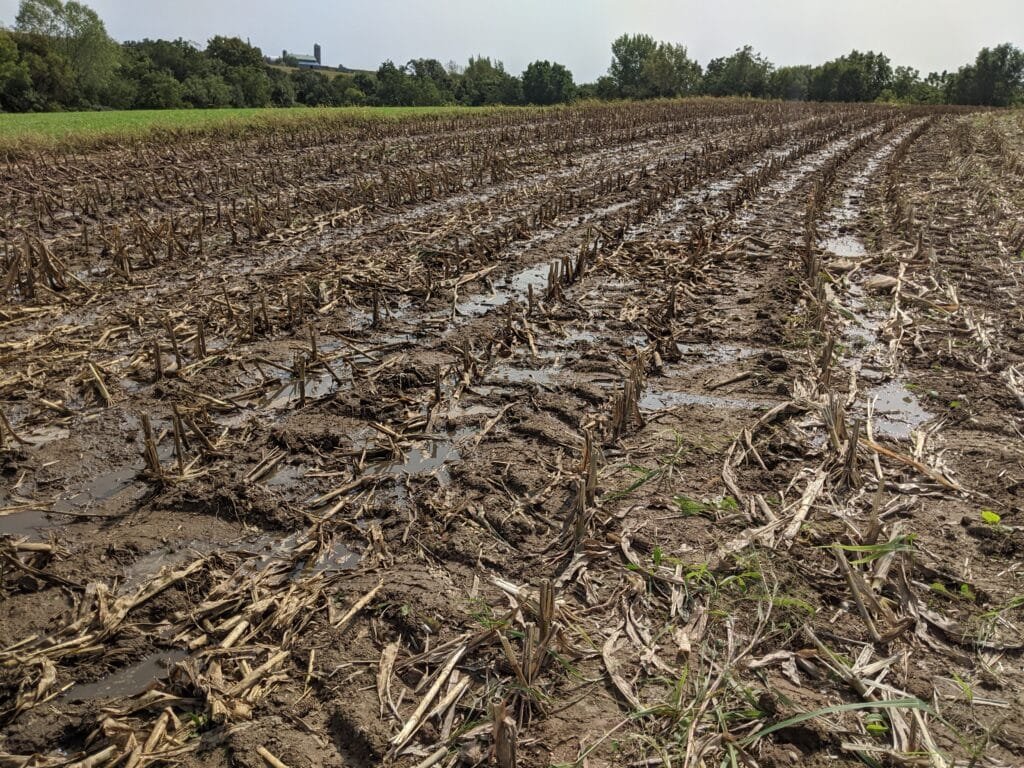
Unfortunately, some of our farming practices short-circuit this flow of water. Decades of tillage have left soils susceptible to erosion and loss of organic matter. Tillage breaks up soil aggregates and slows water infiltration. Bare soil heats up and water evaporates from the surface rather than cycling through plants. Plant transpiration creates a micro-climate around plant leaves and provides a stabilizing effect by absorbing energy from the sun and moderating temperature and humidity fluctuations. Alternating between fast-growing crops during summer and fallow the remainder of the year disrupts this buffering effect. Lack of vegetation slows the cycling of nutrients and water and leads to further loss of soil organic matter. This organic matter serves as a sponge for water and holds nutrients. When we lose organic matter and damage soil aggregates to the point that infiltration is slower than the rate of precipitation, the water cycle is broken.
Continued disruption of the water cycle with tillage and lack of living ground cover leads to further degradation in a downward spiral of more runoff, more erosion, less soil water holding capacity, slower infiltration, more drought stress, and more money spent tilling the soil and replacing lost nutrients in an attempt to “fix” the problem. We end up treating symptoms year after year while the underlying cause gets worse.
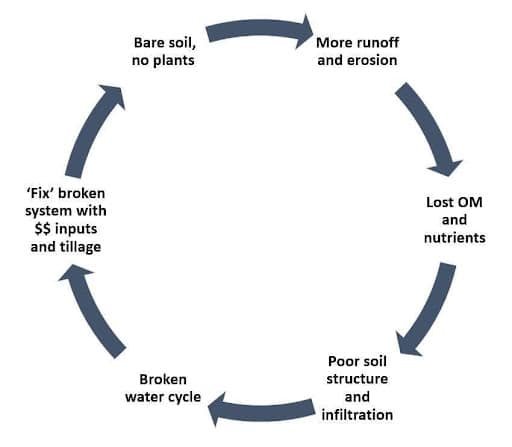
The good news is you can reverse this downward spiral and mitigate the impact of extreme weather by restoring the water cycle on your farm. How you manage your soil has a major impact on water cycling. Following the 6-3-4 is the key to fixing a broken water cycle. Reduce soil disturbance, keep the soil covered, keep a living root in the soil throughout the growing season, add diversity to your cropping system, and integrate livestock. The water cycle is one of the four ecosystem processes those principles are designed to restore. They work because they are how natural systems form soil aggregates and build topsoil.
How Healthy Soil Aggregates Improve Water Infiltration and Trafficability
Soil aggregates are the building blocks of a healthy soil. A well-aggregated soil has more pore space for air and allows water to infiltrate rapidly. To improve aggregation, you must limit disturbance and armor your soil with both residue and living plants. Many farmers who have implemented the soil health principles have found that their fields have better trafficability and can infiltrate multi-inch per hour rainfall events with minimal runoff. On a dairy, that trafficability can be the difference between putting up forage on your schedule when quality is good vs doing it on the weather’s schedule.
Soil Health Practices That Reduce Compaction and Runoff
The quickest way to improve aggregation on row-crop land is with a continuously covered no-till cropping system. Good aggregation is achievable with a minimum amount of tillage but it may take a bit longer. Strip-till is a good alternative on heavier clay soils. Establish cover crops during the growing season or immediately after harvest. Early interseed, aerial application, or high-clearance equipment can be used to establish covers into row crops. Early establishment allows for multispecies blends that do not grow well later in the season. Having a variety of different root systems can provide benefits that you will not get with a single species. Select species that are good for adding organic matter and reducing compaction. Also consider grazing your cover crops. This is a quick way to rebuild soil health and get an economic benefit from cover crops.
It is worth noting what the Iowa poll found about these practices. Agreement that no-till is an effective way to manage compaction rose from 57 percent in 2013 to 63 percent in 2025, and 56 percent of farmers agreed that cover crops can help reduce compaction. But 38 percent were uncertain about cover crops. That uncertainty is the gap we need to close, because keeping a living root in the soil is not an optional practice for compaction management. It is the practice.
How to Reduce Equipment Costs When Transitioning to No-Till
There are ways to minimize equipment costs in a soil health focused cropping system. Most row-crop planters can plant no-till with slight modifications or attachments. No-till generally reduces fuel, labor, and horsepower needs. Sell unused tillage equipment and invest in planter upgrades, a good no-till drill for planting cover crops, and low-disturbance equipment to inject manure into already-established cover crops. Renting or custom-hire are good options to keep equipment investment low.
Two Ways Dairy Farms Can Transition to Healthier Soils
A major challenge many dairies have is dealing with wet soil and compaction. There are different approaches to implementing the soil health principles that can reduce this risk.
Staged Transition to No-Till and Cover Crops
One is to use a staged approach. Switch a percentage of your fields to continuously covered no-till or strip-till starting with a fall cover crop. Use the cover crop as a green manure rather than harvesting it for forage. Then make a commitment that for the next three years you will not do anything on those fields if the soil is too wet. This allows time to rebuild soil aggregation and improve infiltration. If fields are too wet and you must do fieldwork, do it on fields that have not yet transitioned. After three years, switch another set of fields and repeat the process until the entire farm has transitioned. After several years the original fields will have had time to restore proper water cycling and will have much better trafficability and resilience to compaction. Check out this blog post for tips on how to minimize compaction due to equipment traffic during the transition.
Targeted Soil Health Improvements on Vulnerable Acres
Another method is to use a targeted approach. Implement the soil health principles on your most vulnerable acres each year. The top priority should be corn silage ground receiving fall manure. We harvest in conditions that are often wet, with heavy equipment, and remove nearly all the residue. These fields are extremely vulnerable to compaction and erosion and are hands-down the best economic case for planting a cover crop. The second priority should be any fields where fall manure is applied before soils have cooled to below 50°F. These fields are highly susceptible to nutrient loss. Expand from there as you become more comfortable with managing the soil health system.
Build a More Resilient Dairy Farm by Restoring the Water Cycle
Fixing a broken water cycle takes time and dedication. However, with some creativity and persistence you can restore your water cycle and make your farm more resilient to compaction in the face of extreme weather. Reach out to an Understanding Ag consultant for support as you make the transition.

The post Rain is Free. Runoff and Ruts are Expensive. appeared first on Understanding Ag.


