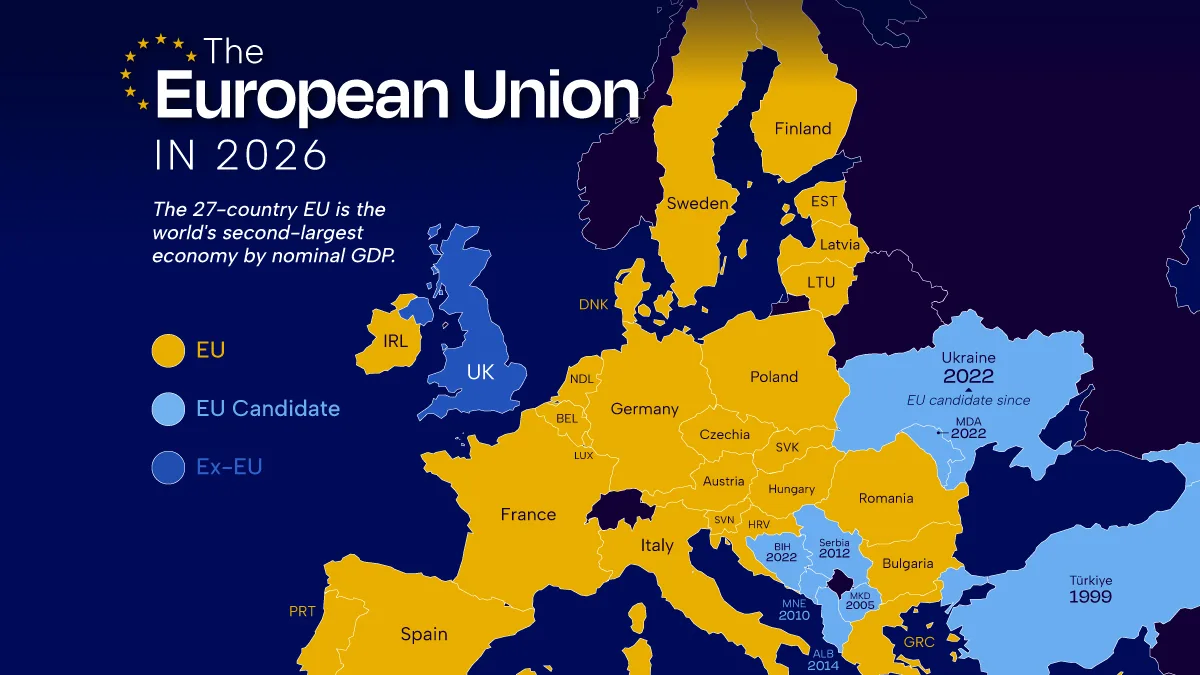
Inside the European Union in 2026
Key Takeaways
- The European Union is a political and economic union consisting of 27 European countries.
- Nine additional countries are formal candidates for EU membership as of 2026.
- European Commission President Ursula von der Leyen has proposed making Canada the EU’s first “associate member,” though the details have yet to be defined.
The European Union is the world’s second-largest economy. While the bloc has steadily expanded over the decades, 2026 could see the emergence of an entirely new form of association.
This map presents the 27-member European Union as of September 2026, highlighting the bloc alongside its nine official candidate countries and the UK, its only former member.
How the EU Grew to 27 Members
The earliest incarnation of what is today the EU was founded in the 1950s with six members: France, Italy, West Germany, and the three Benelux countries. By the time the modern EU was established in 1993, the bloc had doubled in size to 12 members, including a reunified Germany as well as major economies like Spain and the United Kingdom.
More than three decades later, the EU counts 27 full members. Croatia is the newest member, having joined in 2013 after more than half a decade of formal negotiations.
The table below lists EU countries alongside their year of accession and forecasted nominal GDP in 2026.
| Country | Year of EU Accession | 2026F Nominal GDP (billions $) |
|---|---|---|
 Belgium Belgium |
1958 | 777 |
 France France |
1958 | 3,600 |
 Germany Germany |
1958 | 5,450 |
 Italy Italy |
1958 | 2,740 |
 Luxembourg Luxembourg |
1958 | 110 |
 Netherlands Netherlands |
1958 | 1,450 |
 Denmark Denmark |
1973 | 504 |
 Ireland Ireland |
1973 | 779 |
 Greece Greece |
1981 | 308 |
 Portugal Portugal |
1986 | 381 |
 Spain Spain |
1986 | 2,090 |
 Austria Austria |
1995 | 624 |
 Finland Finland |
1995 | 338 |
 Sweden Sweden |
1995 | 760 |
 Cyprus Cyprus |
2004 | 45 |
 Czechia Czechia |
2004 | 433 |
 Estonia Estonia |
2004 | 52 |
 Hungary Hungary |
2004 | 271 |
 Latvia Latvia |
2004 | 54 |
 Lithuania Lithuania |
2004 | 106 |
 Malta Malta |
2004 | 31 |
 Poland Poland |
2004 | 1,130 |
 Slovakia Slovakia |
2004 | 169 |
 Slovenia Slovenia |
2004 | 87 |
 Bulgaria Bulgaria |
2007 | 148 |
 Romania Romania |
2007 | 481 |
 Croatia Croatia |
2013 | 117 |
European integration has deepened alongside expansion. In 1993, the EU established a single market allowing for the free movement of goods, services, capital, and people.
A common currency, the euro, followed in 1999. More than a quarter-century later, roughly two-thirds of EU countries are part of the eurozone.
Deeper integration has also come with setbacks. The eurozone debt crisis placed significant strain on the currency bloc, while Brexit marked the first departure of an EU member. In 2020, the UK formally withdrew following its 2016 referendum.
Which Countries Could Join Next?
The UK’s withdrawal brought the bloc from 28 members back down to 27. However, nine additional countries are formal candidates for eventual accession to the EU. Türkiye is the longest-running candidate, having held the status since 1999, although its accession negotiations have effectively stalled.
More than half of the current candidate countries are in the Western Balkans: Albania, Bosnia and Herzegovina, Montenegro, North Macedonia, and Serbia. Montenegro is among the most advanced candidates in the accession process, with officials discussing a possible 2028 entry date.
Georgia, Moldova, and Ukraine received candidate status more recently. Moldova and Ukraine were granted candidate status in 2022, while Georgia followed in 2023. Ukraine and Moldova opened formal accession negotiations in 2024.
Canada: A New Model for Membership?
Then there’s Canada. The North American country has sought closer EU ties amid rising trade tensions with its southern neighbor, the United States. As a country outside Europe, however, Canada is not pursuing conventional EU membership.
Instead, European Commission President Ursula von der Leyen has proposed making Canada the EU’s first “associate member.” The status does not currently exist under EU treaties, and its exact structure has yet to be defined. Early discussions point toward deeper cooperation in areas including trade, defense, technology, energy, and economic security.
Canada and the EU have already strengthened their ties in other areas. In 2026, Canada became the first non-European country to participate in the EU’s SAFE defense procurement initiative.
U.S. President Donald Trump described the possibility of Canadian associate membership as a “hostile act” and threatened additional tariffs on Canada and the EU.
Learn More on the Voronoi App
For a breakdown of the countries that power the EU economy, check out The $19 Trillion European Union Economy on Voronoi.