

By Ari Pottens and Scott Seymour
Canada’s trade priorities are shifting quickly as its largest trading partner, the United States, proves less reliable with every passing month. Prime Minister Carney is travelling the world seeking new markets to diversify our customer base.
He asserts that “Canada has what the world wants” and touts our status as a clean energy superpower. Many of the Major Project Office’s priority projects are aimed at growing Canada’s energy and resources sectors, including a plan to export more oil and gas by way of British Columbia.
However, with global markets increasingly calling for lower emissions of methane from oil and gas supplies and the growing urgency of energy security, does Canada truly have what the world wants?
The short answer is not yet, and not in all major producing provinces. While BC is a leader in low-emission production, oil and gas from Alberta, Canada’s largest producing province, emits too much methane to meet the most common international methane standards. Luckily, Alberta can implement policies to help get there.
Importer standards equal external pressures
Some of Canada’s new trade partners are countries that are leading the way on methane standards, which means Canada must align with them to unlock new export opportunities. The European Union has already announced its methane regulation that imposes methane emission limits on imported oil and gas starting in 2030. Buyers in Asia are also expressing a preference for low-emission energy: Japan, the world’s second-largest importer of liquefied natural gas, has joined together with South Korea to launch the CLEAN initiative to improve LNG supply chain transparency and drive down methane emissions. Just two weeks ago Japanese and Canadian officials gathered at the Canadian Embassy in Tokyo for a productive discussion on the interconnection between methane mitigation and energy security.
The best way for major buyers to decide which fossil fuels are cleanest is to compare each production region’s methane emission “intensity”—the amount of methane emissions per unit of oil and gas. The most commonly used intensity standard for natural gas production is to have methane emissions less than 0.2% of the volume of the sold gas.
How close to ready are we?
Many leaders in Government describe Canada as having some of the lowest-emission gas on Earth, but aerial measurements have shown that not all oil and gas is produced equally across western Canada:
British Columbia: Based on recent analysis, BC’s oil and gas is calculated to carry less than 0.2% methane emissions intensity, meeting the most common international intensity standard.
Alberta: The oil and gas produced in Alberta carries a much higher emissions intensity at 1.3%, about 7x higher than that 0.2% target and leaving plenty of room for improvement.
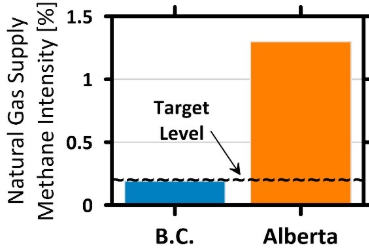
The reality is that if Canada wants to export truly low-emission energy at scale to new customers overseas, Alberta—which accounts for 84% of Canada’s oil production and 61% of Canada’s gas production—will have to reduce its methane emissions substantially.
The best way for Alberta to bring down its emissions is by bolstering its provincial regulations to a level equivalent to or stronger than the recently finalized federal standard. Any finalized equivalency agreement should be based on an assessment made by a truly independent third-party and based on credible federal emissions data.
Building on momentum to get across the finish line
Canada has announced new regulations to reduce oil and gas methane by 72% below 2012 levels by 2030. Provinces can adopt the federal regulations, or, under an “equivalency agreement,” develop their own regulations provided they meet or exceed the federal standard. The federal government has the power to approve these agreements and with that power, ensure Alberta’s new regulations result in meaningful reductions that can help enable the transpacific energy trade that the Carney government has sought.
There are clear market signals coming from overseas energy customers, and Alberta cannot afford to mute or ignore these signals as our nation pursues new trading partners. As Ottawa fast-tracks massive infrastructure investments to build complex, expensive pipelines to serve new customers, this is no time to skimp on regulatory strength to ensure we deliver truly low-emission oil and gas. If Canada wants to build stronger, stabler, trade relationships, then we need stronger regulations and more transparency when it comes to one of our marquee products.
The post Methane reductions are critical to ensuring Canada’s oil and gas is ready to meet the standards of new markets appeared first on Energy Exchange.


