How Countries Compare on Science Scores in 2026
Key Takeaways
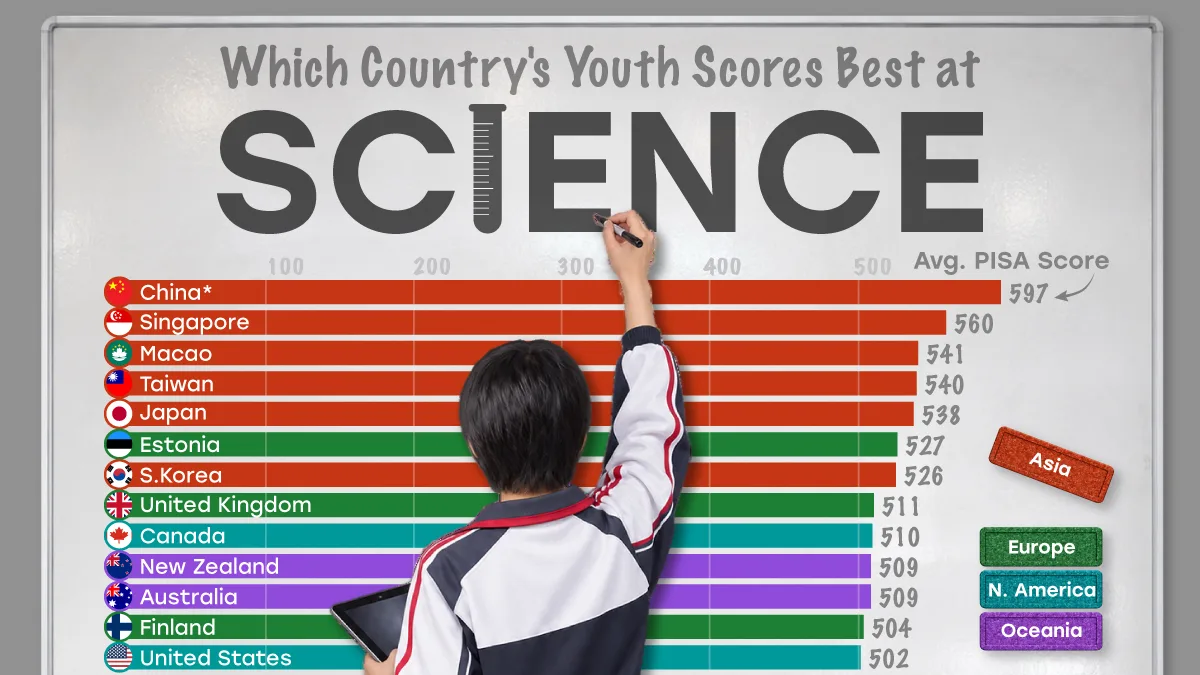
- China led the PISA 2025 science ranking with an average score of 597, followed by Singapore at 560.
- Asian education systems dominate the top of the ranking, with six of the seven highest scores.
- The United States ranks 13th with an average science score of 502, 20 points above the OECD average of 482.
How do science skills compare around the world?
This graphic ranks participating countries and economies by the average science scores of 15-year-old students in the latest PISA 2025 study, published in September 2026.
PISA assesses students in mathematics, reading, and science. Its science assessment goes beyond recalling facts, testing how well students can explain scientific phenomena, evaluate investigations and evidence, and assess scientific information for decision-making.
More than 760,000 students took part in PISA 2025 across 91 countries and economies, representing roughly 33 million 15-year-olds worldwide.
China in this ranking represents the participating jurisdictions of Beijing, Shanghai, Jiangsu, and Zhejiang.
Asia Dominates the Top of the Ranking
Behind China and Singapore, Macao, Taiwan, and Japan round out the top five, while South Korea ranks seventh.
Estonia is the only European country among the top seven, with an average science score of 527.
| Rank | Country | Average PISA score (Science) | Region |
|---|---|---|---|
| 1 |  China China |
597 | Asia |
| 2 |  Singapore Singapore |
560 | Asia |
| 3 |  Macao Macao |
541 | Asia |
| 4 |  Taiwan Taiwan |
540 | Asia |
| 5 |  Japan Japan |
538 | Asia |
| 6 |  Estonia Estonia |
527 | Europe |
| 7 |  Korea Korea |
526 | Asia |
| 8 |  UK UK |
511 | Europe |
| 9 |  Canada Canada |
510 | North America |
| 10 |  New Zealand New Zealand |
509 | Oceania |
| 10 |  Australia Australia |
509 | Oceania |
| 12 |  Finland Finland |
504 | Europe |
| 13 |  United States United States |
502 | North America |
| 14 |  Switzerland Switzerland |
501 | Europe |
| 15 |  Ireland Ireland |
500 | Europe |
| 16 |  Austria Austria |
497 | Europe |
| 17 |  Hong Kong Hong Kong |
496 | Asia |
| 18 |  Poland Poland |
495 | Europe |
| 19 |  Türkiye Türkiye |
494 | Asia |
| 20 |  Czechia Czechia |
490 | Europe |
| 20 |  Belgium Belgium |
490 | Europe |
| 22 |  Lithuania Lithuania |
488 | Europe |
| 23 |  Germany Germany |
486 | Europe |
| 24 |  Netherlands Netherlands |
485 | Europe |
| 24 |  Sweden Sweden |
485 | Europe |
| 26 |  Slovenia Slovenia |
484 | Europe |
| 27 |  France France |
483 | Europe |
| 27 |  Italy Italy |
483 | Europe |
| 29 |  OECD average OECD average |
482 | — |
| 29 |  Portugal Portugal |
482 | Europe |
| 31 |  Hungary Hungary |
480 | Europe |
| 32 |  Denmark Denmark |
478 | Europe |
| 33 |  Spain Spain |
477 | Europe |
| 34 |  Croatia Croatia |
476 | Europe |
| 35 |  Slovakia Slovakia |
475 | Europe |
| 36 |  Luxembourg Luxembourg |
474 | Europe |
| 37 |  Norway Norway |
470 | Europe |
| 38 |  Latvia Latvia |
468 | Europe |
| 39 |  United Arab Emirates United Arab Emirates |
458 | Asia |
| 40 |  Vietnam Vietnam |
457 | Asia |
| 41 |  Malta Malta |
453 | Europe |
What Stands Out About Asia’s Top Performers?
Several of the highest-scoring Asian education systems combine strong academic expectations with learning environments that support consistent performance. China, Singapore, Japan, and South Korea all ranked well above the OECD average in science while also performing strongly in mathematics and reading.
One factor may be fewer classroom distractions. In China, Japan, and South Korea, fewer than 10% of students said classmates were distracted by digital devices during most or every science lesson, compared with 28% across OECD countries. The OECD also found that schools with clear rules around smartphone use generally reported less digital distraction.
These systems also produce a larger share of students with advanced skills. In Singapore, for example, 26% of students reached the top two proficiency levels in science, compared with just 7% across OECD countries.
Some high-performing Asian systems also combine strong results with relatively small links between students’ socioeconomic backgrounds and their science performance, suggesting that their results are not driven solely by affluent students.
Outside school, intensive tutoring and strong academic expectations are also common in parts of East Asia. However, PISA does not isolate these factors as the cause of the region’s higher scores, making it difficult to attribute the performance gap to any single practice.
U.S. Scores Above the OECD Average
The United States scores 502, compared with the OECD average of 482.
Canada ranks ninth at 510, while Australia and New Zealand each score 509.
Together, these English-speaking countries fall within a relatively narrow eight-point range, though all remain below the highest-scoring Asian education systems.
Estonia Leads Europe
Estonia ranks sixth overall with an average science score of 527, making it the highest-scoring European country in the dataset.
The United Kingdom follows among European countries at 511, while Finland scores 504 and Switzerland 501.
Farther down the ranking, many large European economies sit close to the OECD average of 482, including Germany at 486, France and Italy at 483, and Spain at 477.
The OECD notes that several small score differences are not statistically significant, meaning nearby positions in the ranking should not always be interpreted as meaningful performance gaps.
More broadly, PISA 2025 found that roughly three-quarters of students across OECD countries reached at least baseline proficiency in science.
At the same time, the OECD average science score fell to its lowest level recorded in the assessment, continuing a broader decline in student performance.
Learn More on the Voronoi App 
If you enjoyed today’s post, check out Countries by Education Spending as % of GDP on Voronoi.