

.fusion-body .fusion-builder-column-0{width:100% !important;margin-top : 0px;margin-bottom : 30px;}.fusion-builder-column-0 > .fusion-column-wrapper {padding-top : 0px !important;padding-right : 0px !important;margin-right : 1.92%;padding-bottom : 0px !important;padding-left : 0px !important;margin-left : 1.92%;}@media only screen and (max-width:1024px) {.fusion-body .fusion-builder-column-0{width:100% !important;order : 0;}.fusion-builder-column-0 > .fusion-column-wrapper {margin-right : 1.92%;margin-left : 1.92%;}}@media only screen and (max-width:640px) {.fusion-body .fusion-builder-column-0{width:100% !important;order : 0;}.fusion-builder-column-0 > .fusion-column-wrapper {margin-right : 1.92%;margin-left : 1.92%;}}
Solar installers wire PV modules together constantly, but how they’re connected, in series or in parallel, changes how the whole system performs. This lesson from SEI’s RE102: Basics of Electrical Theory for Solar Applications looks at what happens when modules are wired in parallel: why the current goes up, and why the voltage doesn’t.
What Parallel Wiring Does
In a parallel connection, every module’s positive terminal ties into one shared positive point, and every negative terminal ties into one shared negative point. That single design choice creates two separate outcomes:
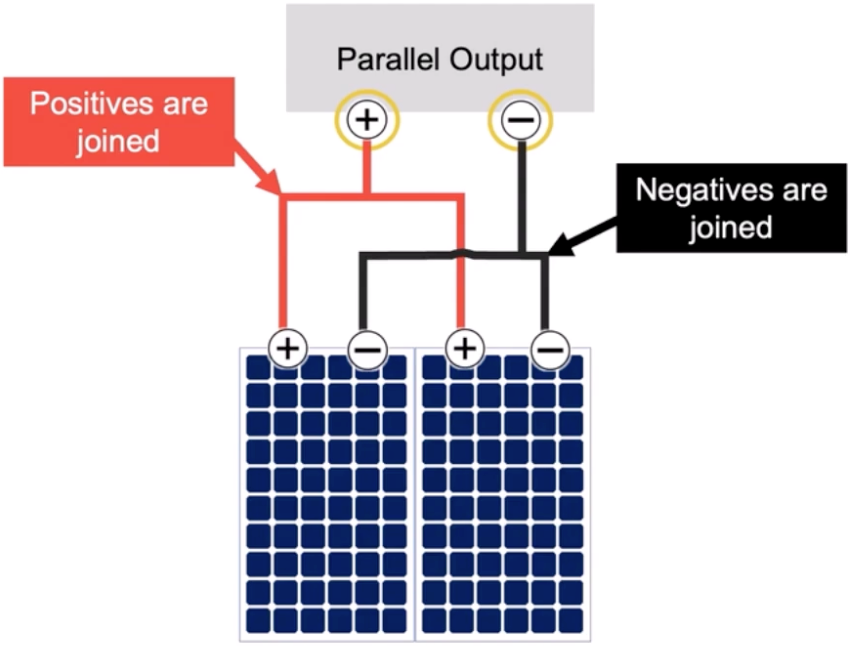 The voltage stays the same: Any components wired between the same two points always share the same voltage across them, a basic rule of circuit theory. So if each module in the array is rated for 50V, the array’s combined voltage is still 50V, no matter how many modules are added.
- The current increases: Each module contributes its own flow of electrons through its own path, and where those paths join becomes, electrically speaking, a wider path, so more electrons can cross a given point over time. Wire two 10A modules in parallel and the array can deliver 20A.
Why it Matters
In a solar system, wiring modules or batteries in parallel is how installers increase current capacity to match what their system needs, without changing the voltage a charge controller or inverter expects to see. This isn’t just a PV array concept; it’s the same principle behind the wiring in any building: every outlet on a breaker panel needs the same voltage, while current draws up as more devices switch on.
Learn the Fundamentals, Free
RE102: Basics of Electrical Theory for Solar Applications is a free, self-paced course covering voltage, current, resistance, and how series and parallel circuits affect a PV array. Enroll and start today!
.fusion-body .fusion-builder-column-1{width:100% !important;margin-top : 0px;margin-bottom : 0px;}.fusion-builder-column-1 > .fusion-column-wrapper {padding-top : 0px !important;padding-right : 0px !important;margin-right : 1.92%;padding-bottom : 0px !important;padding-left : 0px !important;margin-left : 1.92%;}@media only screen and (max-width:1024px) {.fusion-body .fusion-builder-column-1{width:100% !important;}.fusion-builder-column-1 > .fusion-column-wrapper {margin-right : 1.92%;margin-left : 1.92%;}}@media only screen and (max-width:640px) {.fusion-body .fusion-builder-column-1{width:100% !important;}.fusion-builder-column-1 > .fusion-column-wrapper {margin-right : 1.92%;margin-left : 1.92%;}}
.fusion-body .fusion-flex-container.fusion-builder-row-1{ padding-top : 0px;margin-top : 0px;padding-right : 30px;padding-bottom : 0px;margin-bottom : 0px;padding-left : 30px;}


