
Murray Hunt, the 2026 Dairy Cattle Industry Distinction Award winner, challenged the industry to create structures that will serve the sector into the future.
Hunt, who had a major impact on Canadian and global dairy genetics during his career, said that if the 9,000 dairy herds in Canada decline to an expected 3,500 by 2035, organizations serving dairy farmers will need to be more aligned and efficient.
WHY IT MATTERS
The dairy sector is changing, and service providers are working to figure out what they will look like in the future.
Hunt was presented with his award at the annual Lactanet Dairy Open Industry Forum, which draws industry and farmers to discuss the state of the industry and especially genetic and milk testing programs.
“That little spigot at the end of the milk tank can’t pay for the structure that we have now,” he said.
He urged organizations serving dairy farmers to work together to find efficiencies.
A career of change
It isn’t surprising that Hunt used his award speech to challenge the industry.
During his career serving dairy farmers, he brought numerous changes into the dairy genetics sector.
His master’s thesis at the University of Guelph in the early 1970s set the base for the national young dairy sire proving program that led to the acceleration of genetic progress that resulted in Canadian dairy genetics leading the world.
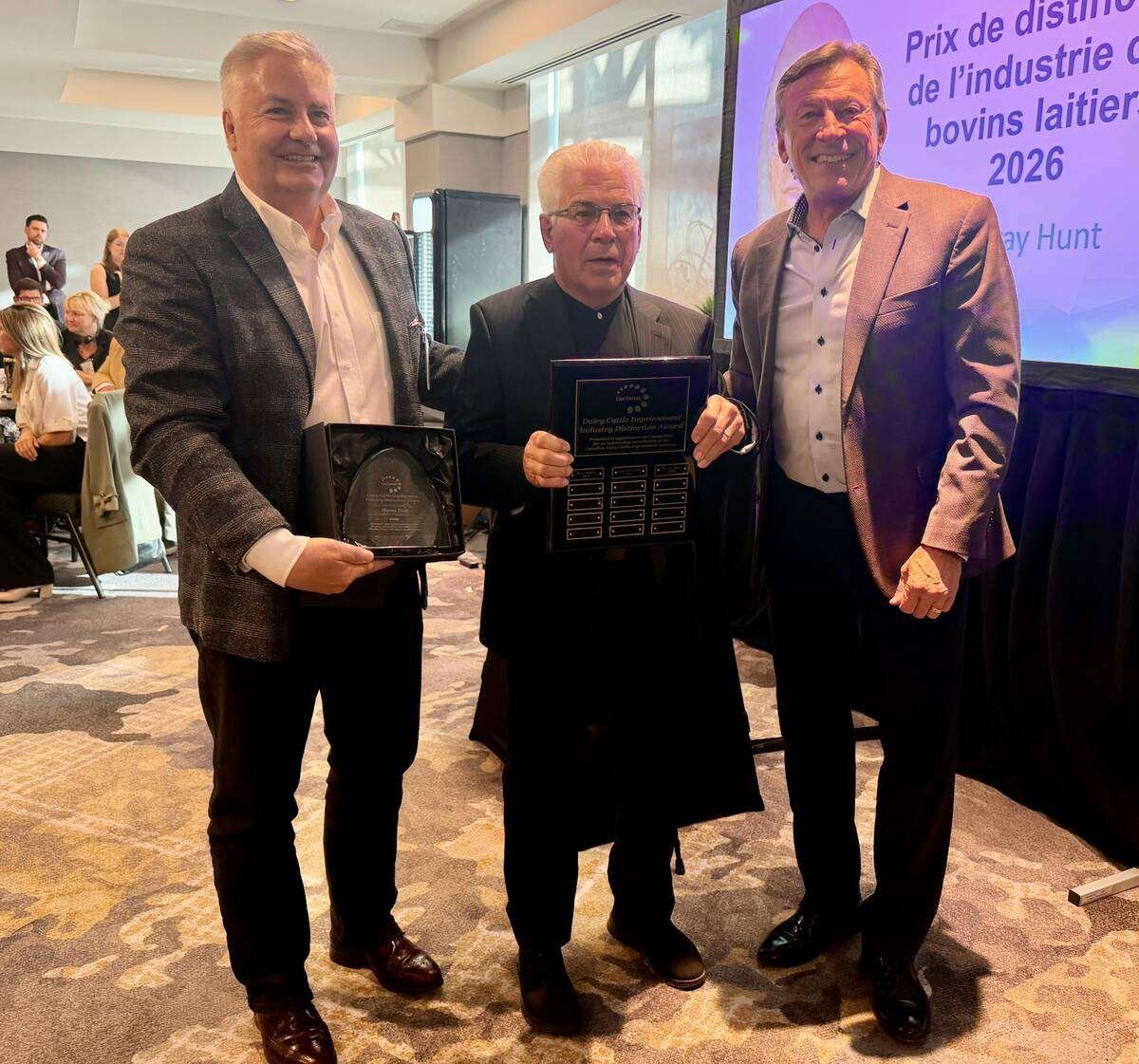
“Looking back now, more than 55 years later, Murray’s master’s thesis was groundbreaking and foundational to the subsequent success of AI (artificial insemination) breeding programs,” said Paul Larmer in introducing Hunt during the award presentation. “At one point, more than 500 young bulls were sampled in Canada in a year.”
Hunt also helped develop the Production Dollar Difference (PDD) index, which helped farmers understand the financial impact of breeding decisions on their farms.
He worked for the Ontario ministry of agriculture as the director of the dairy herd improvement program.
Hunt then worked for 13 years at Holstein Canada, where he led extension and genetic improvement programs and was instrumental in creating the cross-industry groups that helped bring people and data together to develop the system that has benefited Canadian dairy farmers.
“When I joined Holstein Canada, 47 per cent of the first lactation cows were classified Good Plus,” said Hunt in accepting his award. Cows and bulls are classified as Poor, Fair, Good, Good Plus, Very Good and Excellent.
“There were more Goods than there were Good Pluses, and so there was a great need to change udders, and that was successful. I’m not sure we were successful in getting the right feet and legs on the cow, but nevertheless, it was a lot of change.”
He then was instrumental in exporting that system to other countries around the world, and travelled extensively, training dairy cattle classifiers.
Closer to the end of his career, he worked for the Canadian Association of Animal Breeders, and was named executive director in 1991. After his professional retirement in 1998, Hunt and his wife, Karen, ran a consulting company that did work across Canada and internationally. He was also a 4-H leader for 15 years and was involved in his church and theatre community.
While doing all of that other work, he remained involved in his family’s Huntsdale dairy herd, which was awarded a Master Breeder Shield by Holstein Canada in 1984.
At one time, Canadian dairy cattle led the world in genetics.
“I’m very proud of the fact that I worked hard, and we did create the Canadian kind of cow. I’m hearing today, and I fully support the fact that there isn’t one kind of cow for everybody, and that it’s a different world today,” he said, referring to a debate at the industry forum.
He encouraged industry organizations to figure out how to serve the declining number of dairy farmers efficiently.
Taking down the silos
Hunt was an organization silo-breaker.
“Every farmer organization had its own silo, its own goals, its own area, and you didn’t dare get outside them.”
But that was when there were 90,000 dairy farmers, and they milked 25 cows each. Today, there are 9,000 dairy farms, and the average herd size is about 107 cows and growing.
“Some of the silos have been taken down between organizations, but in my opinion, not enough. Sure, we’re faced with data points, automation, new services and everything, but they’re pretty well within organizations. Is that what we can have in the future?”
He encouraged the sector to collaborate on areas where it makes sense, including human resources and information technology.
“I ask you to think, as decision-makers in the industry today, are you prepared to take down all the silos and get together for the benefit of the dairy farms?”
The post Fewer dairy farms will need leaner service groups, award winner says appeared first on Farmtario.


