
Newly appointed provincial agriculture minister Sam Oosterhoff met with commodity leaders at the 107th International Plowing Match and Rural Expo at Walkerton and commited to increasing Risk Management Program funding.
Premier Doug Ford, flanked by Oosterhoff and Huron-Bruce MPP and rural affairs minister Lisa Thompson, fielded questions on the impacts of the trade war and rising fuel and input costs on Ontario’s agri-food sector on the first day of plowing match.
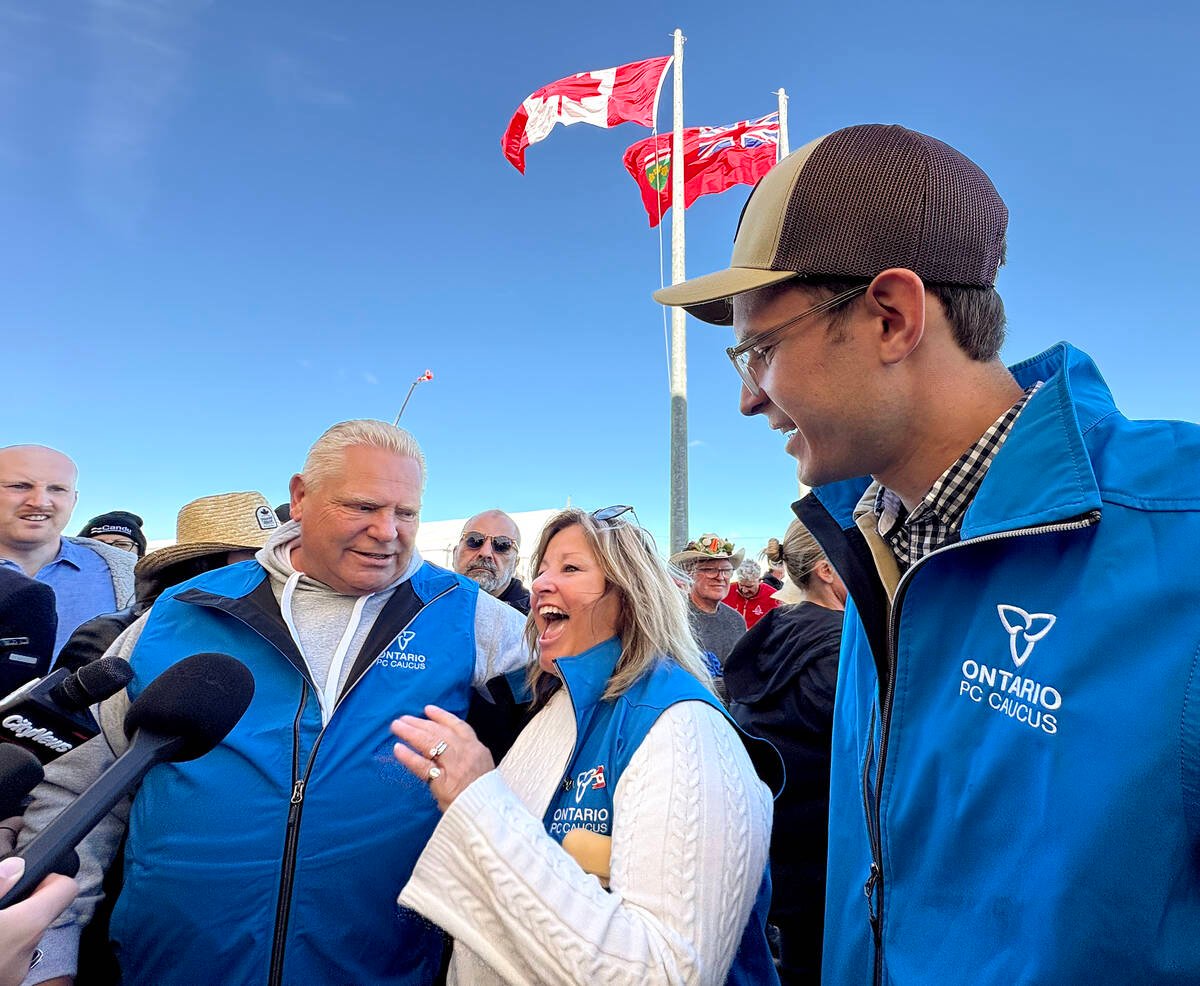
“People don’t realize nothing is bigger than the ag and food industry, $52 billion to our GDP, making us the largest food processors in Canada and one of the most important in the world,” Ford said Tuesday.
Oosterhoff said he grew up sorting hogs and cleaning poultry on his family’s farm, and knows the industry goes beyond the economic numbers.
“It’s also about the culture that’s associated with that. A culture of hard work, of determination, of entrepreneurialism, or risk-taking, of community,” he said.
Oosterhoff said the province is focused on farmer access to programs to offset some of the risk, including expanded funding for the RMP.
RMP funding
“We have an ambitious goal to increase the funding through the Risk Management Program to $250 million by next year,” said Oosterhoff. “I’ve heard strong and resolute support for that, and the need to maintain that commitment and grow that program.”
In January 2025, the province committed to a $100 million program increase phased in over three years culminating in 2027 with a $250 million RMP, with producer premiums remaining at 35 per cent of government funding.
This built on the previous $50 million increase in 2020 and earlier reforms for a roll-over of unused program funds for future year claims.
The premier gave Oosterhoff the tasks of improving security, sovereignty and self-reliance in the agri-food sectors, emphasizing “quicker, faster, immediate” as a way of operating.
That message resonates with farmers, whether it’s cutting red tape, reducing costs or diversifying market access, Oosterhoff said.
“I’m not going to claim to have a magic wand in my hand that I can flip a switch and do all those things,” he said.
Agri-food sector growth
He believes Ontario’s agri-food sector has achievable growth opportunities, pointing to the “incredible” increases in primary production productivity over the last couple of decades.
“There’s also opportunities on the processing side — to keep more of that product here in Ontario, process it, turn it into goods that we can then add value, create jobs, and export all over the globe,” Oosterhoff stated, acknowledging the U.S. plays a role but is not the only option. “We have to look at new markets and expanding what we’re producing.”
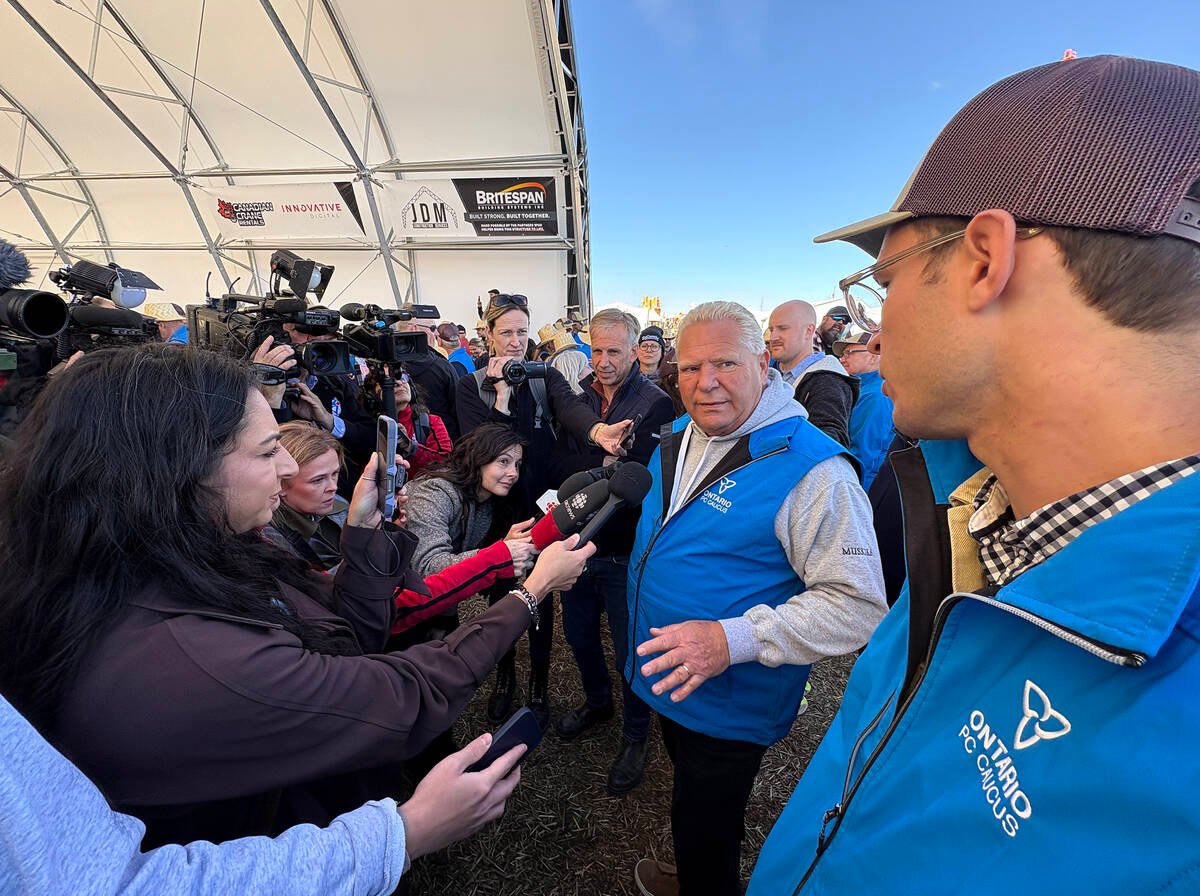
Ford told reporters that 60 per cent of Ontario-grown food is consumed locally and, while the United States is a strong trade partner, it needs to respect that trade flows equally both ways across the border.
Increased pressure
Rising input and fuel costs are top concerns in agriculture, he said. Ford will meet with Alberta Premier Danielle Smith at the end of September to discuss the Northern Shield Energy Corridor, a 3,300-kilometre cross-country pipeline from Alberta to Sarnia, adding he’d like to see it extend to the East Coast and the Irving refinery.
When a reporter pressed Ford, saying a pipeline is a long-term solution but doesn’t address the immediate concern, he pointed to Ontario’s 10.7-cents-a-litre reduction over the last three years and a push for the federal government to maintain the fuel tax relief.
“They said they’re going to cut it off in January. You can’t cut it off in January,” said Ford. “People are hurting. They need money in their pockets.”
Federal fuel tax suspension
Federal finance minister François-Philippe Champagne on Monday introduced Bill C-38, the Canadian Affordability Act, in response to global instability and Middle East supply disruptions increasing fuel costs.
“By extending the federal fuel tax suspension, we’re saving Canadians $5 on a typical 50-litre fill-up, while helping farmers, truckers, builders and businesses manage higher costs,” Champagne said in a press release.
The bill would extend the temporary suspension of the federal fuel excise tax until Jan. 31, 2027, after which the regular rates would be reduced by 50 per cent until March 31, 2027.
Farmland protection
Mike Schreiner, Ontario Green Party leader, used Tuesday’s opening ceremonies to urge politicians to “come together across party lines, jurisdictional lines, unite urban and rural, and let farmers know we have their backs because they feed our communities.”
In May 2025, Schreiner introduced Bill 21, the Protect our Food Act, a bipartisan private member’s bill to protect Ontario’s dwindling productive farmland and create an advisory committee of farmers, soil scientists, professional planners and agricultural organizations to recommend and map long-term protections.
He told the opening ceremony audience the bill would “defend our food security and our food sovereignty to ensure that we don’t continue to lose farmland at an unsustainable rate, because we know that Ontario can be a food superpower.”

Safe water sought
Rachelle, a settler ally of the Grassy Narrows First Nation, also known as Asubpeeschoseewagong Netum Anishinabek, began chanting “Justice for Grassy Narrows,” before being dragged away by an Ontario Provincial Police officer during the premier’s opening ceremony speech Tuesday.
Several others resumed the chant and held signs reading “Stop Doug’s Gravy Train” before being quickly led away.
The First Nation community, about 150 km from Dryden, has experienced generational mercury poisoning since the 1960s and ’70s after the Dryden Paper Mill dumped an estimated nine tonnes of mercury into the water.
The 2024 Western University Riverbank Mercury Methylation Study found that the wastewater, while no longer containing mercury, delivers high levels of sulphate and organic matter that feed bacteria which, combined with existing mercury, create high levels of methylmercury, a more toxic compound.
“(In) Walkerton, there was a water crisis where the government, they addressed it right away,” said Grassy Narrows resident Chrissy Isaacs, who was born with mercury poisoning. “In Grassy Narrows and Wabaseemoong (Independent Nation), we’ve been fighting over 50 years for them to clean up our river, to compensate our people, to shut down the mill so that our people could survive.”
Grassy Narrows community members and supporters marched on Queen’s Park and protested on Wednesday, once again demanding compensation and the shutdown of the Dryden mill, but Isaacs noted Ford and Prime Minister Mark Carney continue to ignore their pleas.
The post RMP funding to reach $250 million, Ontario’s new agriculture minister says appeared first on Farmtario.


