How Student Debt Varies Across the U.S.
Key Takeaways
- Nationally, the average borrower in the U.S. owes roughly $38,000 in student debt.
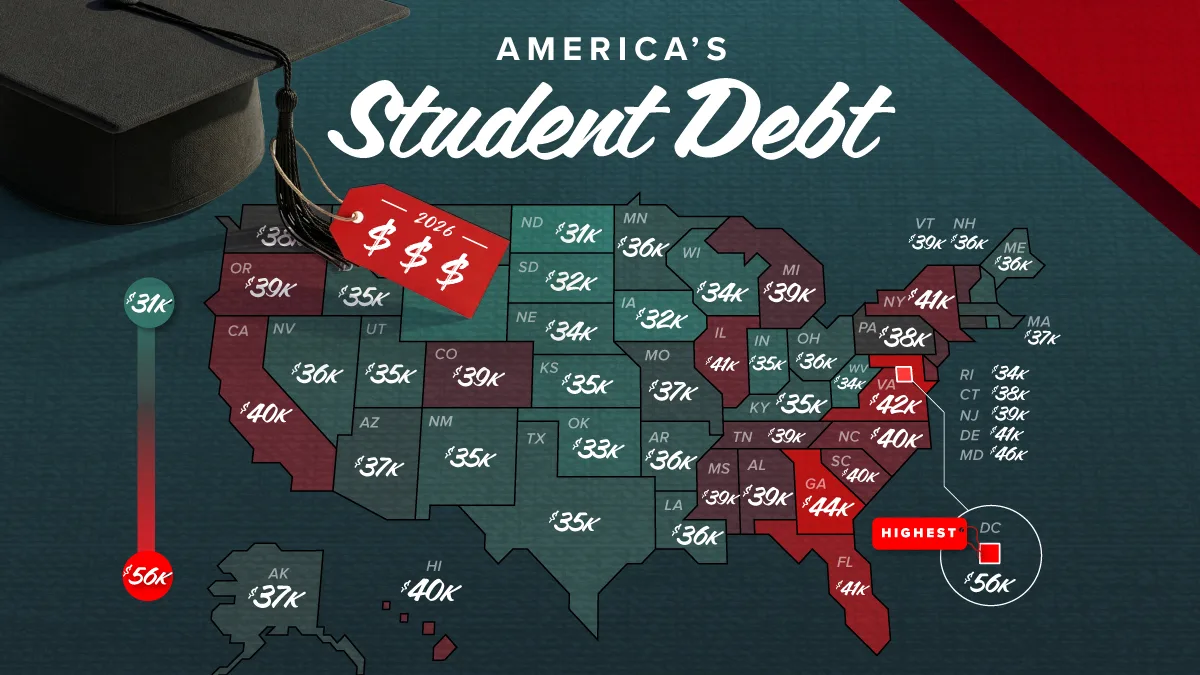
- Borrowers in Washington, D.C., have the highest average federal student debt in the country, at $55,846.
- Student debt is lowest in North Dakota ($30,543) and across much of the Great Plains.
Student debt can follow borrowers long after graduation, with balances shaped by factors ranging from education levels to where borrowers live.
This map shows average federal student loan debt per borrower using Federal Student Aid figures as of March 2026, compiled via the Education Data Initiative. Balances include principal and interest but exclude private student loans.
Where Student Loan Balances Are Highest
More than 40 million individuals, or about one in six American adults, have student debt today. Total federal student loan debt has surpassed $1.8 trillion, making it roughly comparable to the size of South Korea’s economy.
Washington, D.C., stands apart with an average balance of $55,846. Maryland, in a distant second, has the highest average among the 50 states at $45,589, followed by Georgia ($43,813), Virginia ($41,916), and Florida ($41,162).
The following data table ranks states by their average federal debt per borrower.
| Rank | State (+DC) | Avg. Federal Debt per Borrower ($) |
|---|---|---|
| 1 | District of Columbia | 55,846 |
| 2 | Maryland | 45,589 |
| 3 | Georgia | 43,813 |
| 4 | Virginia | 41,916 |
| 5 | Florida | 41,162 |
| 6 | Illinois | 40,774 |
| 7 | New York | 40,666 |
| 8 | Delaware | 40,639 |
| 9 | Hawaii | 40,496 |
| 10 | North Carolina | 40,455 |
| 11 | South Carolina | 40,138 |
| 12 | California | 39,980 |
| 13 | Oregon | 39,499 |
| 14 | New Jersey | 39,174 |
| 15 | Alabama | 39,157 |
| 16 | Mississippi | 39,009 |
| 17 | Colorado | 38,844 |
| 18 | Vermont | 38,770 |
| 19 | Tennessee | 38,664 |
| 20 | Michigan | 38,626 |
| 21 | Connecticut | 38,417 |
| 22 | Washington | 38,139 |
| 23 | Pennsylvania | 37,542 |
| 24 | Alaska | 37,209 |
| 25 | Arizona | 37,114 |
| 26 | Massachusetts | 37,086 |
| 27 | Missouri | 37,024 |
| 28 | Ohio | 36,311 |
| 29 | New Hampshire | 36,228 |
| 30 | Louisiana | 36,167 |
| 31 | Maine | 35,906 |
| 32 | Nevada | 35,879 |
| 33 | Montana | 35,601 |
| 34 | Minnesota | 35,594 |
| 35 | Arkansas | 35,504 |
| 36 | Utah | 35,429 |
| 37 | New Mexico | 35,398 |
| 38 | Kentucky | 35,088 |
| 39 | Texas | 35,014 |
| 40 | Idaho | 34,642 |
| 41 | Kansas | 34,537 |
| 42 | Indiana | 34,502 |
| 43 | Rhode Island | 34,068 |
| 44 | Wisconsin | 33,846 |
| 45 | West Virginia | 33,728 |
| 46 | Nebraska | 33,676 |
| 47 | Oklahoma | 33,483 |
| 48 | Wyoming | 32,847 |
| 49 | Iowa | 31,885 |
| 50 | South Dakota | 31,705 |
| 51 | North Dakota | 30,543 |
States in the country’s interior tend to have lower student debt averages. North Dakota ($30,543) is lowest nationwide, followed by South Dakota ($31,705) and Iowa ($31,885).
Geography can be misleading, however, because these figures are based on a borrower’s state of residence rather than the location of the college they attended. A state’s position therefore reflects the debt carried by people living there, not simply the tuition charged by local universities.
Why D.C. Stands Out
The nation’s capital has an average balance roughly $10,000 higher than the nearest state. One likely factor is D.C.’s high concentration of advanced-degree holders. The District leads the nation in higher education, including graduate education, as well as income, supported in part by high-paying government-adjacent private-sector jobs.
Two-thirds of adults in D.C. have a bachelor’s degree, while more than a third of residents aged 25 and older hold a graduate or professional degree. Meanwhile, median household income tops $109,000, well ahead of any state.
Graduate education, including master’s degrees and law school, can add another layer of borrowing after a bachelor’s degree. Borrowers with more education are more likely to carry larger student loan balances, meaning D.C.’s outlier figure may partly reflect its highly educated population and greater exposure to graduate-school borrowing.
Bigger Balances, Bigger Paychecks?
The D.C. example points to a broader consideration: loan size is only one part of the repayment challenge. Income, employment, and degree completion also matter.
Borrowers with less education are more likely to fall behind on student loan payments, even though they have often taken out less debt than those with more advanced degrees. A smaller loan can still be difficult to repay without the earnings that a completed degree may help provide.
This is important context given that more than 40% of students who attend college never graduate. That leaves millions of Americans carrying student debt without the potential earnings benefit of a completed degree.
Learn More on the Voronoi App
To explore which degrees are associated with the most debt, check out Ranked: Median Student Debt for a U.S. College Degree on Voronoi.