

The average price of photovoltaic systems in Brazil rose by 7% between January and June 2026 for projects up to 300 kW, according to Greener’s “Distributed Energy Solutions” strategic study. Final system prices ranged from BRL 2.02 ($0.38)/W for 30 kW and 50 kW installations to BRL 3.62/W for 2 kW systems.
The survey considers the final price of a PV system, including the equipment kit and integration services. Kit costs are based on price mapping and inquiries with distributors, while final system prices are collected from integrators across Brazil. The difference between the two represents the integration cost, which includes the integrator’s technical and operational margin.
For 2 kW systems, the average price reached BRL 3.62/W in June, up from BRL 3.44/W in January. Based on total installed capacity, this corresponds to a system price of approximately BRL 7,200.
Meanwhile, 30 kW and 50 kW systems recorded the lowest per-watt prices among the system sizes surveyed, at BRL 2.02/W. This corresponds to total system prices of approximately BRL 60,600 and BRL 101,000, respectively.
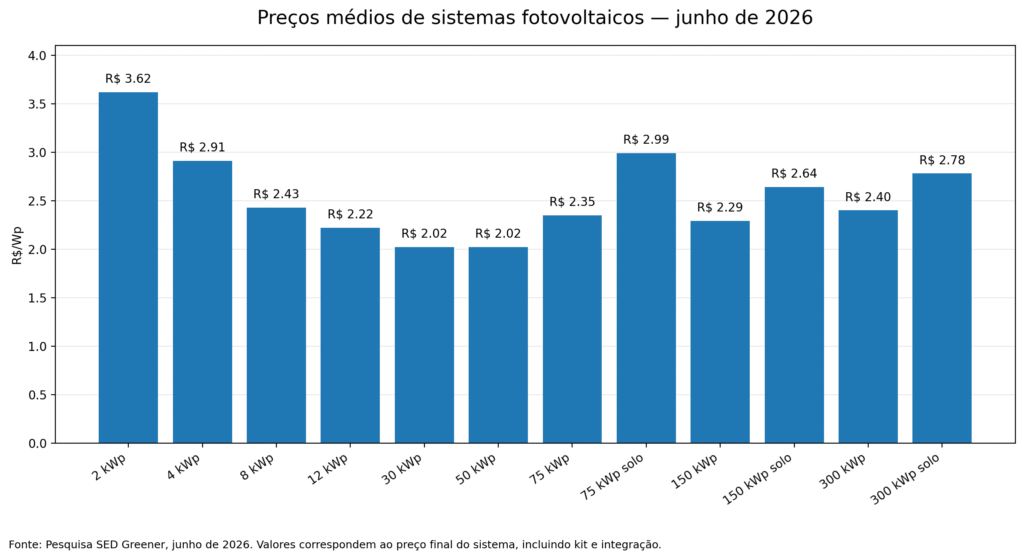
Larger projects have a lower price per watt but require a higher overall investment. A 300 kW system, for example, had an average price of BRL 2.40/W, equivalent to around BRL 720,000. For a ground-mounted system of the same capacity, the average price reached approximately BRL 834,000.
Kit prices rise
The increase in final system prices came amid a sharper rise in equipment costs. The average price of PV kits for 4 kW systems rose by 18.3% between January and June 2026, from BRL 1.42/W to BRL 1.68/W.
The increase varied by system size. For 300 kW systems, the average kit price rose from BRL 1.02/W in January to BRL 1.04/W in June, an increase of 2.0%. For 50 kW systems, it climbed from BRL 1.14/W to BRL 1.24/W, up 8.8%.
Greener’s historical data shows that current prices remain well below levels recorded during the earlier stages of Brazil’s distributed solar market. The average price of a 4 kW residential system fell from BRL 7.74/W in January 2017 to BRL 2.91/W in June 2026. For a 50 kW commercial system, the average price declined from BRL 6.06/W to BRL 2.02/W over the same period.
Residential market gains share
The price trends come as Brazil’s distributed generation market lost momentum in the first half of 2026. New connections fell by 16% compared with the same period in 2025, from 488,000 to 411,000, while the number of new consumer units receiving credits dropped by 43%, from 951,000 to 541,000.
At the same time, residential systems accounted for a growing share of new installations. The residential segment represented 65% of added capacity in the first half of 2026, up from 39% in 2019, while the commercial segment’s share fell to 19%.
The concentration of sales in smaller systems underscores the importance of pricing for residential consumers. In a survey of system integrators, 80% identified residential systems of up to 12 kW as their best-selling category. Commercial systems ranging from 12 kW to 75 kW accounted for 16%, while systems above 75 kW represented 4%.
Financing may also influence purchasing decisions. Only 33% of integrators’ sales involved financing in the first half of 2026, down eight percentage points from 2025 and the lowest share recorded during the period analyzed.
The post PV system costs increase by 7% in Brazil in H1 appeared first on pv magazine Global.


