

Enforced by the U.S. Department of Commerce, a 15% Section 232 tariff on imports of polysilicon products takes effect on December 4, leaving developers with a narrowing window to secure lower-cost supply. Anza, a solar and energy storage data and analytics company, recommends that developers prioritize inventory already in the U.S. and evaluate which additional shipments can clear customs before the December 4 deadline.
Developers should also lock in domestic-content supply, including considering whether blending domestic and imported products could reduce overall CapEx. At the same time, they should review how contracts allocate exposure to retroactive tariffs and stockpiling risks and, where possible, seek written commitments from suppliers to absorb those risks.
The 15% tariff that goes into effect in about ten weeks will raise prices on polysilicon as well as on solar ingots, wafers, cells and modules. Anza reports that the median price for imported modules was $0.27/W before the August 7 proclamation and is now $0.38/W for delivery after December 4, among suppliers that have repriced, an increase of more than 40%.
The tariff is the result of the Secretary of Commerce finding in a Section 232 investigation that the quantities and circumstances of polysilicon imports threaten harm to U.S. national security.
[Read Trump signs Section 232 tariffs, placing minimum import price on polysilicon imports]
The challenge for developers is to move quickly to secure lower costs before the minimum pricing takes effect, Anza says, adding that the options are to secure modules already in the U.S., accelerate imports or shift procurement strategies to preserve project economics.
Anza reports that as of September 9, 55% of active suppliers on its platform had Section 232-inclusive pricing, covering 65% of modules on the platform. While Anza has access to lower-cost pre-deadline supply, although “the window is shrinking.” On quotes where Anza can compare the same SKU and contract terms, pricing has increased by about 15%.
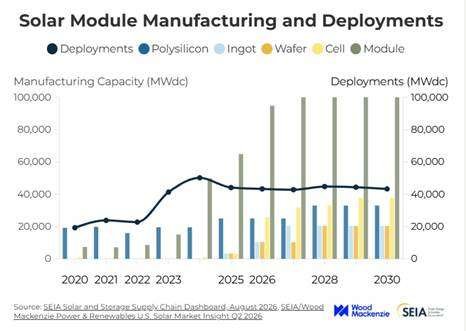
Fortunately, the future holds promise for U.S. manufacturing across the U.S. supply chain. The Solar Energy Industries Association reports that the U.S. currently has 75.3 GW of module manufacturing capacity, which it says is enough to supply current market demand. Moving further up the supply chain shows less current capacity, the Solar Energy Industries Association (SEIA) forecasts a jump in ingot and cell manufacturing in the next year and for polysilicon and wafer by 2028.
Developers who are in the procurement process now are entering the “most critical procurement window,” Aaron Hall, president of Anza said in a statement, adding that developers can’t wait until December 4 to make a procurement decision as modules need time to ship and clear U.S. Customers before the deadline.
“Developers need to understand what is available now, at what price and on what terms, and move quickly on the strategy that makes the most sense for their project,” said Hall.
The post Anza expects at least a 40% spike in U.S. solar module prices after Section 232 appeared first on pv magazine Global.


