How the Global Math Leaderboard Has Changed
Key Takeaways
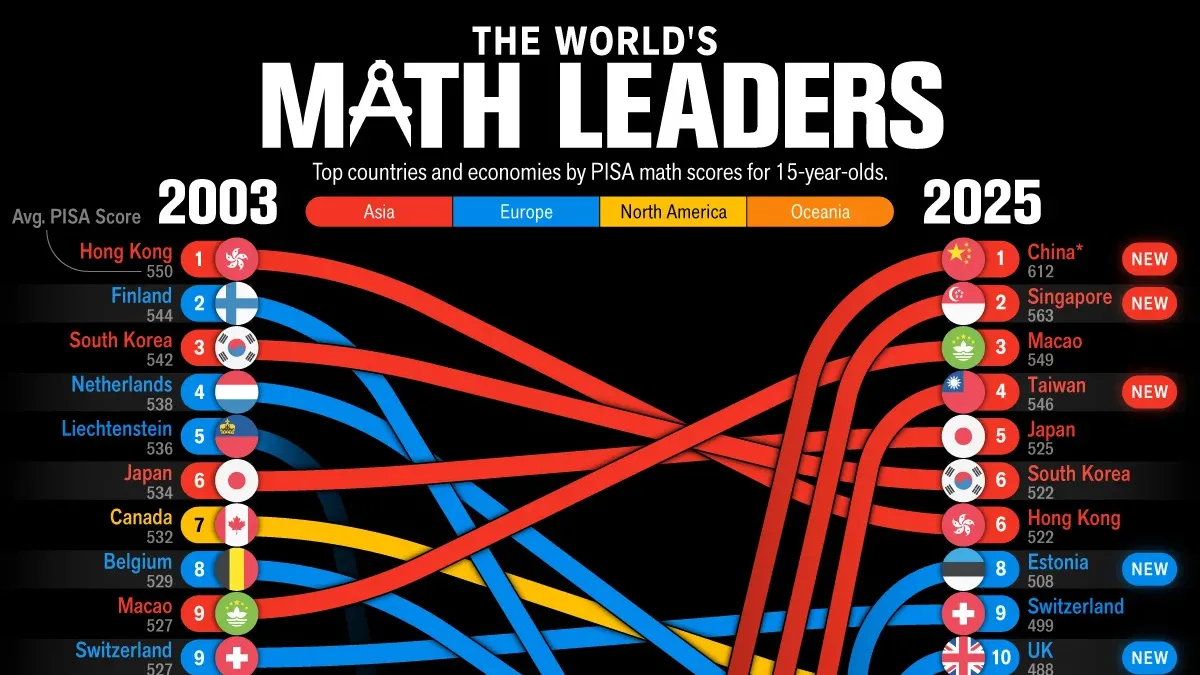
- In 2003, just three of the seven highest-scoring economies in PISA mathematics were in Asia. By 2025, all seven were Asian economies.
- Several former leaders, including Finland, the Netherlands, and Canada, have fallen substantially from their 2003 positions.
- The United States remains well outside the group of top-performing economies in mathematics.
The global landscape for math achievement has shifted significantly over the past two decades.
This visualization compares Programme for International Student Assessment (PISA) mathematics scores for 15-year-olds in 2003 and 2025. PISA measures how well 15-year-old students can apply their knowledge and skills to real-world problems.
The Top Scorers in Math in 2003
In 2003, the highest-performing education systems included a mix of European, Asia-Pacific, and North American economies.
| Country / Economy | 2003 PISA Score | Region |
|---|---|---|
 Hong Kong Hong Kong |
550 | Asia |
 Finland Finland |
544 | Europe |
 South Korea South Korea |
542 | Asia |
 Netherlands Netherlands |
538 | Europe |
 Liechtenstein Liechtenstein |
536 | Europe |
 Japan Japan |
534 | Asia |
 Canada Canada |
532 | North America |
 Belgium Belgium |
529 | Europe |
 Macao Macao |
527 | Asia |
 Switzerland Switzerland |
527 | Europe |
 Australia Australia |
524 | Oceania |
 New Zealand New Zealand |
523 | Oceania |
 Czechia Czechia |
516 | Europe |
 Iceland Iceland |
515 | Europe |
 Denmark Denmark |
514 | Europe |
 France France |
511 | Europe |
 Sweden Sweden |
509 | Europe |
 Austria Austria |
506 | Europe |
 Germany Germany |
503 | Europe |
 Ireland Ireland |
503 | Europe |
 Slovakia Slovakia |
498 | Europe |
 Norway Norway |
495 | Europe |
 Luxembourg Luxembourg |
493 | Europe |
 Hungary Hungary |
490 | Europe |
 Poland Poland |
490 | Europe |
 Spain Spain |
485 | Europe |
 Latvia Latvia |
483 | Europe |
 United States United States |
483 | North America |
 Russia Russia |
468 | Europe |
 Italy Italy |
466 | Europe |
Hong Kong led the participating economies in mathematics with an average score of 550, followed by Finland at 544 and South Korea at 542. The Netherlands, Liechtenstein, Japan, and Canada completed the top seven.
How the Ranking Shifted by 2025
By 2025, every economy in the top seven was located in Asia.
| Country / Economy | 2025 PISA Score | Region |
|---|---|---|
 China China |
612 | Asia |
 Singapore Singapore |
563 | Asia |
| Macao |
549 | Asia |
 Taiwan Taiwan |
546 | Asia |
| Japan |
525 | Asia |
| South Korea |
522 | Asia |
| Hong Kong |
522 | Asia |
 Estonia Estonia |
508 | Europe |
| Switzerland |
499 | Europe |
 UK UK |
488 | Europe |
| Canada |
485 | North America |
| Poland |
484 | Europe |
| Netherlands |
483 | Europe |
| New Zealand |
480 | Oceania |
| Ireland |
480 | Europe |
| Belgium |
480 | Europe |
| Australia |
478 | Oceania |
| Austria |
477 | Europe |
| Czechia |
477 | Europe |
| Denmark |
471 | Europe |
 Lithuania Lithuania |
470 | Europe |
| Finland |
469 | Europe |
| Slovakia |
469 | Europe |
| Italy |
468 | Europe |
| Germany |
464 | Europe |
| Sweden |
464 | Europe |
| United States |
463 | North America |
 Türkiye Türkiye |
462 | Asia |
 Slovenia Slovenia |
460 | Europe |
 Portugal Portugal |
460 | Europe |
China, representing Beijing, Shanghai, Jiangsu, and Zhejiang, recorded the highest mathematics score at 612, while Singapore followed at 563. Across OECD countries as a whole, the average mathematics score stood at 463 in 2025.
Former Leaders Lose Ground
Several countries that ranked near the top in 2003 have moved down considerably.
Finland, which scored 544 in mathematics in 2003, recorded 469 in 2025.
Canada’s score fell from 532 to 485, while the Netherlands declined from 538 to 483.
The United States remains well outside the group of top-performing economies in mathematics. While American students perform more strongly in reading and science, math has historically been a weaker area in PISA assessments.
Math Scores Are Falling More Broadly
OECD data shows that the broader decline is continuing: average mathematics performance across 35 OECD countries fell another nine points between 2022 and 2025.
On a longer timeline, average mathematics scores fell by 22 points between 2015 and 2025, which the OECD estimates is equivalent to just over one year of learning.
PISA also found an association between heavy digital leisure use and student outcomes. Students spending more than four hours a day on digital leisure activities outside school tended to have lower mathematics scores and a weaker sense of belonging.
By contrast, moderate digital use was associated with better outcomes on both measures than either no use or very high use.
China’s Result Comes With an Important Caveat
China’s 2025 result does not represent the entire mainland Chinese student population.
The reported score covers Beijing, Shanghai, Jiangsu, and Zhejiang. These jurisdictions recorded an average mathematics score of 612, the highest in PISA 2025.
Learn More on the Voronoi App 
If you enjoyed today’s post, check out Countries by Education Spending as % of GDP on Voronoi.