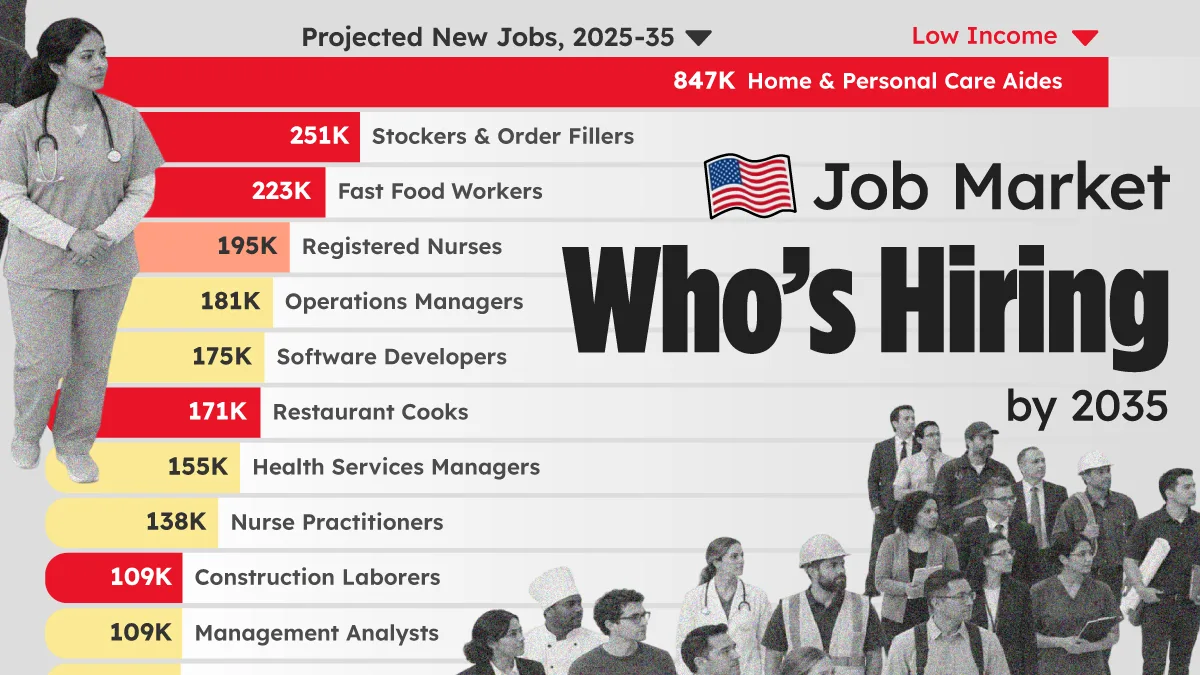
Which U.S. Jobs Will Add the Most Workers by 2035?
Key Takeaways
- Home health and personal care aides are projected to add 847,000 jobs by 2035, more than three times as many as any other occupation.
- Eleven of the 30 occupations expected to add the most jobs have median annual wages below the U.S. median of $50,980.
- Nurse practitioners are projected to grow 41% by 2035, the fastest rate among the occupations shown.
The U.S. labor market is projected to add nearly 5.9 million jobs between 2025 and 2035.
This graphic ranks 30 occupations by their projected increase in employment over the decade. The data for this visualization comes from the U.S. Bureau of Labor Statistics, using employment projections for 2025 to 2035.
The figures measure the net increase in employment for each occupation rather than total job openings, which can also include positions created when existing workers retire or change careers.
Home Care Dominates U.S. Job Growth
Home health and personal care aides stand far above every other occupation, with 847,300 new jobs projected by 2035. That represents about 14% of all net new jobs expected across the U.S. economy over the decade.
| Rank | Occupation | New jobs by 2035P | Median wage, 2025 |
|---|---|---|---|
| 1 | Home & Personal Care Aides | 847K | $35,800 |
| 2 | Stockers & Order Fillers | 251K | $37,330 |
| 3 | Fast Food Workers | 223K | $31,200 |
| 4 | Registered Nurses | 195K | $97,550 |
| 5 | Operations Managers | 181K | $105,770 |
| 6 | Software Developers | 175K | $135,980 |
| 7 | Restaurant Cooks | 171K | $37,390 |
| 8 | Health Services Managers | 155K | $123,860 |
| 9 | Nurse Practitioners | 138K | $132,300 |
| 10 | Construction Laborers | 109K | $47,120 |
| 11 | Management Analysts | 109K | $101,860 |
| 12 | IT Managers | 108K | $175,140 |
| 13 | Medical Assistants | 108K | $45,690 |
| 14 | Mental Health Counselors | 98K | $59,350 |
| 15 | Data Scientists | 95K | $120,230 |
| 16 | Financial Managers | 85K | $166,570 |
| 17 | Heavy Truck Drivers | 84K | $58,640 |
| 18 | Industrial Mechanics | 80K | $64,520 |
| 19 | Accountants & Auditors | 79K | $83,680 |
| 20 | Electricians | 76K | $63,190 |
| 21 | Project Managers | 73K | $102,320 |
| 22 | Maintenance Workers | 69K | $49,590 |
| 23 | Light Truck Drivers | 68K | $44,860 |
| 24 | Food Service Supervisors | 67K | $44,080 |
| 25 | Market Research Analysts | 66K | $78,760 |
| 26 | Other Managers | 66K | $141,900 |
| 27 | HR Specialists | 60K | $75,940 |
| 28 | Landscaping Workers | 56K | $39,150 |
| 29 | Construction Managers | 55K | $114,990 |
| 30 | Janitors & Cleaners | 54K | $36,840 |
Demand is being fueled in part by America’s aging population and a shift toward providing long-term care in home and community settings. The Census Bureau projects that adults age 65 and older will outnumber children under 18 by 2029.
Healthcare and Tech Roles Are Growing Quickly
Healthcare occupations appear throughout the ranking, including registered nurses, medical assistants, nurse practitioners, and medical and health services managers.
Nurse practitioners are projected to grow 41% between 2025 and 2035, the fastest percentage increase among the occupations shown, while adding nearly 138,000 jobs.
Technology also remains a major source of higher-paying employment, with software developers projected to add about 175,000 jobs and data scientists another 95,000. Both occupations had median annual wages above $120,000 in 2025.
Job Growth Spans the Wage Spectrum
Some of the country’s biggest sources of new jobs are relatively low-paying service occupations.
Eleven of the 30 occupations shown have median annual wages below the overall U.S. median of $50,980, including home health and personal care aides, fast food workers, restaurant cooks, and light truck drivers.
At the other end of the spectrum, the ranking includes IT managers, financial managers, software developers, and nurse practitioners, all with median wages above $130,000.
The Skills Shaping the Jobs of the Future
Looking ahead, the skills needed in the labor market are also expected to shift.
According to the World Economic Forum’s Future of Jobs Report 2025, nearly 40% of skills required on the job are expected to change by 2030.
While demand for AI, big data, and cybersecurity skills is rising quickly, employers also continue to prioritize human capabilities such as analytical thinking, creative thinking, resilience, leadership, and collaboration.
Learn More on the Voronoi App 
If you enjoyed today’s post, check out Every U.S. State’s Most Common Job, 25 Years Apart on Voronoi.