

More than 700 companies have now committed to reaching net-zero carbon emissions by 2040 through The Climate Pledge, but the rapid growth of corporate climate action is running into a major global challenge: there is still not enough clean energy capacity being built to meet the world’s 2030 renewable target.
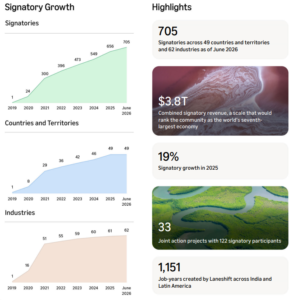
The Climate Pledge’s 2026 report counted 705 signatories across 49 countries and territories and 62 industries. The combined revenue of the companies is about $3.8 trillion. The current Climate Pledge website now lists 728 signatories.
At the same time, the International Renewable Energy Agency (IRENA) says the world added a record 692 gigawatts (GW) of renewable power capacity in 2025, bringing total renewable capacity to 5,149 GW.
That is strong growth, but it is still below the pace needed to triple global renewable capacity by 2030. The gap matters for companies trying to cut emissions because corporate demand for clean electricity is growing faster than renewable supply in many markets.
Climate Pledge Companies Are Turning Net-Zero Targets Into Action
The new Climate Pledge report provides some evidence that corporate commitments are translating into action.
Among 119 signatories analyzed in the report, representing about 90% of publicly available signatory revenue, operational carbon emissions fell by an average of 11% between the measured periods. That compares with a 7% average decline among other companies in the dataset.
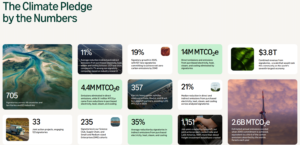
The median reduction among the analyzed signatories was even higher at 21%. Three out of four companies reduced emissions from their direct operations and purchased energy.
The biggest reduction came from Scope 2 emissions, which fell by an average of 35%. These are emissions linked to purchased electricity, heat, steam, and cooling. Renewable energy procurement was a major reason for that decline.
By comparison, Scope 1 emissions fell 4% on average. These come directly from company operations, including fuel use and industrial processes.
That difference highlights a major issue for the next stage of corporate decarbonization. Buying more renewable electricity can reduce power-related emissions, but cutting emissions from factories, fleets, buildings and industrial processes is often harder.
Angel Hsu, Associate Professor and Founder of the Data Driven Envirolab at the University of North Carolina at Chapel Hill, wrote:
“Through the Net Zero Tracker, we spend our time scrutinizing whether corporate climate commitments are credible and actually hold up over time. What’s encouraging in the data is how many companies are not only staying the course, but in many cases strengthening their targets over time while backing them with measurable progress. That continued commitment is what turns a net-zero claim into a credible plan.”
Renewable Power Is Growing at Record Speed
Global renewable deployment is nevertheless moving quickly. IRENA reports that 692 GW of renewable capacity was added in 2025, a 15.5% increase from the previous year. Renewables accounted for 85.6% of all new power capacity added globally.
Solar dominated the expansion, with about 511 GW added. Wind contributed another 158.7 GW. Together, solar and wind made up 96.8% of net renewable additions.
- Renewables now represent about 49% of global installed power capacity, according to IRENA.
The economics are also improving. IRENA says more than 85% of new renewable projects are now cheaper than fossil-fuel alternatives, while the cost of solar power has fallen 87% since 2010, onshore wind by 55%, and battery storage by 93%.
The market is therefore no longer simply waiting for renewable technology to become competitive. The bigger challenge is deploying it fast enough and connecting it to consumers.
The World Still Has a 2030 Renewable Capacity Gap
At COP28, countries agreed to work toward tripling global renewable power capacity by 2030. IRENA estimates this means reaching about 11.2 terawatts (TW) by 2030. To get there, the world needs average annual additions of about 1,122 GW between 2025 and 2030, with renewable capacity growing about 16.6% a year.
The 692 GW added in 2025 was therefore about 430 GW below that annual average pace. Put another way, 2025 deployment reached only about 62% of the average annual capacity addition needed to stay on the tripling path.
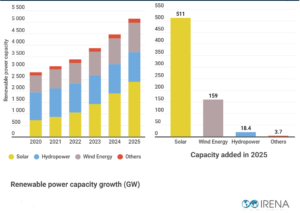
IRENA’s latest data also shows that deployment remains highly concentrated. China, the United States and the European Union accounted for 79.5% of all new renewable capacity added in 2025, while Africa accounted for only 1.6%.
That imbalance is a major concern for companies operating across emerging markets, where access to renewable electricity can remain limited even as corporate climate targets become more demanding.
Grids and Finance Are Becoming the Bottlenecks
The renewable gap is not simply a question of building more solar panels and wind turbines. IRENA’s 2026 analysis points to several practical barriers, including:
- Grid capacity,
- Energy storage,
- Permitting,
- Financing, and
- Supply chains.
Grid upgrades are especially important because solar and wind projects can be built faster than new transmission and distribution infrastructure. This creates a growing problem for companies.
A business can have a target to use 100% renewable electricity, but achieving it depends on whether suitable projects exist in the markets where it operates and whether the grid can deliver the required power.
The Climate Pledge report reflects that challenge. Its signatories reduced purchased-energy emissions much faster than direct operational emissions, showing that renewable procurement can move relatively quickly while harder industrial reductions take longer.
That is why corporate demand can play an important role in the renewable market. Long-term power purchase agreements and other procurement contracts can provide developers with predictable demand and help projects secure financing.
Corporate Demand Could Boost Carbon Markets
The Climate Pledge is relevant to the carbon market as well. Its members commit to measure and report emissions, reduce them through operational changes and clean energy, and neutralize remaining emissions with additional, quantifiable, real and permanent offsets.
Yet, that does not mean all 700-plus companies will rely heavily on carbon credits. The framework puts direct emissions cuts first. But as companies reduce their operational emissions, the remaining emissions become harder to eliminate. That could increase demand for high-quality carbon removals and other credible climate projects over time.
The Climate Pledge report estimates that if its signatories collectively reach net zero, they could eliminate at least 2.6 billion metric tons of CO2e annually. The organization says this is roughly equivalent to one-third of the carbon absorbed by the world’s forests each year.
This is a projection, not a measured reduction already achieved, and the report notes that emissions overlaps between companies mean it should not be treated as a simple absolute emissions reduction. That distinction is important when assessing the real market impact.
The Next Decade Will Test How Fast Markets Can Scale
The two new data sets point to the same market challenge from different directions. Corporate climate commitments are expanding quickly. The Climate Pledge added 107 companies in 2025, a 19% increase from 2024. Signatories now span dozens of industries, including sectors that are difficult to decarbonize.
Renewable power is also expanding at record levels, but the world still needs much faster deployment to reach the 2030 tripling goal. For companies, this creates both a challenge and a business opportunity.
More renewable capacity, stronger grids and better storage can make corporate emissions targets easier to deliver. Long-term corporate demand can, in turn, help finance new clean energy projects. The key issue is timing.
The Climate Pledge gives companies until 2040 to reach net zero, while the global renewable tripling target arrives in 2030. That leaves only a few years to close the renewable deployment gap. The latest numbers show progress, but they also show how much more infrastructure must be built.
The corporate climate market is growing. The renewable market is growing even faster. However, neither is moving fast enough to close the gap between today’s commitments and the clean energy system needed to meet them.
The post 700+ Companies Commit to Net Zero by 2040, But Renewable Growth Still Falls Short appeared first on Carbon Credits.


