

A road that regularly disappears beneath the waterline needs an innovative long-term solution to keep it dry. Here’s what that looks like.
The A483 Fabian Way drainage improvement project solved a long-standing flooding issue on one of South Wales’s busiest commuter roads. To fix surface water problems on the main route into Swansea, Neath Port Talbot County Borough Council (NPTCBC) and ACO Technologies worked together, while also helping to ensure the protection of a Site of Special Scientific Interest (SSSI) next to the River Neath wetlands.
Fabian Way shows how technical, environmental, and infrastructure needs can be balanced through thoughtful design. Here, Matthew Denniff, Storm Water Control Sales Engineer at ACO Water Management, explores five key lessons for designers and environmental consultants.
The project faced two main challenges; legacy drainage systems which often caused flooding and made parts of the road unusable, and polluted run-off that had to be prevented from reaching the protected SSSI and nearby marshland. Martin Smith, Regional Specification Manager at ACO, and I designed a solution for both issues, with several lessons learned that can help guide similar projects in the future.
Lesson one: Treat water management and environmental protection as one challenge
Flood resilience and safeguarding natural features should be approached as a single, integrated design problem. On most highway drainage schemes, attenuation and flow control sit at the heart of the brief. For Fabian Way, the system also had to meet a higher pollution mitigation standard set by Natural Resources Wales (NRW) and NPTCBC, with any discharge into the surrounding wetlands subject to enhanced treatment requirements.
Approaching these as separate workstreams would have risked compromise on one or both. By viewing them as a unified problem from the outset, the design team could specify a system that delivered the hydraulic performance needed to stop the flooding while also meeting the heightened environmental standards the unique location required.
Lesson two: Reassess designs on long-tail projects for maximum benefit
Initial discussions within the project team in late 2022 and early 2023 could not establish an optimal treatment approach for the surface run-off. However, rather than press ahead with a less-suited solution, Martin and I revisted the issue when ACO’s StormSed range launched during the design phase.
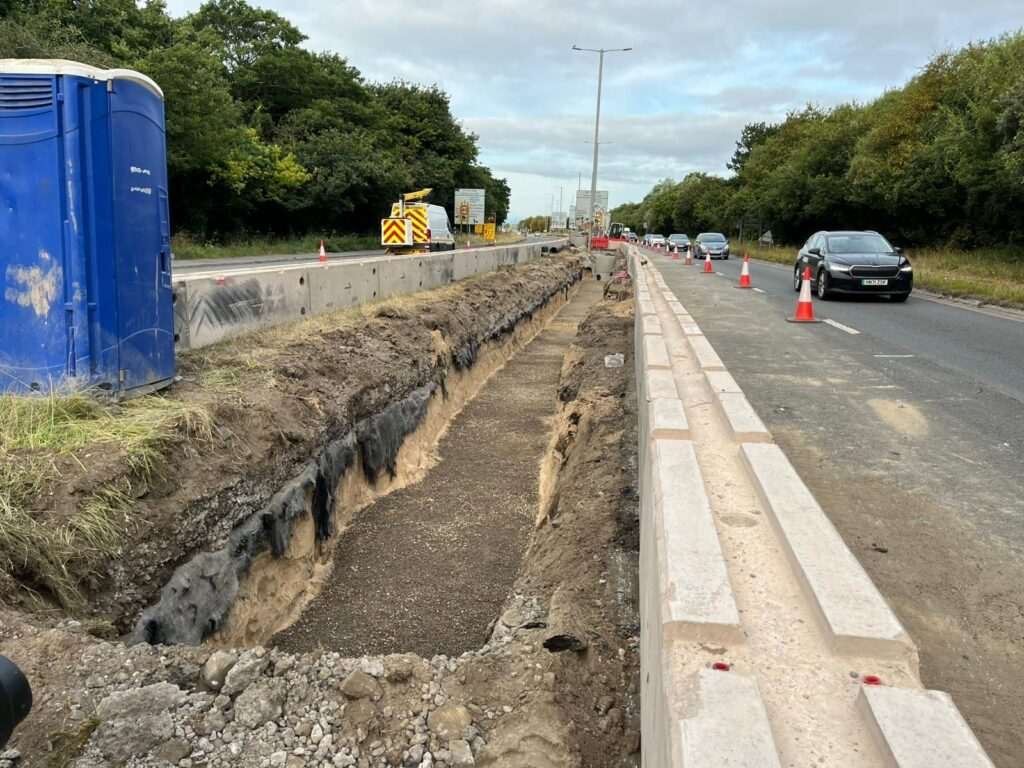
This reassessment proved decisive. The StormSed Filter 1800 and StormSed Vortex 1000 units offered superior pollution capture at a lower overall cost than the original proposal, making them a better fit for a sensitive location. The final scheme, approved in March 2025 by both the SuDS Approving Body (SABS) office and NRW, divided the carriageway into several drainage networks to improve resilience, with the central reservation providing 70m³ of attenuation, supported by StormSed treatment chambers, Q-Brake flow controls, and ACO HB480E+ kerb drainage.
The wider message is the value of remaining open to design revisions on schemes with longer development timelines. Where new technology or refined product selection emerges during the design phase, the cost of reassessment is often outweighed by the long-term gains in performance, cost, or environmental outcome.
Lesson three: Plan around physical constraints rather than against them
Few infrastructure schemes offer a clean slate, and Fabian Way was no exception. Existing pipework, lighting, and signage in the central reservation could not be altered or removed for installation, ruling out the use of standard attenuation units as they would not fit the available footprint.
The solution was to specify custom StormBrixx tanks, manufactured to be shallower, thinner, and longer than the standard product, and therefore suiting the constrained space. This adapted approach allowed the full 70m³ of attenuation volume to be delivered within a footprint that would otherwise have made the scheme unfeasible.
What this taught us was a lesson in design philosophy. On retrofit and improvement schemes in particular, working with the realities of fixed constraints by using bespoke or adapted components often delivers a better result than trying to force a standard product into an unsuitable space. The willingness to depart from off-the-shelf solutions where necessary can be the difference between a successful outcome and a stalled project.
Lesson four: Build in long-term performance
Designed performance only translates into the real-world when the product is properly maintained. Drainage systems protecting environmentally sensitive locations need to perform consistently for decades. At Fabian Way, NPTCBC has committed funding to clean the attenuation system whenever the central reservation grass is cut, combining drainage upkeep with an existing maintenance routine. By embedding maintenance into the wider operational norm of the road, the council is ensuring the system can continue delivering its hydraulic and environmental benefits long after the project’s completion.
It is a model worth replicating. For schemes where downstream environmental outcomes are central to the design intent, securing a maintenance regime should be treated as part of the design conversation, not a separate box to tick once the contractor leaves site.
Lesson five: Systems-based approachs are better for environmentally sensitive drainage
The most important lesson from Fabian Way is the value of a fully integrated, systems-based approach. The StormBrixx tanks, StormSed chambers, Q-Brake flow controls and HB480E+ kerb drainage were specified to work together as a single coordinated solution, supported by a maintenance regime designed around them. The result is a scheme that simplifies installation, supports long-term reliability, and balances competing demands without compromising on any of them.
Fabian Way was a unique project, but its lessons translate well. Early collaboration with regulators, technical reassessment when new options emerge, design adaptation around fixed constraints, and integrated maintenance are all transferable principles, applicable wherever highway infrastructure meets environmental sensitivity.
The overarching lesson from Fabian Way is straightforward: schemes in environmentally sensitive locations are rarely succeed based on a single decision – they thrive by treating the design as a system, and giving each part the attention it needs.
Image: ACO
More on Transport & Planning:
Public health crisis: UK urban nature access comparable with Victorian Britain
UK flash flooding season is here, new mitigation efforts are needed
TPE unveils £1bn battery-electric train fleet for northern England


