

There was a time when Ola Electric looked like the company that could change India’s automobile industry.
Not merely the EV industry.
The whole automobile industry.
It had acquired a Dutch electric-scooter startup, built one of India’s most ambitious two-wheeler factories, promised millions of vehicles, created a scooter that became a household name, began developing its own battery cells and then started talking about motorcycles, cars, AI and energy storage.
The ambition was enormous.
So was the attention.
And for a while, the numbers justified it.
Then the market moved on.
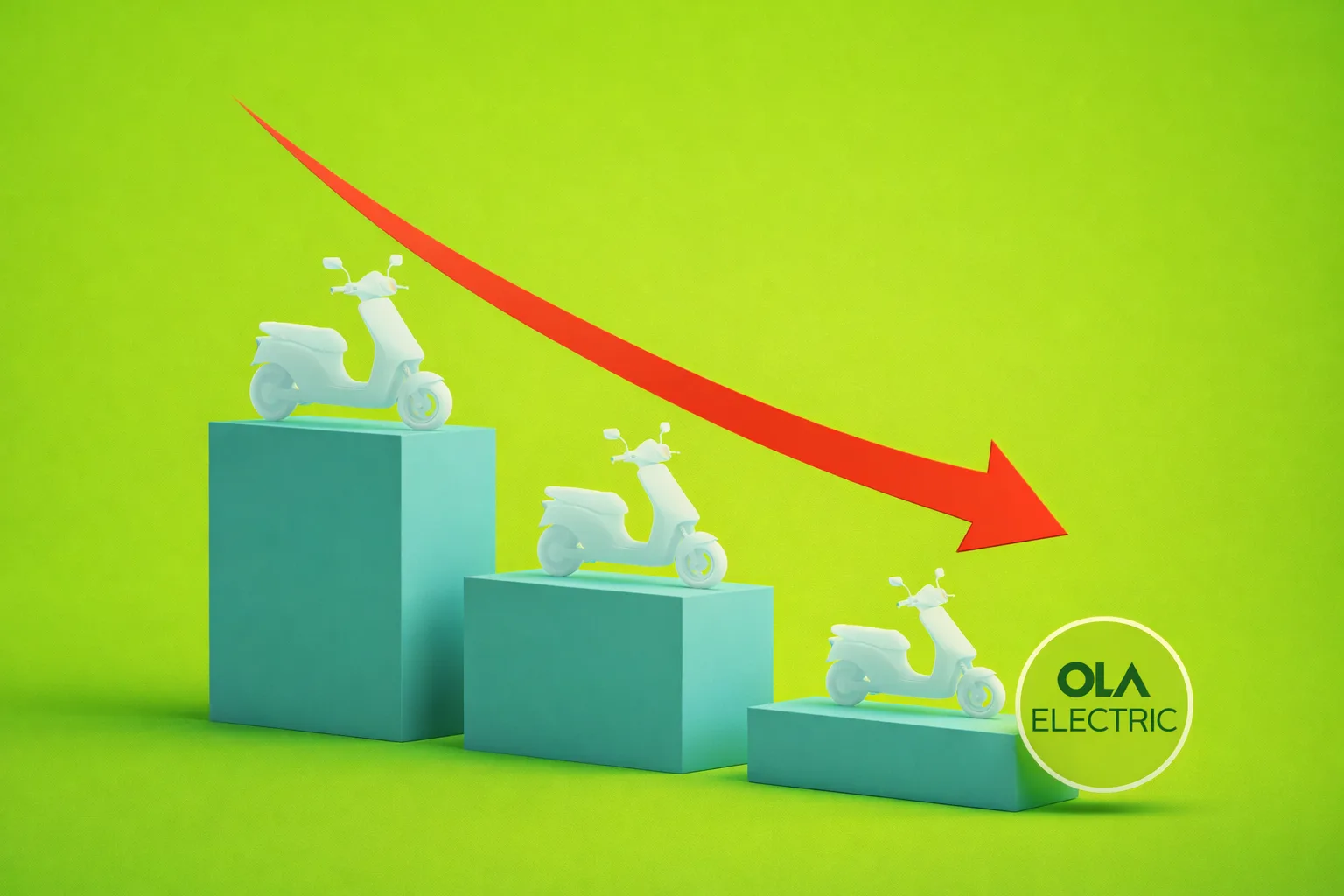
In September 2026, Ola Electric registered 13,449 electric two-wheelers, while TVS registered 53,990, Bajaj 48,383, Ather 30,477 and Hero MotoCorp 24,306, according to Vahan data recorded on October 1. Ola’s share was about 6.6%. The electric two-wheeler market itself was growing strongly, crossing 2 lakh registrations in September.
That distinction matters.
Ola did not lose because the EV market failed.
It lost ground while the EV market was expanding.
And that makes the Ola story far more interesting.
The question is not simply what went wrong.
The question is:
When did Ola stop concentrating on the next problem in front of it and start chasing the next big idea
Etergo was the beginning
In 2020, Ola Electric acquired Amsterdam-based Etergo, the startup behind the AppScooter.
It was an intelligent acquisition.
India’s electric scooter market was still young. Ather had credibility, but the category had not yet found a mass-market product that combined attractive design, technology and scale.
Etergo gave Ola a starting point.
Ola brought capital, Indian manufacturing ambition and access to a huge potential market.
The result was the S1 and S1 Pro.
And suddenly, electric scooters looked different.
They were no longer simply practical alternatives for people trying to save fuel.
They became aspirational.
Touchscreens, connected features, voice commands, software updates and a futuristic design gave the S1 the image of something from the next generation of mobility. E-VehicleInfo’s earlier coverage of Ola’s rise also documented the company’s extraordinary manufacturing ambitions around the Futurefactory.
Ola had understood the Indian consumer.
People did not necessarily want a cheaper version of a petrol scooter.
They wanted something that felt new.
That was Ola’s great opening.
And it worked.
The problem was that Ola brought a software-company mindset into a hardware business
This is where the first cracks appeared.
A software product can be launched, patched and improved.
A vehicle is less forgiving.
A software bug can be fixed overnight.
A problem with a vehicle can put somebody on the side of a road.
That difference became painfully important for Ola.
A BBC investigation in 2025 reported that former employees questioned the speed with which the first Ola scooter moved from the Etergo platform towards launch, including concerns around testing and compliance. Ola disputed that characterisation and said the scooter had been fully re-engineered and tested for Indian conditions.
But whatever one makes of that particular dispute, the larger problem was impossible to ignore.
There were fire incidents.
There were complaints about software and vehicle failures.
There were suspension-related controversies.
And then there was the issue that eventually became even more damaging than the product complaints themselves:
service.
Selling an EV was only half the battle
Ola initially wanted to change the way Indians bought vehicles.
No traditional dealership dependency.
Online ordering.
Direct customer relationships.
A modern, digital-first experience.
It made sense.
Until something went wrong.
Then the customer needed a workshop, a technician, a spare part and somebody who could actually solve the problem.
The company expanded its service network aggressively after the criticism intensified. Ola later announced 4,000 sales and service touchpoints and began building what it called Hyperservice. Its current website now shows 590 service centres and says it is working to make one lakh third-party mechanics EV-ready, alongside AI-based diagnostics and online parts ordering.
There is an important admission hidden in that evolution.
Ola eventually had to build the ecosystem it once hoped technology could partly replace.
Even more revealing is what happened in 2026.
Ola opened its sales and service network to dealer partners and started opening dealer-led stores, with an announced plan to build a 500-outlet dealer network.
That is a major strategic turn.
The company that once wanted to bypass the traditional automobile distribution model is now using dealers to expand it.
And there is nothing wrong with that.
In fact, it may be one of the more sensible decisions Ola has made.
But it tells us something about the original strategy.
The automobile business turned out to be more traditional than Ola expected.
While Ola was struggling with service, TVS and Bajaj were studying the market
This is where the story turns.
TVS did not need to convince India that electric scooters could be exciting.
Bajaj did not need to teach customers how to live with an EV.
Ola had already done much of that work.
The incumbents simply brought their old strengths into the new market.
Manufacturing.
Distribution.
Service.
Parts.
Suppliers.
Brand trust.
Customer relationships.
Ola had challenged them to enter the race.
They entered.
And once they did, being first was no longer enough.
By 2026, TVS and Bajaj together were taking almost half of India’s electric two-wheeler registrations, while TVS, Bajaj, Ather and Hero accounted for roughly three-quarters of September’s market.
This was the moment when Ola’s original advantage disappeared.
The company had shown the old automobile industry where the market was going.
The old automobile industry eventually followed it there.
And then Ola started expanding in every direction
This is perhaps the most important part of the story.
Ola had a huge opportunity sitting in front of it.
Hundreds of thousands of customers.
A recognisable brand.
An enormous factory.
A growing EV market.
A software platform.
Its own battery ambitions.
The obvious strategy was simple:
make the existing business extremely good.
Instead, the horizon kept moving.
Motorcycles.
Cars.
Battery cells.
AI.
New scooter platforms.
Energy storage.
Three-wheelers and four-wheelers through the planned Gen 4 architecture.
And later, even a futuristic motorcycle concept called Diamondhead.
None of these ideas was stupid.
That is what makes the story difficult.
The problem was not ambition.
It was sequencing.
The motorcycle made sense. The timing was harder to defend
In August 2024, Ola unveiled its Roadster motorcycle family.
It was an obvious opportunity.
India is a motorcycle country. If Ola wanted to become a serious automobile company rather than remain a scooter company, it eventually had to enter motorcycles.
The company did.
Roadster deliveries followed.
Today, Ola’s public website is focused on the Roadster X and X+, while the broader Roadster programme remains part of the company’s motorcycle strategy.
But the question was not whether Ola should build a motorcycle.
It was whether Ola should be trying to build a new category while its original category was still recovering.
Every new vehicle means another set of engineering problems.
Another supplier base.
Another parts inventory.
Another production process.
Another service requirement.
Another opportunity to disappoint a customer.
When your existing customers are asking for better service, launching another ambitious vehicle can easily become a distraction.
The car was not the mistake. The pattern was.
Ola also wanted to build an electric car.
At one point, the company’s vision included a high-performance electric car with a long range and rapid acceleration.
Then, in 2024, the car project was suspended as Ola refocused on two-wheelers. Reuters reported the shift as part of the company’s decision to concentrate resources on scooters and motorcycles.
Abandoning the car was probably sensible.
The more interesting point is what happened before it.
Ola had again moved the conversation several steps ahead of its current business.
That became a recurring feature of the company.
The next product was always exciting.
The current problem was rarely as exciting.
Then came the biggest bet of all: the cell
If there is one part of Ola’s strategy that should not be dismissed, it is this.
The battery cell.
Because Ola understood something that many people outside the industry did not.
The EV revolution is not ultimately about scooters.
It is about batteries.
The cell determines a huge part of an EV’s cost, range, performance, packaging and future energy applications.
So Ola decided it would not remain dependent on somebody else’s battery technology.
It built the Battery Innovation Centre.
It began developing cell chemistry in-house.
It built the Gigafactory.
And it started working on its indigenous 4680 Bharat Cell. Ola’s current technology pages describe the Battery Innovation Centre as the core of its cell R&D effort and the Gigafactory as the facility for developing and mass manufacturing advanced cell technology.
That was not a side project.
It was potentially the foundation of an entirely different company.
But even the cell journey exposed the same problem
In 2025, Ola faced scrutiny after missing a milestone linked to its advanced-cell production commitments under the government’s PLI scheme. The company subsequently moderated its near-term capacity ambitions.
And that is where the timing becomes important.
Ola was trying to build one of the most complicated pieces of the EV value chain while its scooter business was under pressure.
Cell manufacturing is not like launching a new software feature.
You need chemistry.
Equipment.
Yield.
Quality.
Capital.
Scale.
Reliability.
And customers.
Yet Ola persisted.
By late 2025 and into 2026, the 4680 Bharat Cell was no longer just a presentation slide. Ola began mass deliveries of vehicles powered by its own cells, including the S1 Pro+ and Roadster X+, and expanded the cell platform into energy products.
Then came another important development.
In April 2026, Ola announced readiness of an indigenous 46100 LFP cell, designed for lower cost and broader use across mobility and energy storage.
And in August 2026, the company brought that LFP technology into the mass-market S1 Z range.
Now, for the first time, the logic of Ola’s vertical-integration strategy becomes much clearer.
The company is not merely trying to make an electric scooter.
It wants to control the technology underneath it.
That could still become Ola’s greatest advantage.
But it took much longer, and cost much more organisational effort, than the early presentations suggested.
Ola also built its own motor
This part is easy to miss.
But it matters.
Ola developed a rare-earth-free ferrite motor and received government certification for the technology in 2025. The company said the motor matched the performance of rare-earth permanent-magnet motors in the tested 7kW and 11kW variants while reducing dependence on imported rare-earth materials.
This is actually a serious piece of engineering.
And it fits perfectly into Ola’s newer “India Inside” strategy.
The company’s current website says the company is building its powertrain in-house around the 4680 Bharat Cell and ferrite motor, with MoveOS as its software layer. It also highlights its vertically integrated approach to batteries, motors and vehicle structures.
In other words, today’s Ola is trying to own much more of the machine than the Ola of 2021 did.
The irony is that this strategy may ultimately work.
But the company had to cross a very painful valley to get there.
The software bet became MoveOS — and then AI
From the beginning, Ola wanted the scooter to behave more like a smartphone on wheels.
That idea evolved into MoveOS.
Ola’s current software platform includes navigation, OTA updates, vehicle controls, biometric unlocking, security functions and connected features. MoveOS 5 added more advanced capabilities, while MoveOS 6 brought further AI-led functionality.
Then Krutrim entered the story.
Bhavish Aggarwal’s AI venture was launched separately, but Ola has increasingly connected that AI ambition with the vehicle experience. MoveOS 6, for example, brought Krutrim-powered voice and AI features into the scooter ecosystem.
This is ambitious.
And now, unlike in 2021, it actually fits the larger architecture Ola is building.
Battery.
Motor.
Software.
AI.
Vehicle.
Energy storage.
The pieces are beginning to look like one ecosystem.
But again, there is a lesson hidden inside it.
The pieces only become an advantage when the organisation can execute them together.
Then came Diamondhead
If you want to understand the Ola mindset, look at Diamondhead.
It is not simply another motorcycle.
Ola describes it as a future-focused motorcycle with hub-centred steering, AI-enabled riding assistance, adaptive suspension, torque vectoring, high-voltage architecture and even a custom silicon chip. The company has positioned it as a future product targeted for 2027.
This is classic Ola.
Think five years ahead.
Redesign the category.
Build something that makes people stop and look.
There is nothing wrong with that.
But Ola’s history raises the obvious question:
Should a company struggling to regain mass-market trust be spending so much energy imagining the motorcycle after the motorcycle after the motorcycle?
Perhaps.
Perhaps not.
That is the strategic debate Ola now has to settle.
And then Shakti changed the story again
This may be the most important development after the cell.
Ola Shakti takes the battery technology out of the scooter.
Ola’s current site now presents Shakti, Shakti Rack, Mahashakti and solar charge controllers as a separate energy portfolio. Its Shakti systems range from home batteries to larger energy-storage applications, and the company has also announced a move into utility-scale energy storage.
Suddenly, the battery factory has another purpose.
A cell can power a scooter.
The same cell technology can power a home.
The same technology can go into commercial storage.
And potentially, eventually, into much larger energy systems.
That is a much more ambitious business than Ola Electric’s original scooter proposition.
And perhaps that is what Bhavish Aggarwal was trying to build all along.
Not simply an EV company.
An energy-and-mobility company.
But the market did not wait for Ola to finish the blueprint
This is the part that cannot be explained away by future technology.
While Ola was building its ecosystem, its competitors were building theirs.
TVS.
Bajaj.
Ather.
Hero.
The market matured.
The customer became more demanding.
And suddenly the question was not:
Who has the coolest electric scooter?
It became:
Who will still be here five years from now?
In September 2026, the market answered that question quite clearly.
TVS led.
Bajaj followed.
Ather and Hero were close behind.
Ola was fifth.
And yet the electric two-wheeler market itself was stronger than ever.
The first half of FY27 crossed 1.1 million registrations, with TVS, Bajaj, Ather and Hero all gaining share while Ola’s first-half registrations fell 23% year on year.
That is the brutal part.
The train was moving. Ola simply was no longer sitting in the driver’s cabin.
There was another thing Ola underestimated: boring execution
Automotive companies are built on boring things.
Spare parts.
Warranty claims.
Dealer relationships.
Supplier quality.
Technician training.
Inventory.
Registration.
Delivery.
Customer complaints.
Repair times.
These things do not make for glamorous keynote presentations.
But they make or break automobile companies.
Ola’s own recent strategy shows that it has learned this lesson.
Its website now emphasises service centres, AI-assisted diagnostics, parts availability, Hyperservice, third-party mechanics and dealer partners. The company has also moved towards a dealer-led distribution model.
That is not the Ola of the original S1 launch.
It is a more pragmatic Ola.
And perhaps a more mature one.
So where did Ola actually miss the train?
Not when it bought Etergo.
That was smart.
Not when it launched the S1.
That was probably the company’s greatest product-market achievement.
Not when it built the Futurefactory.
India needed large-scale EV manufacturing.
Not even when it decided to develop its own cells.
That could still become its greatest strategic asset.
And not necessarily when it launched motorcycles.
India needs electric motorcycles.
The real mistake was more subtle.
Ola repeatedly moved to the next chapter before completely finishing the previous one.
It wanted scale before service was mature.
It wanted vertical integration before the core vehicle business had stabilised.
It wanted motorcycles while scooters still needed work.
It talked about cars before two-wheelers had become a durable competitive fortress.
It built cells while fighting a brutal market-share battle.
It launched an AI business while the EV organisation was under pressure.
And all the while, established manufacturers were learning from Ola’s mistakes.
That is where the train was missed.
Not because Ola dreamed too big.
Because it tried to live too many futures at the same time.
The irony is that today’s Ola may finally have a coherent strategy
Look at Ola’s current website and the story is different from three years ago.
The S1 range is now built around the Gen 3 platform.
The company has S1 Pro+, S1 Pro, S1 X+, S1 X and S1 Z variants across price points. Its motorcycle lineup is centred on the Roadster X and X+. Its energy division now includes Shakti and larger storage products. The company talks about its own cells, its ferrite motor, MoveOS, manufacturing and an integrated technology stack.
Ola also says it has a community of nearly one million riders.
Its Futurefactory remains a highly automated manufacturing facility, while its Gigafactory is intended to develop and mass-produce cell technology.
In other words, the pieces are now sitting on the same table.
That is why writing Ola off would be premature.
But ambition is no longer enough
The market has become wiser.
Customers have become wiser.
Investors have become wiser.
And Ola itself has been forced to become wiser.
The company no longer gets to win simply because it announces something nobody else has announced.
It has to prove that the product works.
That the service works.
That the economics work.
That the factory works.
That the cells work.
That the dealer works.
That Shakti works.
And, eventually, that all these pieces make money together.
That is a much harder challenge than launching the first electric scooter.
Ola’s real second chance
I don’t think the most interesting question is whether Ola can return to No.1 in electric scooters.
It might.
But that is not the biggest opportunity anymore.
The bigger question is whether Ola can turn what it has spent years building into an integrated Indian technology company.
A cell company feeding an EV company.
An EV company feeding an energy-storage company.
MoveOS connecting the products.
Krutrim adding intelligence.
A manufacturing ecosystem bringing more components in-house.
A wider distribution network bringing the products to more customers.
That is a compelling architecture.
But architecture is not the same thing as execution.
And Ola has already learned that lesson once.
The final verdict
Ola did something few startups manage to do.
It changed an industry before the industry was ready.
Then the industry caught up.
TVS and Bajaj learned.
Ather persisted.
Hero adapted.
Customers became less forgiving.
And Ola discovered that creating a market is easier than defending one.
The company began with Etergo.
It built S1.
Then came Futurefactory.
Then motorcycles.
Then the car dream.
Then battery cells.
Then MoveOS.
Then Krutrim.
Then the ferrite motor.
Then Bharat Cell.
Then Diamondhead.
And now Shakti.
From the outside, it can look like a collection of disconnected bets.
Maybe it was.
Or perhaps it was always one very large bet that simply took too long to become coherent.
That is what makes the Ola story unfinished.
The company has not run out of ideas.
It has run out of excuses.
The next chapter cannot be won with another promise.
It has to be won with execution.
Because the first Ola made people believe in the electric future.
The second Ola now has to convince them that it can actually deliver it.
And that is the train it cannot afford to miss again.


