
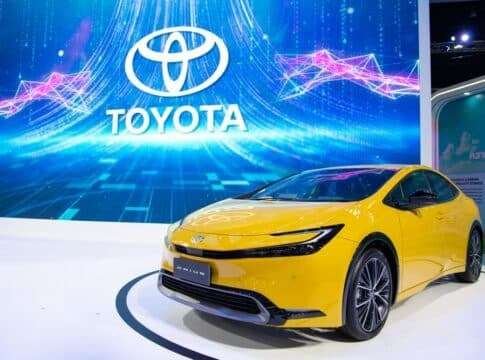
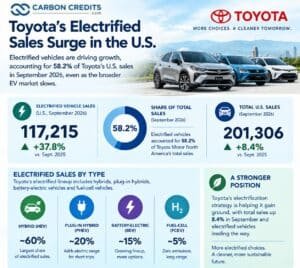
Toyota is showing that electrification can drive growth even as parts of the U.S. electric vehicle market slow. The Japanese automaker sold 117,215 electrified vehicles in the United States in September 2026, up 37.8% from a year earlier. Electrified vehicles accounted for 58.2% of Toyota Motor North America’s total September sales.
The result came as sales of Toyota’s gasoline-only vehicles fell sharply. Yet, total sales still increased 8.4% to 201,306 vehicles, outperforming the roughly 6.5% industry increase forecast by Cox Automotive.
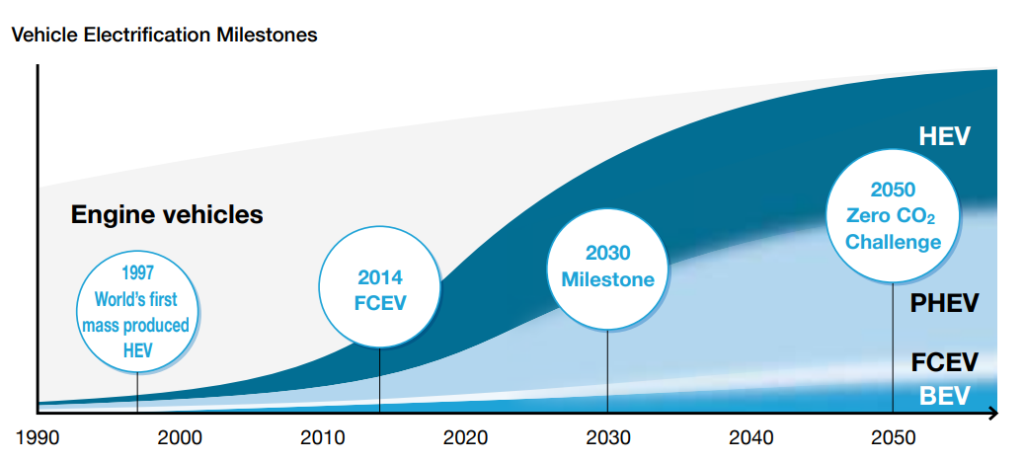
The numbers highlight Toyota’s different approach to electrification. Rather than relying mainly on battery-electric vehicles (BEVs), Toyota has built a broad lineup of hybrids, plug-in hybrids, BEVs and fuel-cell vehicles.
That strategy is now producing measurable sales growth.
Electrified Vehicles Are Driving Toyota’s U.S. Growth
Toyota’s September results were led by its electrified lineup. The company sold 117,215 electrified vehicles, up 32,125 units from September 2025. For the third quarter, electrified vehicle sales reached 363,367, up 28.5% year over year and representing 57.4% of total sales.
Toyota’s overall third-quarter sales reached 633,223 vehicles, up just 0.6%. That means electrified vehicles accounted for most of the company’s sales growth during the quarter.
The Toyota division sold 104,105 electrified vehicles in September, up 36.6%. Lexus added another 13,110, up 47.4%. Toyota also ended September with 32 electrified vehicle options across its Toyota and Lexus brands.
The contrast with conventional vehicles is significant. Toyota’s gasoline-powered sales fell 16.5% in September, according to reporting based on the company’s sales data. The figures suggest that electrification is increasingly supporting Toyota’s sales even when demand for traditional powertrains weakens.
Hybrids Are Doing Much of the Heavy Lifting
Toyota’s definition of “electrified” includes more than battery-electric vehicles. Its lineup includes conventional hybrids, plug-in hybrids, battery-electric vehicles, and fuel-cell vehicles. This gives the company a broader base for capturing consumers who want lower fuel consumption without moving immediately to a fully electric vehicle.
Andrew Gilleland, senior vice president, Automotive Operations Group, Toyota Motor North America, noted:
“Our third-quarter results reinforce a simple truth—customers want choices. From affordability to electrification, our multi-path strategy continues to meet customers where they are and give them options that fit their lifestyles. With solid momentum and disciplined inventory heading into Q4, we’re well-positioned to finish the year strong.”
That approach is particularly relevant in the U.S., where EV adoption has faced affordability and policy challenges.
The International Energy Agency estimates that electric cars accounted for just under 10% of U.S. car sales in 2025, compared with 25% globally. Global electric car sales exceeded 20 million units in 2025, up 20% from 2024.
Toyota’s results show that consumers can still shift toward electrified powertrains even when BEV adoption is slower.
The company’s June results had already shown the trend. Toyota sold 122,063 electrified vehicles in the U.S. that month, up 35%, while second-quarter electrified sales reached 383,091, up 19.5%. The September figures indicate that momentum continued into the third quarter.
Toyota Is Closing the Gap With GM
The electrification-led sales growth is also helping Toyota gain ground on General Motors in the U.S. Toyota sold 633,223 vehicles in the third quarter, compared with GM’s 670,974. GM’s sales fell 5.5%, while Toyota’s edged up 0.6%.
Toyota therefore trailed GM by only about 37,751 vehicles during the quarter.
Cox Automotive said Toyota was gaining market share as consumers shifted toward hybrids and passenger cars, areas where Asian automakers have maintained a strong position. Toyota’s growth is notable because its strategy does not depend solely on BEV sales.
It has continued investing in hybrids while expanding its battery electric lineup. This gives the company multiple ways to respond to changes in fuel prices, consumer preferences, incentives, and emissions regulations.
The approach also gives Toyota time to expand its BEV business while maintaining sales from its established hybrid franchise.
Global EV Sales Are Still Growing
Toyota’s results come against a global backdrop of continued EV expansion. The IEA expects global electric car sales to reach about 23 million vehicles in 2026, representing roughly 28% of total car sales. Europe is projected to see EV sales increase about 20%, taking electric vehicles to approximately one-third of new-car sales.
China’s electric car share is expected to approach 60% this year. However, growth is becoming less uniform.
Global EV sales were about 3.9 million in the first quarter of 2026, down 8% from the same period in 2025. The decline was largely linked to weaker sales in China and the U.S. following policy changes. Europe moved in the opposite direction, with first-quarter EV sales rising close to 30% year over year.
The IEA also expects the number of electric-car models available globally to exceed 1,100 in 2026, with about 150 new electric models announced for the year. That means competition is increasing even as the overall market expands.
- ALSO SEE: China’s Battery EV Market Grows as Tesla (TSLA Stock) Posts Third Straight Monthly Sales Decline
Toyota Is Planning a Bigger Electrified Mix
Toyota’s own forecasts show that electrification will become a larger part of its global sales. For fiscal 2027, Toyota forecasts 10.5 million Toyota and Lexus vehicle sales, broadly flat from fiscal 2026.
But it expects electrified vehicle sales to rise from 5.04 million to 5.956 million units. That would increase the electrified share from 48.1% to 56.7%.
The forecast includes:
- 5.071 million hybrids, up from 4.620 million.
- 286,000 plug-in hybrids, up from 175,000.
- 598,000 BEVs, up from 243,000.
Toyota expects total electrified sales to approach 6 million vehicles in fiscal 2027. It also expects hybrid sales to exceed 5 million for the first time.
The numbers show where Toyota sees near-term demand. Hybrids remain the largest part of the strategy, while BEV sales are expected to more than double.
The Sales Surge Also Supports Toyota’s Climate Strategy
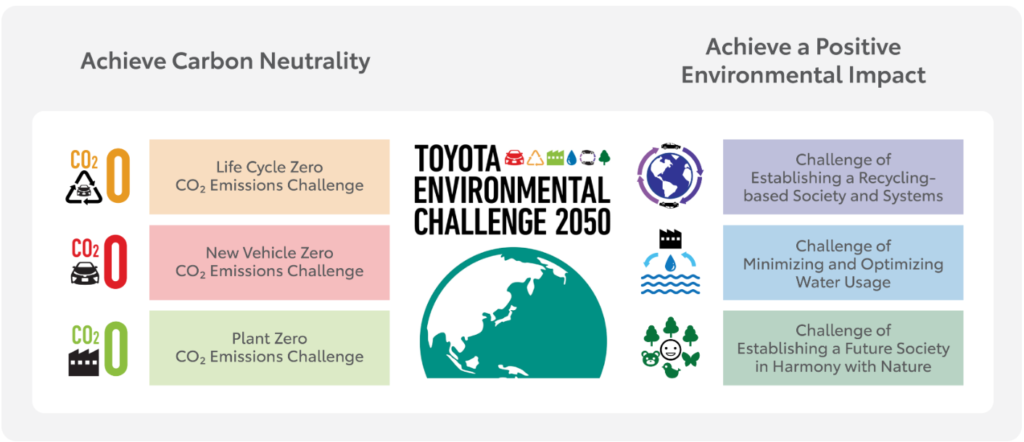
Toyota’s broader environmental strategy is built around its Environmental Challenge 2050, which includes six targets covering carbon emissions, water, circularity and biodiversity.
The company aims to achieve carbon neutrality across the vehicle lifecycle by 2050. In North America, Toyota aims to make all facilities carbon neutral by 2035.
Toyota reported a 32% reduction in Scope 1 and Scope 2 greenhouse-gas emissions from its North American operations compared with FY2019 as of FY2025.
It is also increasing renewable electricity use. At the end of FY2025, 114 participating Toyota dealerships had reduced their use of electricity from nonrenewable sources by 20% through the company’s environmental program.
Electrified vehicles form an important part of this strategy because they can reduce tailpipe emissions compared with conventional vehicles. However, Toyota’s multi-pathway approach also reflects the different infrastructure and energy conditions across markets.
Toyota Stock Reflects a More Complicated EV Story
Toyota’s electrification gains have not translated into a sustained rise in its U.S.-listed shares.
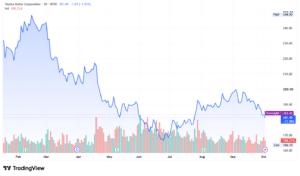
Toyota Motor’s NYSE-listed ADR closed at $183.10 on September 30, down 1.93% that day. It closed at $183.34 on October 1 and $181.49 on October 2. The stock had been trading near $198 in early September, putting it roughly 9% below its September 11 close by October 2.
The movement reflects broader concerns around the global auto market, including tariffs, China competition, fuel prices, interest rates, and changing EV policies. Still, Toyota’s sales data offer a different signal.
The company’s electrified vehicles are gaining share even as the broader U.S. auto market faces uneven EV demand. Its third-quarter electrified sales rose nearly 29%, while total sales were almost flat.
Hybrids Put Toyota on a Different EV Growth Path
Toyota’s latest U.S. results show a different path through the global auto industry’s transition. Globally, EV adoption continues to expand. The IEA expects electric vehicles to represent 28% of global car sales in 2026, with roughly 23 million electric cars sold.
Toyota’s own forecast points to nearly 6 million electrified vehicle sales in fiscal 2027, including almost 600,000 BEVs. The figures suggest Toyota’s electrification strategy is broadening rather than shifting entirely toward battery-electric vehicles.
For now, hybrids remain the company’s largest electrified segment. But with BEV sales forecast to more than double, Toyota is also increasing its exposure to the fastest-changing part of the automotive market. That combination is helping the automaker buck the recent U.S. EV slowdown while keeping its longer-term carbon neutrality targets in focus.
The post Toyota (TM Stock) Bucks the EV Slowdown as Electrified Sales Surge Nearly 40% appeared first on Carbon Credits.


