
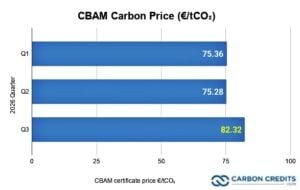
The European Union set the Q3 2026 price for Carbon Border Adjustment Mechanism (CBAM) certificates at €82.32 per tonne of CO₂. This provides importers with a new benchmark for the carbon cost of emissions-heavy goods entering the bloc.
The European Commission published the price on October 5, after calculating it from EU Emissions Trading System (EU ETS) auction prices during the third quarter. It is the highest quarterly CBAM certificate price published so far in 2026. The price rose 9.4% from €75.28/tCO₂ in Q2 and about 9.2% from €75.36/tCO₂ in Q1.
The move comes as CBAM enters its first year of full operation. Importers now bear costs tied to the carbon emissions of their products. This makes the EU’s carbon price more important for global manufacturers and exporters.
CBAM Turns Carbon Reporting Into a Financial Cost
The CBAM definitive regime took effect on January 1, 2026, replacing the transitional system that operated from 2023 through 2025. The mechanism currently covers cement, iron and steel, aluminum, fertilizers, electricity and hydrogen.
Importers must report the emissions embedded in covered goods and eventually surrender the corresponding number of CBAM certificates. The system is designed to address carbon leakage.
Without CBAM, EU manufacturers covered by the EU ETS could face a carbon cost that foreign producers do not pay. This could encourage production to move outside the EU or allow more carbon-intensive imports to compete with European goods.
CBAM is intended to apply a comparable carbon cost to covered imports. The European Commission states that the mechanism aims to make sure imported products pay a carbon price similar to what EU producers pay. This also encourages cleaner production outside the EU.
An EU official recently said that starting in January 2026, CBAM will shift from reporting emissions to adding a financial cost to those emissions.
Q3 CBAM Price Climbs Nearly 10%
The new €82.32/tCO₂ price marks a clear increase during 2026. The Q3 price is important because it applies to CBAM-covered emissions from goods imported into the EU during that quarter.
However, importers do not begin buying certificates during 2026. The Commission says that approved CBAM declarants will start buying certificates in February 2027 for their imports from 2026.
The first CBAM declarations and corresponding certificate surrender are due by September 30, 2027. This gives companies time to calculate their embedded emissions, verify data, and prepare for the financial obligation.
How Much Could €82.32 Cost Importers?
The certificate price provides a straightforward way to estimate the potential carbon cost. For example, an importer with 10,000 tonnes of embedded emissions would face a gross certificate cost of approximately €823,200 at the Q3 2026 price.
At 100,000 tonnes, the figure rises to about €8.23 million.
The actual liability can be lower because CBAM allows importers to deduct a carbon price already paid in the country where the goods were produced. The final number of certificates also depends on the rules for calculating embedded emissions and the applicable free-allocation adjustment. That makes emissions data increasingly valuable.
The Commission has released guidance for specific sectors, including cement, hydrogen, fertilizers, iron and steel, aluminum, and electricity. It aims to help companies calculate embedded emissions during the set period.
For exporters, cleaner production can therefore become a competitive advantage. Lower embedded emissions mean fewer CBAM certificates are ultimately required.
Weekly CBAM Pricing Starts in 2027
The €82.32 price is also important because it represents the last phase of the EU’s temporary quarterly pricing system. For 2026, the Commission calculates four prices, one for each calendar quarter.
From 2027 onward, certificate prices will be calculated and published weekly. The methodology is designed to track the EU ETS more closely by using the relevant auction prices for EU ETS allowances. This means importers will face a more dynamic carbon price environment.
The EU’s approach aims to keep the carbon cost for imports aligned with the carbon cost faced by European producers under the ETS. It also means companies will need to pay closer attention to carbon price movements when planning procurement, production and investment.
For businesses importing large quantities of emissions-intensive materials, carbon pricing could increasingly become part of ordinary supply chain cost management.
EU Could Expand CBAM’s Reach
CBAM is not necessarily staying limited to its current product categories. In June, the European Commission welcomed a Council agreement to extend CBAM to specific downstream goods and strengthen anti-circumvention measures.
The proposal aims to stop companies from sidestepping the rules. They can’t process covered materials into specific products outside the EU and then import them. This could expand the number of businesses exposed to the mechanism.
At the same time, the EU recently assessed its 50-tonne de minimis threshold. From April 2025 to March 2026, the Commission found that the threshold would exempt only 0.87% of embedded emissions. This is below the 1% limit set by the regulation.
The threshold was introduced to reduce the administrative burden on smaller importers. The Commission previously estimated that it would exempt about 182,000 importers while still covering more than 99% of emissions within CBAM’s scope.
The result is a system designed to reduce paperwork for small shipments without removing most emissions from the mechanism.
- RELATED: EU Unveils Biggest Carbon Market Overhaul Yet to Keep Industry Competitive and Net Zero on Track
Carbon Pricing Is Expanding Beyond Europe
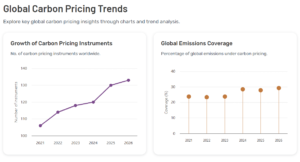
The CBAM price arrives as carbon pricing continues to expand globally. The World Bank’s State and Trends of Carbon Pricing 2026 report found that 87 carbon pricing policies were operating worldwide as of 2026.
Direct carbon pricing now covers over 29% of global greenhouse gas emissions. In 2025, carbon pricing systems generated over $107 billion in government revenue. The average direct carbon price reached nearly $21/tCO₂e.
- The EU’s €82.32 CBAM certificate price is therefore substantially above the global average direct carbon price.
However, the comparison is not like-for-like. The World Bank figure includes various carbon taxes and emissions trading systems. In contrast, CBAM is tied to the EU’s carbon market and targets embedded emissions in certain imports.
Still, the trend is clear: Carbon is increasingly becoming a direct economic cost in international trade.
EU Climate Policy Is Tightening the Long-Term Signal
CBAM is part of the EU’s broader climate strategy.
The bloc set a target in 2026 to cut net greenhouse gas emissions by 90% from 1990 levels by 2040. At least 85% of this reduction must happen within the EU, and up to 5% can come from international carbon credits. The bloc remains committed to achieving climate neutrality by 2050.
CBAM supports that trajectory by extending the carbon price signal beyond EU borders for covered products. The policy also interacts directly with the EU ETS, where European industrial producers already face carbon costs.
As the EU ETS gradually cuts free allocation for sectors under CBAM, the border mechanism will become more important. This gives manufacturers a stronger incentive to reduce emissions rather than simply absorb higher carbon costs.
The shift also creates stronger incentives for exporters to provide accurate, verified emissions data. Companies with lower actual emissions can potentially reduce their CBAM liability compared with producers relying on higher default values.
From 2027, the move to weekly certificate pricing will make the system even more closely tied to carbon market movements.
CBAM Is Becoming a Global Trade Signal
The European Commission’s €82.32/tCO₂ Q3 price marks another step in the transition from carbon reporting to carbon pricing at the border. The price is almost 10% above the Q2 benchmark.
The EU is also getting ready for weekly pricing starting in 2027, with the first certificate surrender deadline set for September 2027. At the same time, carbon pricing is spreading globally. The World Bank reports that direct carbon pricing now covers nearly 30% of global emissions.
For companies exporting emissions-intensive products to Europe, the implications are clear. Carbon emissions are no longer only an environmental metric. Under CBAM, they can directly affect the cost of accessing the EU market.
As the mechanism expands and the EU continues tightening its climate targets, the ability to measure, verify, and reduce embedded emissions is likely to become an increasingly important part of international industrial competitiveness.
The post EU Carbon Price Jumps as CBAM Certificate Hits €82.32 per Tonne appeared first on Carbon Credits.


