
The voluntary carbon market (VCM) continued to move away from a volume-driven model in the third quarter of 2026, with carbon credit retirements falling even as buyers spent more on the credits they purchased.
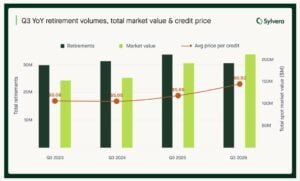
- Carbon credit retirements reached 30.6 million in Q3 2026, down 9% from 33.7 million a year earlier, according to carbon market data provider Sylvera. However, the value of those retirements rose to $211.8 million from $190.6 million in Q3 2025.
The difference points to a market where buyers are becoming more selective. The report reveals that the average price paid for a retired credit climbed to $6.92 in Q3, compared with $5.66 a year earlier. For the first nine months of 2026, the average reached $6.12, up from $5.40 during the same period in 2025.
The trend also builds on what Sylvera identified earlier this year. In the first half of 2026, retirement volumes were down 9% year over year, while market value increased. By the end of Q3, however, cumulative retirements had edged above 2025 levels at 130.3 million credits, compared with 129.1 million through the first three quarters of last year.
Meanwhile, year-to-date retirement value reached $798 million, 14% above the $697.3 million recorded a year earlier.
Quality Is Taking a Bigger Role in Carbon Credit Pricing
The strongest signal from the latest data comes from the widening gap between higher- and lower-quality credits.
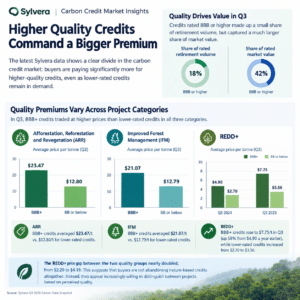
Credits rated BBB or higher represented only 18% of rated retirement volume in Q3. Yet they generated 42% of rated market value. This suggests buyers are willing to pay significantly more for credits that meet stronger quality expectations rather than simply purchasing the cheapest available supply.
The premium becomes even clearer across individual project categories.
- For afforestation, reforestation and revegetation (ARR), BBB+ credits averaged $23.47 per tonne in Q3, compared with $12.80 for credits rated BB or below. Improved forest management (IFM) showed a similar divide. BBB+ IFM credits reached $21.07, while lower-rated credits averaged $12.79.
- REDD+ also saw a sharp quality-driven price difference. BBB+ REDD+ credits averaged $7.75 in Q3, up 58% from $4.90 a year earlier. Lower-rated REDD+ credits increased from $2.70 to $3.56 over the same period.
As a result, the REDD+ price gap between the two quality groups nearly doubled from $2.20 to $4.19. The trend suggests that buyers are not abandoning nature-based credits altogether. Instead, they appear increasingly willing to distinguish between projects based on perceived quality.
- RELATED: Carbon Credit Prices Explained: What Determines the Value of a Carbon Credit?
- LIVE PRICES: Carbon Credit Prices Today 2026 | Live Chart, EU ETS & VCM
Renewables Still Dominate, But Their Market Position Is Changing
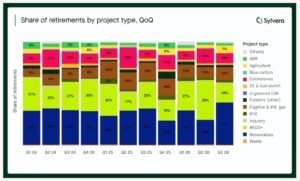
Renewable energy projects accounted for 41% of Q3 retirements, giving them the largest share among project categories. However, Sylvera cautions that the increase in market share does not represent renewed growth in renewable credit demand.
Renewable retirements totaled 40.7 million credits during the first nine months of 2026, roughly unchanged from the same period in 2025. That remains far below the 77.1 million credits retired during the first three quarters of 2022. Full-year renewable retirements peaked at 99.7 million in 2022 before falling to 49.3 million in 2025.
The quality issue is particularly important here. Sylvera does not rate renewable projects above C because many grid-connected renewable projects face additionality concerns. As a result, renewables accounted for 76% of B/C/D-rated retirement volume in Q3.
That helped push the share of B/C/D-rated credits across the entire retirement market to 66.1%, the highest level since Q3 2023. In other words, renewable credits continue to provide substantial market volume, but their presence also weighs on the overall quality profile of retirements.
REDD+ Demand Normalizes While Agriculture Gains Ground
REDD+ accounted for 18% of Q3 retirements, down sharply from 38% in Q2. However, the comparison needs context because Q2’s unusually high share was largely driven by one major retirement.
Beyond that temporary spike, REDD+ demand appears relatively stable, with retirement activity spread across Colombia, Brazil, Cambodia, Peru, and the Democratic Republic of Congo.
Agriculture was a more notable growth area. Its share of retirements increased from 2.55% to 7.82%, while retirement volume more than doubled. Energy and utility companies played an important role in that shift, with agriculture representing 28% of their Q3 retirement mix, compared with 6.8% a year earlier.
This diversification matters because the market is gradually moving beyond a small group of traditional project categories. Buyers are showing greater interest in credits tied to agriculture, forest management, and other project types where measurable climate and environmental benefits can support stronger pricing.
Corporate Buyers Are Still Active
Despite the overall decline in quarterly retirement volumes, major corporate buyers continued to transact at scale.
Yamato Transport and Corpay each retired about 2 million credits in Q3, making them the largest retirees during the quarter. Primax Colombia followed with just over 1 million.
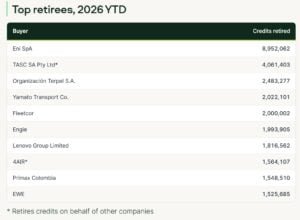
For the first nine months of 2026, Eni remained the largest retiree with nearly 9 million credits. TASC, Organización Terpel, Engie and Lenovo also ranked among the largest buyers.
At the same time, Shell’s retreat remains significant. The company retired only about 496,000 credits through the first three quarters of 2026, compared with roughly 7 million during the same period in 2025. Sylvera first highlighted the decline in its Q2 report, and the latest numbers suggest the pullback has continued.
Q3 Reports Point to a More Selective Market
Sylvera’s findings broadly align with the quality-focused direction highlighted by other Q3 market research, although the datasets show different parts of the market.
CEEZER described Q3 as a cooler market, with weaker retirement activity and a sharper focus on credits carrying recognized quality labels.
- Its analysis found that CCP-labeled retirement value increased 6.9% year over year even as the associated volume fell 17.7%. It also found that CCP-labeled issuances carried a roughly 48% premium over the broader market, up from about 5% a year earlier.
The difference between the reports is useful. Sylvera’s data shows that quality premiums are already visible across individual project types, while CEEZER’s analysis suggests that recognized integrity standards are becoming an increasingly important market filter.
Together, the findings point to a carbon market that is becoming less focused on buying the largest possible volume of credits. Instead, buyers appear more willing to pay for credits that can offer stronger ratings, clearer additionality, and greater confidence in environmental outcomes.
What Comes Next for the Carbon Market?
Sylvera’s Q3 data suggests that the voluntary carbon market is entering a more selective phase.
Retirement volumes remain uneven, and large corporate buying decisions can significantly influence quarterly results. Yet the rise in average prices and total market value shows that weaker volume does not necessarily mean weaker demand.
Instead, the market appears to be splitting between lower-cost credits that continue to provide significant volume and higher-quality credits that attract a growing share of spending.
That shift could have major implications for developers. Projects with stronger additionality, monitoring, and permanence claims may increasingly compete for a premium, while lower-quality supply could face greater difficulty attracting buyers.
For investors and corporate buyers, the message is similar: headline retirement volumes alone no longer tell the full story. The more important question may be how much capital is flowing toward credits that the market considers genuinely high quality.
Is the carbon market finally shifting from buying more credits to buying better ones?
The post Carbon Credits Get More Expensive as Q3 Retirements Decline, Sylvera Finds appeared first on Carbon Credits.


