
Fruit trees are flowering earlier, increasing their exposure to damaging late spring frosts.
A study led by the University of Göttingen shows that the plant growth regulator ethephon can delay flowering in Kordia — a variety of sweet cherry — potentially protecting blossoms and developing fruitlets from frost. The treatment did not significantly delay flowering in a second sweet cherry or two apple varieties, highlighting the importance of crop and cultivar selection. The results were published in BMC Plant Biology.
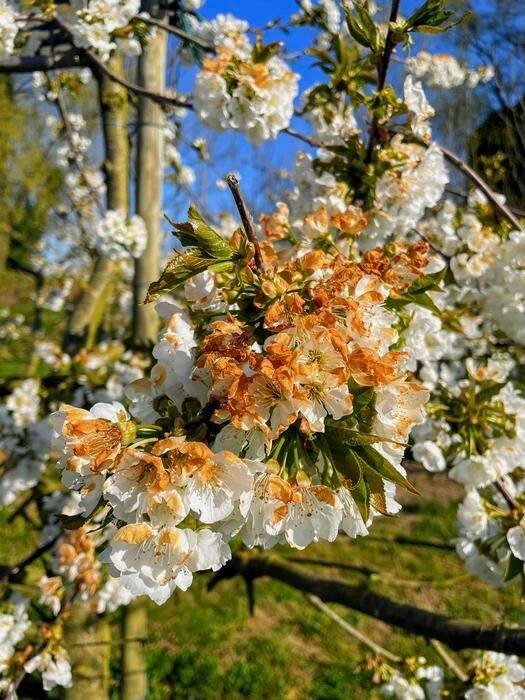
The researchers treated trees in commercial sweet cherry and apple orchards in the German state of Lower Saxony. They tested two ethephon concentrations, applied either in early or in late autumn, and monitored flowering and fruit development during spring 2024.
The study included 20 trees each of two sweet cherry varieties — Bellise and Kordia, as well as two apple varieties — Elstar and Kanzi. Flowering stage was recorded repeatedly on four marked branches per tree, with around 30 cherry flower buds and 15 apple flower buds per branch.
In sweet cherry variety Kordia, 88 per cent of flower buds on untreated trees were in bloom on April 9, compared with 56 per cent after a high-dose early-autumn treatment and 63 per cent after a low-dose late-autumn treatment. “Our results show that applying ethephon in autumn can postpone flowering in some sweet cherry cultivars,” says Wiebke Kämper at Göttingen University’s Agroecology and Functional Agrobiodiversity Group. “This could provide fruit growers with an additional tool for reducing the risk of frost damage.”
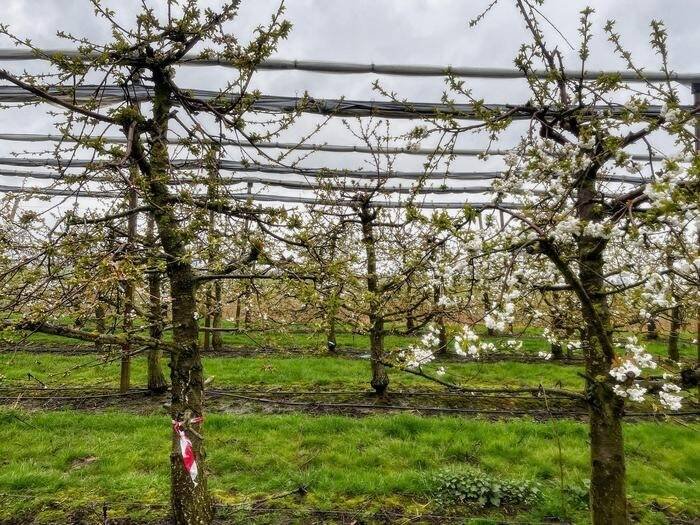
However, the response was not consistent: the treatment did not delay flowering in Bellise, Elstar or Kanzi.
“Effects depend strongly on the crop, and the variety, as well as the timing and concentration,” Kämper says. “We expected stronger effects in stone fruit than in apples, and the unusually early, warm spring of 2024 may have further limited our ability to detect differences. Further trials across varieties, regions and years are needed before recommendations for practical use can be made.”
The research was funded by the European Union’s Horizon Europe programme through a Marie Skłodowska-Curie grant and supported by the Open Access Publication Funds of Göttingen University.


