Which Countries Owe the Most to the IMF?
Key Takeaways
- Argentina owes the IMF $56.8 billion, nearly four times as much as second-place Ukraine.
- Pakistan, Egypt, and Ecuador round out the five largest IMF debtors.
- Relative to GDP, Argentina (8.2%) and Ecuador (6.8%) have some of the largest IMF debt burdens in the ranking.
From Argentina’s recurring financial crises to Ukraine’s wartime financing needs, countries turn to the International Monetary Fund (IMF) for assistance when economic pressures mount.
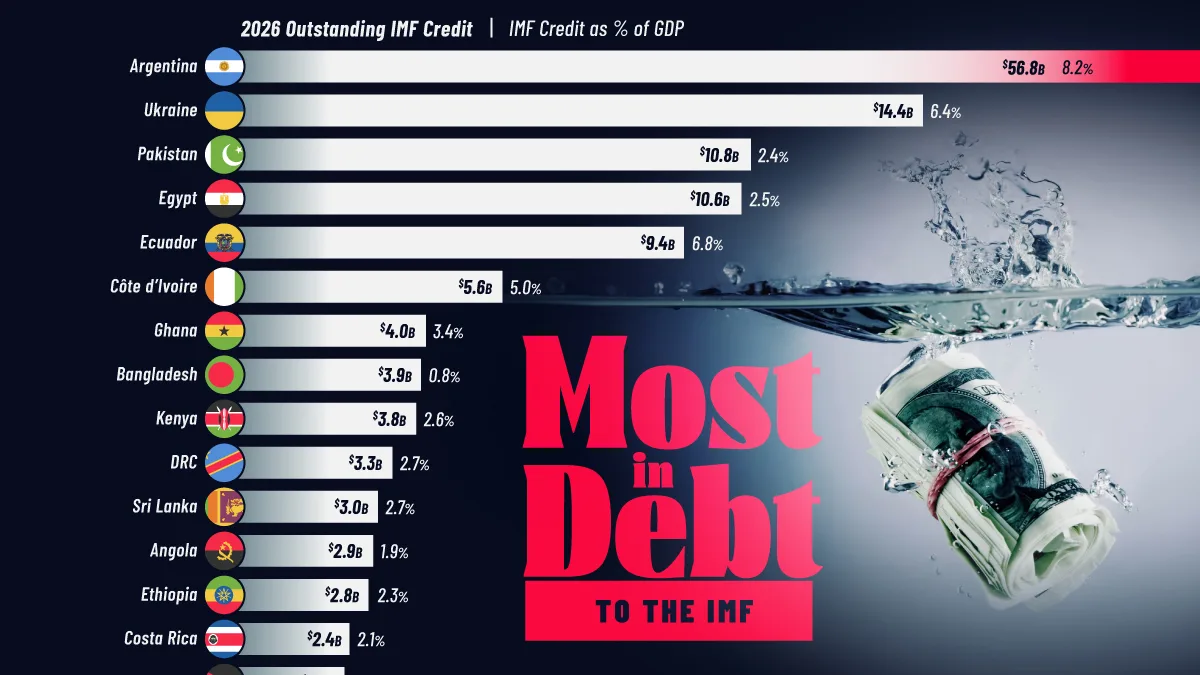
This graphic ranks countries by outstanding IMF credit, using official IMF credit data as of early October 2026. Amounts are converted into U.S. dollars, with each country’s outstanding credit also shown as a percentage of its estimated 2026 GDP.
Argentina’s $57 Billion Debt Bill
Argentina dominates the ranking, with its outstanding balance exceeding the combined total of the next six largest IMF borrowers. Ukraine ranks a distant second at $14.4 billion, followed by Pakistan ($10.8 billion), Egypt ($10.6 billion), and Ecuador ($9.4 billion).
At 8.2% of estimated GDP, Argentina’s outstanding IMF credit also represents a substantial share of its economy.
This table ranks the largest IMF borrowers worldwide as of October 2026.
| Rank | Country | Outstanding IMF debt in 2026 (billions USD) | IMF debt as % of GDP (2026) |
|---|---|---|---|
| 1 |  Argentina Argentina |
56.8 | 8.2 |
| 2 |  Ukraine Ukraine |
14.4 | 6.4 |
| 3 |  Pakistan Pakistan |
10.8 | 2.4 |
| 4 |  Egypt Egypt |
10.6 | 2.5 |
| 5 |  Ecuador Ecuador |
9.4 | 6.8 |
| 6 |  Côte d’Ivoire Côte d’Ivoire |
5.6 | 5.0 |
| 7 |  Ghana Ghana |
4.0 | 3.4 |
| 8 |  Bangladesh Bangladesh |
3.9 | 0.8 |
| 9 |  Kenya Kenya |
3.8 | 2.6 |
| 10 |  DR Congo DR Congo |
3.3 | 2.7 |
| 11 |  Sri Lanka Sri Lanka |
3.0 | 2.7 |
| 12 |  Angola Angola |
2.9 | 1.9 |
| 13 |  Ethiopia Ethiopia |
2.8 | 2.3 |
| 14 |  Costa Rica Costa Rica |
2.4 | 2.1 |
| 15 |  Jordan Jordan |
2.3 | 3.6 |
| 16 |  Tanzania Tanzania |
2.2 | 2.4 |
| 17 |  Zambia Zambia |
1.7 | 4.2 |
| 18 |  Cameroon Cameroon |
1.5 | 2.3 |
| 19 |  Sudan Sudan |
1.3 | 3.0 |
| 20 |  Papua New Guinea Papua New Guinea |
1.3 | 3.7 |
| 21 |  Morocco Morocco |
1.3 | 0.7 |
| 22 |  Uganda Uganda |
1.2 | 1.7 |
| 23 |  Jamaica Jamaica |
1.2 | 5.2 |
| 24 |  Benin Benin |
1.1 | 3.8 |
| 25 |  Senegal Senegal |
1.0 | 2.6 |
| 26 |  Madagascar Madagascar |
1.0 | 4.8 |
Argentina’s unusually large balance reflects a long history of IMF borrowing. In 2018, the country secured a record $57 billion financing arrangement amid a currency crisis, followed by another major program in 2022.
Its latest agreement, approved in April 2025, provided $20 billion in financing, including an immediate $12 billion disbursement. The program aimed to stabilize the economy, rebuild foreign exchange reserves, and restore investor confidence.
Why Argentina Keeps Returning to the IMF
Argentina’s repeated IMF borrowing reflects decades of currency crises, high inflation, and limited access to international capital markets. Despite having paid off its IMF debt entirely under former President Néstor Kirchner in the 2000s, the country returned to the Fund for emergency financing in 2018.
A subsequent recession, currency depreciation, and difficulties meeting repayment obligations led to further negotiations and a new agreement in 2022.
Under President Javier Milei, Argentina has pursued spending cuts, fiscal discipline, and a more flexible exchange-rate system. The 2025 IMF agreement supported those reforms, while a May 2026 review unlocked another $1 billion in financing.
Ukraine and Pakistan’s Different Challenges
Ukraine’s borrowing reflects the extraordinary costs of Russia’s 2022 invasion. The war has damaged infrastructure, disrupted businesses, and placed enormous pressure on government finances, making international assistance essential to maintaining economic stability.
In February 2026, Ukraine secured a new $8.1 billion IMF program as part of a broader $136.5 billion international support package. The funding is intended to support financial stability during the war while laying the groundwork for reconstruction and recovery.
Pakistan, meanwhile, faces longstanding challenges involving low tax collection, foreign currency shortages, and energy-sector debt. Its IMF-backed reforms focus on expanding the tax base, rebuilding foreign exchange reserves, and improving public finances. In May 2026, another program review unlocked approximately $1.3 billion in financing, including climate-resilience support.
Learn More on the Voronoi App
To see how the rankings have changed in recent years, check out Argentina leads in debt to the IMF, equivalent to 5% of GDP on Voronoi.