
What we heard from our friends from across the pond and our neighbors to the north about recyclability labeling.
At the 2026 How2Recycle Summit on September 30, the countdown to the U.S.’s most rigorous recyclability labeling law was on: Attendees from the world’s largest retailers and CPGs gathered in San Diego just days before California’s SB 343 came into effect on October 4, 2026.
In the U.S., California is anomalous in its regulatory push to raise the bar for recyclability labeling claims, but similar regulatory shifts are taking shape around the world. Let’s unpack key lessons from labeling requirements in the UK and Canada for U.S. companies.
How labeling mandates in the EU impact companies in the UK
Founded in 2009, OPRL became the UK’s premier voluntary on-pack recyclability labeling program, helping consumers navigate the “bin dance,” or the moment they decide whether packaging belongs in the recycling or trash. This system provided inspiration to GreenBlue in developing the How2Recycle label suite, and like How2Recycle, OPRL is voluntary, meaning there is no regulation mandating that packaging producers use these labels.
There are, however, new regulations impacting OPRL: One element of the EU’s new Paper and Packaging Waste Regulation (PPWR) is a mandatory standard on-pack label symbology identifying package materials and directing recovery. The proposed harmonized waste-sorting labels include set icons, terminology, and colors.
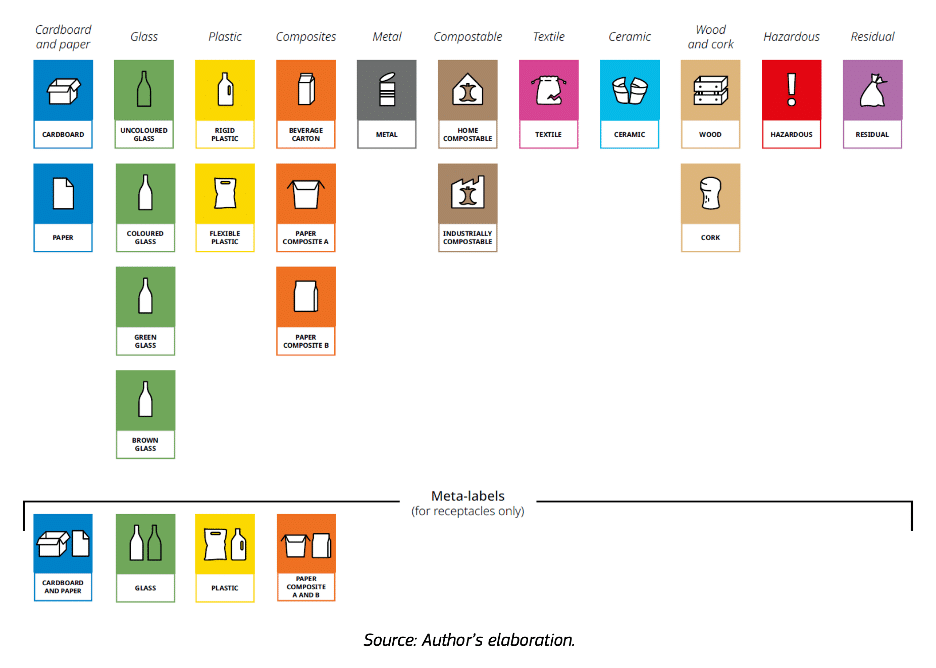
Source: European Commission, “JRC technical proposal on EU harmonised waste sorting labels under the packaging and packaging waste regulation.”
So, what does this new EU mandate mean for labeling in the UK? While England, Scotland, and Wales are not technically bound by the PPWR since they are not members of the EU, producers within the EU and producers operating in Northern Ireland, which continues to follow EU rules on goods, will need to make changes to their on-pack disposal instructions that comply with the new PPWR labeling regulations.
Once the PPWR waste-sorting label proposal is finalized, producers will have two years to comply by printing the label standard on all packaging sold in the EU. These labels will replace individual EU country requirements and may even take away the space for voluntary labels.
At the How2Recycle Summit, we heard how OPRL is monitoring the PPWR developments closely and preparing so that they can continue to support members through implementation with tools and education. “We have to accept change,” said Jude Allan, managing director of OPRL during the How2Recycle Summit.
While OPRL may need to shift its label approach, the goal for OPRL remains to provide effective recycling communication that enables consumer action and builds trust in the recycling system. While awaiting finalization of the implementation, OPRL has been conversing with their members to help them understand the new regulation and develop an EU labeling tool to support a smooth transition for impacted producers.
Allen left the U.S. audience with this advice: Learn from each other, watch how the harmonized system plays out in Europe and learn from their implementation, but also stay close to the happenings in Canada.
Harmony is trending across Canada
Members from five of the Canadian Producer Responsibility Organizations (PROs), representing programs in 9 of the 13 provinces and territories, spoke to us about the opportunity to harmonize on-pack labeling ahead of mandatory requirements. Canada is about a decade ahead of the U.S. on EPR, but like the U.S., Canadian EPR programs have been enacted on a province-by-province basis.
While over 90% of Canadians live in a place with EPR for packaging, the nine programs vary in maturity, reach, and structure. On stage at the How2Recycle Summit, representatives from the PROs emphasized their efforts to harmonize programs where possible, while accounting for provinces’ unique collection systems, infrastructure, and consumer needs.
The PROS are finding common ground by advancing end markets, providing producers with consistent packaging design guidance, and creating harmonized collection lists for curbside, depots, and drop-offs, where possible. As ÉEQ’s Charles David Mathieu-Poulin explained, labeling also emerged as another area where cross-PRO collaboration makes sense.
“We have a lot of projects together, and the labeling kind of came up at one point in conversations where like, I feel this is a space where we have to do it,” he said.
Recycle Manitoba’s Christa Rust added that producers have communicated the need for consistent recycling messaging, pointing to the millions that PROs invest in consumer education and the confusion that persists when on-pack instructions don’t align with local recycling programs.
While federal labelling regulations were proposed several years ago, these proposals have not moved forward. Now, the PROs are hopeful they can get to a system that works ahead of any federal labeling coming into force or develop a system that would be acceptable under any future federal regulations.
And despite differences in provincial collection systems, there may be more common ground than meets the eye. As the PROs discussed at the How2Recycle Summit, many packaging formats are already accepted across jurisdictions. The challenge is finding ways to build on those similarities while accounting for regional collection differences. “We need to start. And walk before we run. Sometimes we try to do the marathon first…and then never end up starting,” said Mathieu-Poulin.
Eyes on the prize: Global harmonization
Throughout the How2Recycle Summit, attendees and speakers all seemed to agree that a global harmonized label system would be the dream. Being able to pick up a package anywhere in the world, look for the label, and know with confidence how to dispose of it? Amazing. While different regulations and recycling systems make global harmonization challenging, the experiences shared in Canada and the UK show how collaboration can — even incrementally — bring us closer to that goal.
The post Across Borders and Bins: The Push for Recycling Label Harmonization appeared first on GreenBlue.


