

The UN Climate Change Conference COP31 will take place in Türkiye in November 2026. A flagship target is to raise the share of final energy demand met by electricity from 20% today to 35% by 2035.
Rising electricity demand signals rising affluence in developing countries, and progress towards “electrification of everything” via solar and wind. Dramatically cheaper, cleaner and more reliable domestic energy is a result.
Most industrial economies (including USA, China, the European Union, Japan and Australia) have annual per capita electricity consumption in the range 6-12 MWh compared with the global average of 4 MWh. For Latin America, India and ASEAN the figure is 1-3 MWh.
In an affluent advanced economy, about 20 Megawatt-hours (MWh) of clean electricity per person per year is required for decarbonisation of land transport, heating & cooling in buildings, water heating, and industrial process heat. This is relatively straightforward using off-the-shelf technology.
Another 5-25 MWh per person per year is required for decarbonization of the chemical industry, which includes metals, plastics, cement, precursor chemicals, and synthetic shipping & aviation fuels. This needs substantial technology development over the next decade.
The “Final energy” mentioned in the COP31 target refers to energy products delivered to the consumer, including vehicle fuel, natural gas and electricity. This is a silly measure of energy because it conflates chemical energy with electrical energy. The electricity used in a heat pump or electric vehicle is 3-5 times smaller than fossil fuel energy delivering the same service.
Rapid domestic electrification in Australia
COP31 is led jointly by Türkiye and Australia. Australia has a good electrification story to tell.
Australia is the global n. 1 for per capita solar generation, and n. 8 for wind. The Government target for 2030 is 82% of electricity from renewables (mostly solar and wind), up from 50% today.
The state of South Australia is tracking towards 100% net supply of electricity from solar and wind in 2028. South Australia has become an attractive destination for companies wishing to manufacture using clean energy.
More than 40% of Australian dwellings have rooftop solar (global n. 1 per capita), tracking towards 50% by 2030. The average size of new systems is 10 kW with turnkey cost of $10,000. This low cost arises from very smooth Government approvals, an experienced workforce, and absence of tariffs.
About 7% of Australian dwellings have home batteries, which is expected to triple by 2030, making Australia the global n. 1 per capita. The typical size of new home batteries is 25 kWh. Home battery uptake is driven by Government support, which is gradually reducing as it does its job of kick-starting the industry.
A revolution in domestic energy is underway. Home batteries coupled with rooftop solar, heat pumps and an EV allows families to enjoy abundant, clean, reliable and permanently cheap domestic energy: below $800 per year for electricity (and zero natural gas and vehicle fuel bills).
Completion of the 350 GWh Snowy 2.0 system around 2029 will deliver 13 kWh of long duration rechargeable pumped hydro energy storage per person (global n. 1).
EV uptake is rising rapidly, driven by the war on Iran. It’s currently at one quarter of new car sales (similar to the global average), although well behind the global leader Norway at 98%.
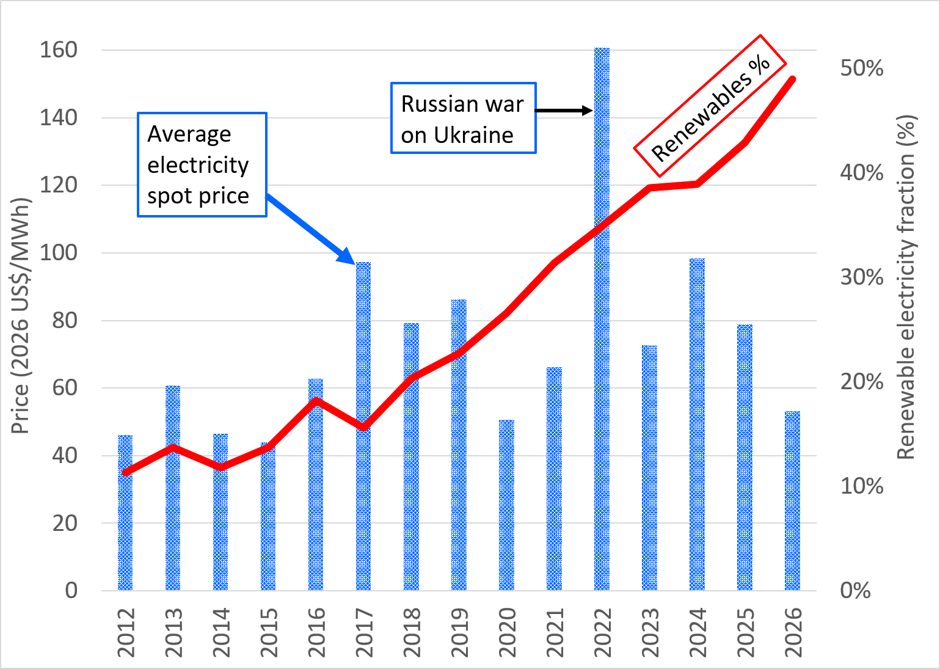
The rise of solar and batteries is having a remarkable effect on wholesale electricity prices. The graph shows inflation-adjusted average wholesale spot market prices in Australia’s national electricity market since 2012 (blue bars) and the renewable energy fraction of generation (red line). Expensive fossil gas is being pushed out of the market for both ancillary services and peak period power – gas dropped from 13% of generation a decade ago to 3% today.
Authors: Prof. Ricardo Rüther (UFSC), Prof. Andrew Blakers (ANU)
ISES, the International Solar Energy Society is a UN-accredited membership NGO founded in 1954 working towards a world with 100% renewable energy for all, used efficiently and wisely.
The post Electrifying everything appeared first on pv magazine Global.


