
Stockpiled Forage for Winter Grazing, Part 1: Growing and Managing Stockpiled Forage
By Fernando Falomir
Managing livestock in brittle environments requires us to grow enough forage during the growing season to carry the herd through the dormant months, but growing the forage is only half of the equation. We also have to ration that stockpile carefully enough to maintain animal performance while leaving the pasture in a condition that allows vigorous growth the following spring.
This is something I have had to learn firsthand ranching in the Chihuahuan Desert. In a brittle environment, there are years when we have more grass than we know what to do with and others when the rain simply doesn’t come. That variability makes it difficult to manage around an “average” year. Instead, we have to build enough flexibility into the operation to take advantage of the good years while carrying some of that forage forward into the bad ones.
The exact grazing strategy will vary from ranch to ranch, but the starting point is almost always stocking rate. We need enough animals to make effective use of the forage we grow without putting ourselves in a position where purchased feed becomes a normal part of carrying those animals through winter.
Burke Teichert has often emphasized the economic difference between Fed Feed Vs Grazed Feed, and I think this is one of the most important principles in ranch economics. Every day that a cow can harvest her own feed is one less day that we have to harvest it, bale it, transport it, store it, and eventually deliver it back to her.
This becomes even more important during drought, when forage supplies are already tight and hay prices can easily reach $300 to $350 per ton or more depending on quality. The actual cost of feeding that hay is even greater once we account for transportation, storage losses, fuel, equipment depreciation, and labor.
So how much fed feed is appropriate?
There isn’t a single answer. High cattle prices may justify some additional feeding, but they don’t automatically make expensive feed profitable. We still have to understand our true cost of production, the value of the additional performance we’re buying, and how that expense fits into the entire operation.
Pasture condition also matters. A ranch that is rebuilding degraded pastures may need to leave more residual forage and temporarily rely on more outside feed or supplement than a ranch that has spent years improving soil function and accumulating higher quality standing forage. The business model matters as well. A seedstock operation, a yearling enterprise, and a low-input cow-calf operation aren’t necessarily going to make the same decisions.
What is much more consistent is the cost of chronic overstocking. If we routinely carry more animals than the land can support, we eventually make up the difference with purchased feed. That increases our cost of production while putting additional pressure on the resource that is supposed to be producing our cheapest feed. I always recommend being properly stocked for the dry season with a resident herd that is composed of adapted cattle, meaning that they can thrive with lower quality forages. If there is a surplus, then stock with a liquidable herd such as stocker or custom grazing with an established ship out date in mind.
One of the most useful questions we can ask ourselves is what our operation would look like if winter hay wasn’t a major annual expense? That doesn’t mean everyone should stop feeding hay tomorrow. It means we should continually look for opportunities to replace fed feed with grazed feed. I’ve worked with and visited producers in some very cold climates who have managed to get through severe winters with surprisingly little hay, and in some situations, none at all. Witnessing that changes your perspective on what is actually possible. Yes, cattle can graze through heavy snow as long as there is enough forage underneath for them to get a full bite with little effort.
Jim Gerrish’s Kick the Hay Habit is also a good resource for anyone interested in pushing an operation farther in that direction.
The savings aren’t limited to the price of the hay either. Every bale we don’t have to feed represents less fuel, fewer tractor hours, less equipment depreciation, and, perhaps most importantly, less of our time spent feeding cows.
How to Prepare Pastures for Winter Grazing
The grazing decisions we make during the growing season have a direct effect on how successfully we can graze through winter. By the time the grass is dormant, many of the important decisions have already been made.
Plants need sufficient recovery during the growing season to rebuild leaf area, maintain their root systems, and store the energy necessary to survive dormancy and initiate growth the following spring. This becomes particularly important late in the growing season.
Why Late-Season Grass Growth Matters
Warm-season grasses naturally begin shutting down as temperatures and day length decline, while many cool-season grasses can remain active surprisingly late into the fall, provided that moisture is available. That late-season growth allows the plant to continue photosynthesizing and preparing for winter.
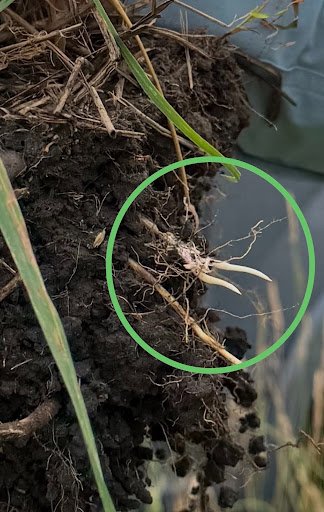
I’ve seen this very clearly while working on high-elevation ranches in Colorado. Cool-season perennial grasses that had been allowed full recovery before fall remained actively growing much later than I would have expected based simply on temperature. In the picture below, I pulled apart the crown of a recovered perennial grass that was deferred most of the summer and could already see the developing growing points that would contribute to the following year’s growth.
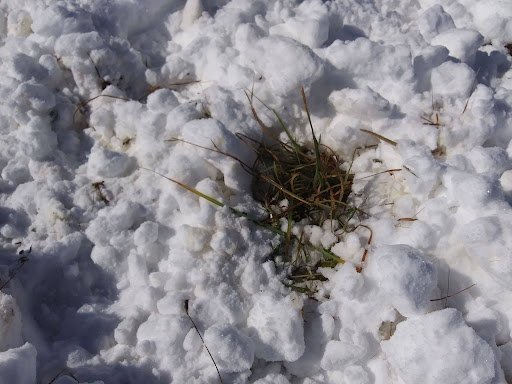
I’ve also seen well-managed meadow brome remain green beneath the snow while surrounding vegetation had already gone dormant. Those observations made me pay much more attention to what happens during that final recovery period before winter.
There are several reasons why this matters. A pasture that stays actively growing a little longer in the fall and begins growing a little earlier in the spring effectively extends the grazing season from both ends. We may only gain a few days or weeks, but across an entire herd those additional grazing days can represent a significant amount of hay that doesn’t have to be purchased or fed; it can add to almost a full month of less hay.
Living plants also continue feeding the soil biology associated with their roots. As long as photosynthesis is occurring, some of that captured carbon is being transferred belowground through root exudates and other plant processes. Extending the period of living roots therefore helps maintain biological activity for a greater portion of the year and defer them from consuming soil organic matter or even worse consume the soil aggregates formed during summer growth.
How Residual Forage Protects Soil and Conserves Moisture
The standing material left above ground is equally important. Residual forage catches snow and moisture, reduces wind speed at the soil surface, buffers temperature changes, and protects the soil from evaporation and erosion. In a brittle environment, where the timing of the next meaningful precipitation event is uncertain, maintaining that soil armor can be more valuable than trying to harvest every last pound of forage with an animal. This is how we set up our pastures for next year’s growth.
This is one of the lessons that drought has reinforced for me repeatedly. When rainfall becomes scarce, the difference between covered and exposed soil becomes much more obvious. Residue that may have looked like “wasted grass” during a good year suddenly becomes extremely valuable when every bit of moisture counts.
For that reason, I don’t consider all ungrazed forage to be wasted forage. Some of that material has a different job to do. We need to train our eyes to accept seeing some standing forage and a greater portion being trampled and making contact with the soil.
How to Manage Stockpiled Forage Through Winter
Once we enter the dormant season, the challenge changes from growing forage to rationing what we have.
I like to think of stockpiled forage almost like money in a bank account. We start winter with a certain balance, and every day the herd makes a withdrawal. In the Chihuahuan Desert, I always intentionally carry forage from one growing season into the next because rainfall is simply too unpredictable to assume that next year’s forage will arrive on time.
I’ve even had to rely on stockpiled forage that was nearly two years old, with the grass faded to an unappealing gray color, to carry my cattle through difficult seasons. Obviously, that isn’t ideal from a forage-quality standpoint, but carrying that reserve can be extremely valuable when the alternative is buying large quantities of feed during a drought. Eventually all stockpiled forage older than two years old needs to be grazed or trampled or else it could lead to perennial stand loss. Those perennial grasses need to be stimulated every so often, but definitely not totally grazed every single time if you want to ensure diversity of more palatable species to have a chance to fully establish. Finding the right balance is key. The challenge is making that forage last.
If we allow cattle unrestricted access to a large area, they naturally select the highest-quality plants and plant parts first. As winter progresses, the pasture may still appear to contain plenty of standing forage, but the nutritional quality of what remains available to the animals can be very different from what was there when they entered. I’ve seen this happen enough times that I no longer judge available forage simply by how much grass I can see from the pickup. A pasture can still look full while the cattle are telling you something very different.
Long periods of stay also increase the effect of manure and urine fouling and allow animals to repeatedly return to preferred plants and areas. The result is greater selectivity, uneven utilization, and larger swings in diet quality and bare spots with no soil armor. These are the places where sticky burs, cheat grass, medusa, thistles, broom weed, etc… take a hold and thrive in your pastures.
Temporary fencing and smaller grazing allocations give us much greater control over that process. The objective isn’t necessarily to force cattle to consume everything. Rather, we want to control the proportion that is grazed, the proportion that is trampled, and the amount that remains standing. All while maintaining sufficient animal performance to get through. Note that I didn’t state fat cows.
Increasing stock density within reason can also encourage cattle to consume a wider variety of plants instead of selecting only their favorite grasses. I’ve watched cattle broaden their diet considerably when competition and grazing pressure change. Plants that were almost completely ignored under low stock density can become part of the diet when cattle are managed as a tighter herd. This may include forbs and other shrubs that actually provide a whole array of benefits, some have very high crude protein during months that everything ese is dormant. Some may even have medicinal properties such as natural de-wormers and anti-inflammatory.
That doesn’t mean we want them consuming every plant equally, nor does it mean that higher stock density is automatically better. It simply gives us another way to influence grazing behavior. The important distinction is that grazing efficiency shouldn’t be confused with trying to achieve maximum utilization. A pasture that looks completely cleaned off after the cattle leave may represent high utilization, but it isn’t necessarily good grazing management. We still need enough material left behind to protect the soil, capture snow, and provide favorable conditions for the next growing season.
Match Cattle Nutritional Needs to Available Winter Forage
Managing winter forage becomes much easier when the nutritional requirements of the cow are reasonably aligned with the quality of the forage available. This is why choosing a proper time of the year for calving season deserves more consideration than it often receives. A cow approaching calving and entering lactation has substantially greater nutritional requirements than a dry cow in mid-gestation. If our highest nutritional demand occurs during the period when forage quality is naturally at its lowest, we have created a nutritional gap that will probably have to be filled with purchased feed.
There are obviously other considerations when choosing the right calving season for your operation, including markets, labor, weather, and the goals of the operation. Still, we should at least consider what it costs to maintain a cow whose nutritional requirements are increasing during the poorest forage period of the year.
If stockpiled forage is lower than expected, early weaning is another management tool worth considering. Removing the nutritional demand of lactation can substantially reduce the cow’s requirements and allow a limited amount of stockpile to carry the herd farther into winter. This becomes especially interesting in years when calf prices are strong. There are times when selling a 400- to 500-pound calf earlier makes more economic sense than trying to capture additional pounds while simultaneously increasing the nutritional requirements of the cow.
It’s very easy to get greedy when calf prices are high and try to squeeze every additional pound out of them. But those pounds aren’t free. If keeping the calf on the cow another month means we’re buying expensive hay later in the winter, we need to account for that cost as well.
We tend to focus heavily on weaning weight, but pounds per head aren’t the same thing as more profit.
Understanding the Quality of Dormant Forage
One of the most difficult things about winter grazing is that forage quantity is much easier to see than forage quality. A pasture can have tremendous standing biomass and still fail to meet the nutritional requirements of the herd.
As grasses mature and become dormant, crude protein and digestible energy generally decline while the proportion of structural fiber increases (lignin). Under drought conditions, the situation can become even more variable because plants may mature early or produce less leaf relative to stem.
Why Forage Testing Matters for Winter Cattle Nutrition
This is where forage testing can be extremely useful. A relatively inexpensive forage analysis can tell us much more than we can determine simply by looking at a pasture. If we know crude protein, fiber levels, and estimated energy, we have a much better idea of what nutrient is actually limiting animal performance and determine an effective supplementation strategy.
I also pay a lot of attention to differences in forage quality that result from management.
One example that really caught my attention this year was KR bluestem in central Texas. I’ve measured plants under better-managed grazing conditions at around 16 Brix during active growth, while nearby plants under different conditions were closer to 8. Brix isn’t a complete measure of forage quality and shouldn’t be treated as one, but a difference that large tells me that plants that look almost identical from the road aren’t necessarily functioning the same way. That becomes especially important when those grasses mature.
If the plant begins with relatively poor nutritional quality during the growing season, we shouldn’t expect it to magically improve after dormancy. Mature warm-season grasses can become quite low in crude protein during winter, which makes it increasingly difficult for cattle to efficiently digest all of that standing fiber. Especially in poor functioning soils!
This is also where diversity becomes extremely valuable. On diverse rangelands, cattle aren’t limited to a monoculture of dormant grass. They can select among grasses, forbs, shrubs, and other plants that mature at different times and contain different concentrations of protein, energy, and minerals. The better the diversity, the more opportunities the animal has to build its own diet and the greater the opportunity to take advantage of certain species throughout the year.
Build a More Resilient Winter Grazing Plan
Understanding how much forage is available and what nutritional value it provides is the first step toward making better winter grazing decisions. When we know what our pastures can provide, we can make more informed choices about stocking rates, grazing allocations, and whether supplementation is actually necessary.
But what happens when stockpiled forage can no longer meet the nutritional needs of the herd? The answer isn’t always to feed more hay or rely on larger amounts of purchased supplements. By understanding how dormant forage supports rumen function, how to correct nutritional deficiencies, and how cattle adapt to their environment, we can make more strategic feeding decisions that help maintain animal performance without creating unnecessary feed costs.
In Part 2, we’ll explore how to supplement winter forage without replacing grazing, develop cattle better suited to their environment, recognize signs that nutritional needs aren’t being met, and make the most of bale grazing when additional feed is necessary.
Every ranch is different, and there isn’t a one-size-fits-all approach to winter grazing. Stocking rates, forage availability, climate, soil conditions, and cattle genetics all influence what will work for your operation. If you’re looking for ways to reduce feed costs, improve pasture performance, and build a more resilient ranch, reach out to Understanding Ag to start a conversation with one of our experienced consultants. We’ll help you evaluate your operation, identify opportunities, and develop a practical plan based on your land, livestock, and goals.
The post Stockpiled Forage for Winter Grazing Part 1 appeared first on Understanding Ag.


