
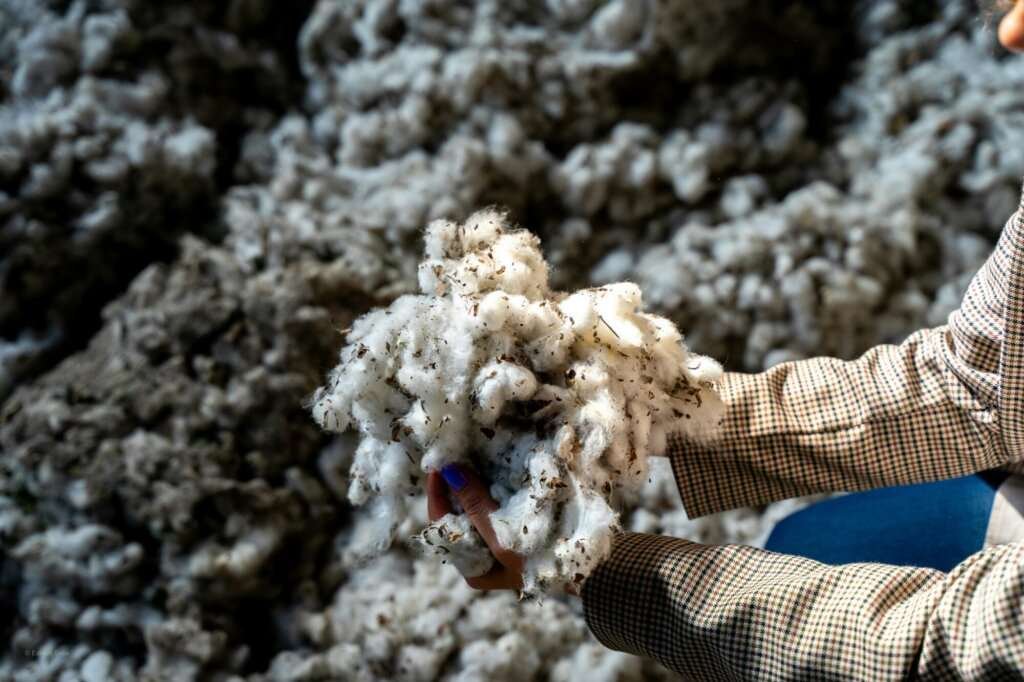
The word “natural” carries a lot of weight in fashion’s sustainability conversation. Natural fibres, the assumption goes, will eventually return to the earth. The problem is that biodegradation is not a property a fibre either has or doesn’t have. It is a system outcome, shaped by conditions, chemistry, and context in ways that most industry communication does not yet reflect.¹
This matters because a significant number of sustainability claims rest on it. And as regulatory scrutiny of greenwashing tightens across Europe and beyond, the gap between what “biodegradable” implies, and what the science actually shows, is becoming harder to ignore.
The same fibre, two completely different outcomes
One of the most striking illustrations of this comes from a shipwreck. A pair of cotton denim jeans recovered from the Atlantic Ocean after more than 130 years were found intact and supple. The cold, dark, nutrient-poor conditions of the deep ocean had suppressed microbial activity so completely that a fibre we consider naturally biodegradable had persisted for over a century without meaningful breakdown.²
Compare that to cotton denim in an active compost environment, where the same material degrades substantially in under three months.²
The fibre is identical. The outcome is entirely different. What changed is the system around it: temperature, moisture, oxygen availability, microbial diversity, and nutrient conditions. Biodegradation depends on all of these, not on fibre origin alone.¹ ² As the Nature of Fashion research argues, biodiversity is not simply a backdrop to decomposition but one of its essential requirements. Designing for biodegradation, therefore, is about more than creating materials with the potential to break down. It also means designing chemistries that are low in toxicity and compatible with the living systems that carry out decomposition, while protecting the health and diversity of the ecosystems in which that breakdown takes place. ³
What chemical treatments do to natural fibres
The picture becomes more complicated once we account for how textiles are actually produced. Almost all commercial garments, including those made from natural fibres, are processed with dyes, finishes, and chemical treatments applied at multiple stages of manufacturing. These modifications significantly alter what happens at their end of life.
Research summarised in the Nature of Fashion infosheets, that were developed in partnership with the University of Leeds, shows the range of effects.⁴ Antimicrobial treatments can stall biodegradation almost entirely,⁵ easy-care finishes reduce both the rate and the total completion of breakdown,⁵ and water repellents slow the process throughout.⁶ In one study, cotton treated with a water repellent showed only 2.6% degradation in seawater after 42 days, compared to 25 to 57% for unmodified cotton in the same conditions and timeframe.⁶ Dyes delay the onset of biodegradation, while softeners, interestingly, appear to speed up the initial onset by promoting microbial attachment to the fabric surface.⁵
There is a further irony worth noting. Because natural fibres are more bioavailable than synthetics, they may actually release chemical treatments into surrounding environments more rapidly as they break down.⁴ A fibre being natural does not magically make the chemistry applied to it safe. In some cases, it may accelerate that chemistry’s reach – for better and for worse.
The certification gap
Laboratory biodegradability testing provides important signals about a material’s potential, but it is conducted under specific, controlled conditions that rarely reflect where textiles actually end up. As the Nature of Fashion research states plainly: it is impossible to test for all conditions into which fibres are released.¹ ²
A garment may pass a biodegradation certification in an industrial composting simulation and still persist indefinitely in a cold marine environment, a nutrient-poor landfill, or the open waterways where much of the world’s textile waste ultimately arrives. A claim of “biodegradable” without specifying the timeframe and environment in which that biodegradation will actually occur is incomplete, at best. The US Federal Trade Commission’s own guidance states that biodegradability claims must be based on evidence that a product will completely break down and return to nature within a reasonably short period of time after customary disposal, but customary disposal for textiles is highly varied and often does not match the conditions used in certification testing.²
This does not make certification valueless, it just makes precision even more necessary. The question after establishing that something can biodegrade is equally important: what, exactly, is being returned to the environment, and is it harmful or healthful when it gets there?
What this means for design
None of this is a counsel of despair. It is a design challenge, and a solvable one.
Ecological systems have spent a very long time developing the biochemical infrastructure and networks that break matter down and rebuild it into something useful. That infrastructure works best with materials it recognises: chemistries whose breakdown products are familiar, building blocks that can be metabolised and cycled rather than accumulated and locked up, unaccessible.³ As the Nature of Fashion 2021 report observes, the second law of thermodynamics means no material loop can ever be completely isolated from the biosphere. As there is leakage in any system, materials should be designed for biodegradability and low toxicity from the outset.⁷
The direction this points toward is not simply “use natural fibres.” It is: use materials and chemistries whose entire arc, from production through use, through breakdown, has been designed with ecological compatibility and human health in mind. It means specifying finishes whose degradation products are known to be non-toxic. It means understanding that biodegradation is a system, and that designing for it requires thinking beyond the fibre, to the conditions in which it will eventually land.
This is the territory the Nature of Fashion: Design for Transformation initiative has been exploring across pilots in Ghana, the Netherlands, and Germany. Together, these pilots show that decomposition is not a technology but an ecological function, one that depends on local materials, microbial communities, infrastructure, and the people who steward them. That has implications far beyond material selection. For brands, it means designing products with their entire afterlife in mind, including the chemistry they introduce into ecosystems. For policymakers and standards bodies, it means moving beyond binary biodegradability claims towards frameworks that account for context, toxicity, and real end-of-life conditions. And for circularity practitioners, it means treating decomposition not as a universal solution, but as one pathway within a broader system that must be designed around local ecological realities.
The science of what textiles actually do at the end of their lives is more complex than much industry communication suggests. But complexity is not a barrier to action. It is an invitation to ask better questions: not simply whether a material can biodegrade, but where, under what conditions, over what timeframe, and with what consequences for the ecosystems and communities that make that transformation possible.
Sources
- Sommer, L. Infosheet #1: What is biodegradation? Why do some textiles break down in nature, but not others? Nature of Fashion: Design for Transformation, in partnership with the University of Leeds. Biomimicry Institute, 2024.
- Sommer, L. Infosheet #2: How well do natural and manmade cellulosics biodegrade? What is the impact of dyes, finishes and treatments on the biodegradability and toxicity of these textiles? Nature of Fashion: Design for Transformation, in partnership with the University of Leeds. Biomimicry Institute, 2024.
- Banwell, E. and Schuknecht, M. How Nature Transforms Materials. Biosysmic for Nature of Fashion: Design for Transformation. Biomimicry Institute, 2024.
- Sommer, L. Infosheet #3: Can synthetics be harmlessly biodegraded? What is their real impact and toxicity once released into ecosystems? Nature of Fashion: Design for Transformation, in partnership with the University of Leeds. Biomimicry Institute, 2024.
- Lykaki, M. et al. (2021); Zambrano, M.C. et al. (2021); Smith, R. et al. (2021). Cited in Infosheet #2.
- Kim, L. et al. (2022). Cited in Infosheet #2.
- Rattner, B. et al. The Nature of Fashion. Biomimicry Institute, 2021. Available at biomimicry.org
- Rattner, B. et al. The Nature of Fashion. Biomimicry Institute, 2021. Available at biomimicry.org
The post What Biodegradation Actually Requires appeared first on The Biomimicry Institute.


