A Closer Look at the UAE’s Food Imports
Key Takeaways
- Frozen meat leads the UAE’s food imports at 17.9% of import value in 2025.
- Together, frozen meat, fruits and nuts, dairy products, and vegetables represent 46.9% of food import value. However, refrigeration needs vary by product.
- Dubai Food District aims to connect food trade, storage, processing, and distribution within one integrated ecosystem.
The UAE’s food import basket spans everything from frozen meat to coffee, grains, and confectionery. In turn, this variety creates different storage and handling needs along the supply chain.
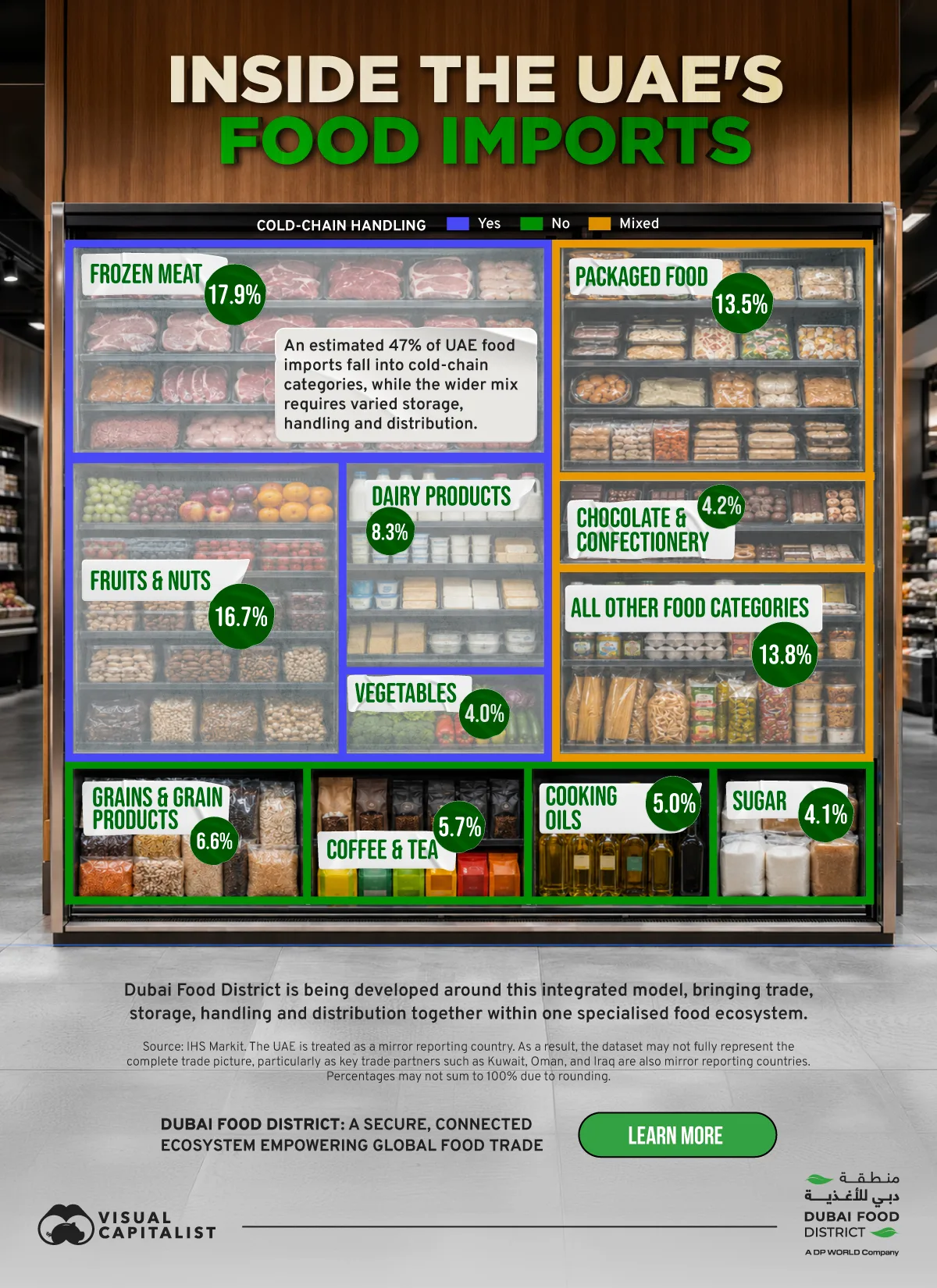
This graphic, in partnership with DP World, shows the UAE’s 2025 food imports by category using data from IHS Markit.
A Diverse Food Import Basket
A few leading categories account for almost half of food import value. Meanwhile, the remaining categories reveal the breadth of the UAE’s food supply.
Here is a table that shows the UAE’s food imports by category and share of import value in 2025.
| Rank | Food category | Share of food import value |
|---|---|---|
| 1 | Frozen meat | 17.9% |
| 2 | Fruits & nuts | 16.7% |
| 3 | Packaged food | 13.5% |
| 4 | Dairy products | 8.3% |
| 5 | Grains & grain products | 6.6% |
| 6 | Coffee & tea | 5.7% |
| 7 | Cooking oils | 5.0% |
| 8 | Chocolate & confectionery | 4.2% |
| 9 | Sugar | 4.1% |
| 10 | Vegetables | 4.0% |
| — | All other food categories | 13.8% |
Methodology
By value, frozen meat leads at 17.9%, followed by fruits and nuts at 16.7% and packaged food at 13.5%. Together, these three categories account for 48.2% of food import value.
Beyond these leaders, dairy products contribute 8.3%, while grains and grain products represent 6.6%. All other food categories collectively account for 13.8%.
For instance, the remainder includes spices, beverages, beans, lentils, and chickpeas. This grouping captures smaller categories rather than a single food type.
Keeping Food Fresh From Origin to Shelf
Four categories together represent 46.9% of food import value: frozen meat, fruits and nuts, dairy products, and vegetables. However, their exact refrigeration requirements vary by product.
This combined share highlights the importance of specialized handling, rather than measuring the precise proportion requiring refrigeration. Maintaining appropriate storage and transport conditions helps preserve food quality throughout the journey.
Bringing Food Trade Together
The Dubai Food District aims to bring food trade, logistics, storage, processing, and distribution together in one ecosystem. For example, DP World’s plans include cold stores, temperature-controlled warehousing, and processing facilities.
By connecting global sourcing with specialized infrastructure, the district aims to support different food categories within a coordinated network. Ultimately, that integrated approach seeks to help businesses move food efficiently from origin to shelf.

Learn more about the Dubai Food District
-
 Trade2 weeks ago
Visualized: The World on the UAE’s Plate
Which regions feed the UAE? Explore the 2025 data behind its broad and diverse sourcing network.
-
 Trade3 weeks ago
Oman: A Trade Gateway on the Rise
How much did Oman’s exports and imports grow from 2020 to 2025? Explore the data behind this rising trade gateway.
-
 Economy1 year ago
Visualized: Countries by Container Volume Per Capita
Which countries punch above their weight in container volume per capita
-

 Cities1 year ago
Ranked: The Top Cities in the World by Reputation
Discover the top 10 city reputations of 2024 and see why Dubai is a rising hub for investment, innovation, and opportunity.
-
 Economy1 year ago
Ranked: The Top 10 Countries by Merchandise Exports Per Capita
Explore how the UAE, powered by Jebel Ali Port, is rising as a global trade hub, challenging traditional leaders in commerce.
-
 Technology2 years ago
Visualized: UAE Vehicle Trade Growth by Country
The UAE’s vehicle trade is booming, with China leading import growth & Iraq topping export growth thanks to Dubai’s port of Jebel Ali.