
Cyber Sort is HJV Engineering’s latest mobile custom potato-storage sorting system.
Similar in shape to a — you guessed it — Cybertruck (no relation), it uses a Tomra 3A vision system to detect and remove foreign debris and damaged or deteriorated potatoes as they leave storage.
“I believe in multiple lines of defence,” said Dan Mann, HJV vice-president of engineering.
In 2025, HJV launched a split-grader, Cyber Sort’s sister machine, which uses the Tomra 3A system to sort potatoes going into storage. Because the Tomra vision component is removable for servicing, the HJV team began exploring how it could be used elsewhere.
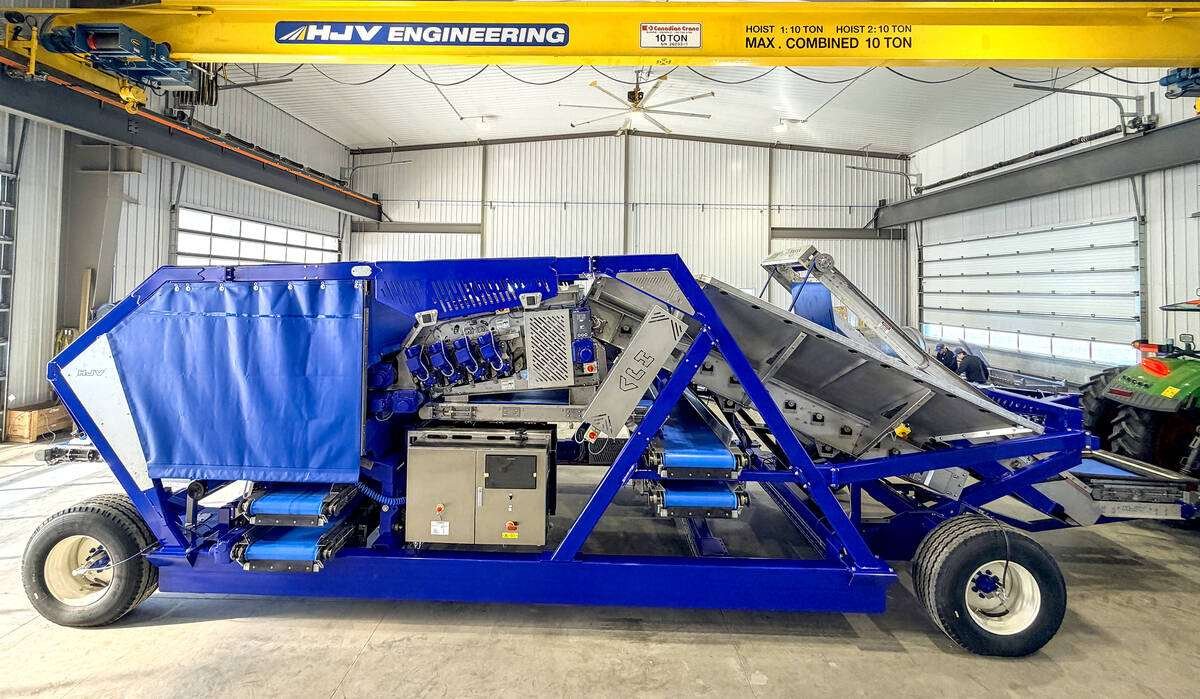
“We could pull that (Tomra 3A) machine out and put it into another chassis. We could then use it (for potatoes) to come out of storage for nine months,” Mann explained the Cyber Sort’s creation. “The upside to that is obviously being able to use the same asset, and secondly, we would then see the crop twice.”
Electronic sorting
Using the Tomra 3A in the split-grader and Cyber Sort as an in-and-out cohesive system boosts visual quality control closer to 100 per cent and extends the tech’s operating window from six weeks to nine months.
Mann stated the Cyber Sort alone can effectively eliminate debris, such as golf balls, walnuts and corn trash, and deteriorated potatoes, as the crop exits storage.
“That (debris) can be extremely expensive if it gets into the fry lines,” he said, adding that unlike other separation machines, the Tomra 3A vision system isn’t limited to weight differentiation used for stones and clods of dirt.
“We can actually go after any foreign debris like golf balls, pop cans, bottles, different debris that you can find in a field that are not different in weight to a potato because we’re electronically sorting.”
Loading options
The Cyber Sort can be bucket loaded by a skid steer or payloader, or an optional 30-inch-wide telescopic conveyor-style scoop. The scoop moves in any direction to pull potatoes from the pile and transport them to the hopper.
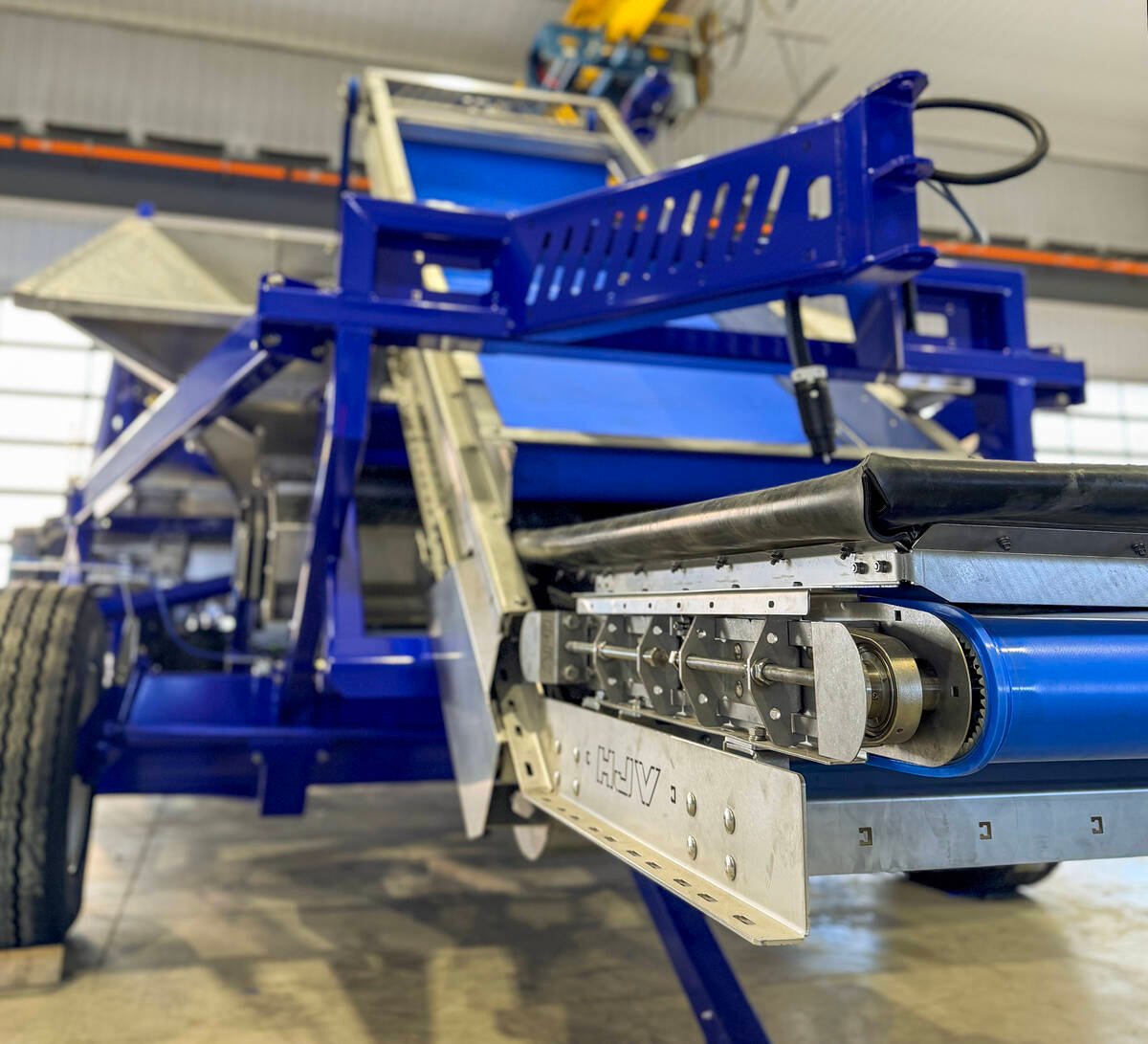
The hopper distributes potatoes evenly across the 2.4-metre Tomra 3A system, helping it maintain a throughput of 100 tonnes per hour, said Mann.
At approximately 12.19 metres long and 3.66 metres wide, the Cyber Sort requires a tractor or transport-equivalent vehicle to haul it.
HJV incorporated patented features to keep the Cyber Sort compact but robust, including a suspension system that reduces road-related impact capable of jolting the cameras out of alignment.
“If you hit a big pothole, it will actually stop the head of the camera from getting jolted. This means you don’t have to do camera alignments and calibration so often,” he stated.
Auto-levelling
Cyber Sort uses an automatic tire-inflation levelling system to ensure optimal Tomra 3A system function.
“It does this every time we start the machine, so it automatically levels,” he said. “Then you can hit the road switch, and it will put it into road mode and reinflate the tires.”
The main frame is made from mild steel, but outside of that, HJV builds with primarily stainless steel, especially for potato contact points, to ensure robustness and food safety.
With its large chipping industry, Ontario isn’t the primary market for the Cyber Sort.
Instead, the United States is driving sales, Mann said, especially in Washington State, where 700 tractor-trailer loads of potatoes leave storage daily to supply the french fry market.


